Rupert Cornwell: Little hope of a new start with Russia

For free real time breaking news alerts sent straight to your inbox sign up to our breaking news emails
Sign up to our free breaking news emails
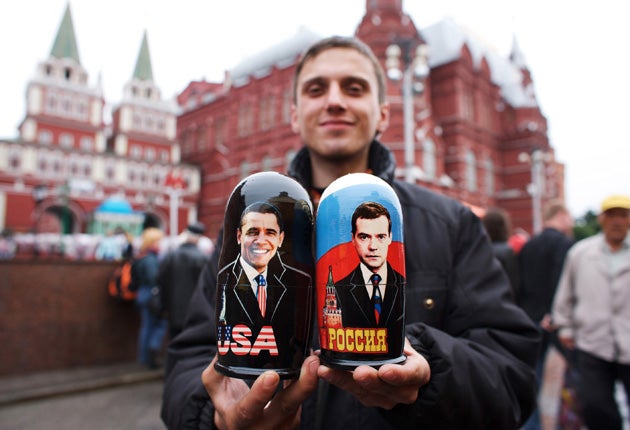
The American Vice President, Joe Biden and Hillary Clinton, the Secretary of State, want to press the "reset" button in US relations with Russia, after the tensions of the later Bush years. Alas, President Barack Obama's trip to Moscow is likely to prove how difficult this will be, especially when an authoritarian regime in the Kremlin hankers for Soviet-era "parity" with the US.
Relations between Washington and its one-time superpower rival are not simple at the best of times. They are made more complicated now by the divided leadership structure. Formally, Mr Obama's counterpart is President Dimitri Medvedev. But no one doubts that real power still lies with former president Vladimir Putin, now Prime Minister.
And the Putin era has reconfirmed the eternal link between domestic and foreign policy in Russia. The more hardline the regime at home, the more assertive and uncompromising its policies abroad, reinforcing its message to its own people that Russia is somehow under threat from the West. Hence the anti-Americanism that again colours the Kremlin's world view.
Mr Putin has never hidden his belief that Russia was exploited and humiliated by the US during the chaotic period after the fall of communism. The former president has even declared that the disappearance of the Soviet Union was the greatest geo-political tragedy of the 20th century. Nor is it a coincidence that Russians are far more sceptical than most others, in Europe and elsewhere, that Mr Obama represents real change in Washington. The messenger may be different, but the assumption is that the US will ultimately look after its interests, just as Russia defends its own.
From this perspective, prospects for a substantial "reset" in US/Russian relations are modest at best. First and foremost, the Russian leadership will want to take the personal measure of this young and inexperienced American President, much as Nikita Khrushchev did of John Kennedy in 1961. Mr Obama will not make the mistake Mr Kennedy did, of appearing to be too soft.
Of the four main items on the agenda progress is likely on only two, the two where respective national interests do coincide. A Taliban victory in Afghanistan, raising the likelihood of instability in Russia's Islamic regions, would be scarcely less welcome to the Kremlin than Washington. Friday's announcement that US planes will be allowed to use Russian airspace to carry troops and weapons to Afghanistan is a sign that in this war, the two countries will co-operate.
They should also be able agree further steps – in outline at least – to reduce nuclear weapons, the one area where Russia has long had approximate parity with the US. But the Kremlin is linking any deal with US abandonment of its plans for missile defences in eastern Europe. Mr Obama is cooler on the project than his predecessor, but will not give it up.
On the two most contentious issues, the chances of progress are bleak. Russia, though worried about a nuclear-armed Iran, will not step up pressure on Tehran now, not least because tensions around Iran increase the value of its oil and gas, its two main exports.
Thorniest of all is Nato enlargement. A topmost priority of the Putin/Medvedev regime is to re- establish de facto Russian hegemony over the former states of the Soviet Union. Hence the Kremlin's constant pressure on Ukraine, and its military action last year against Georgia. Russia wants an implicit but cast-iron acknowledgement that neither country will join Nato. The US refuses to give one. As a result, Georgia remains an ever-perilous flashpoint, that could undo at a stroke every effort for a "reset" in relations between Washington and Moscow.
Subscribe to Independent Premium to bookmark this article
Want to bookmark your favourite articles and stories to read or reference later? Start your Independent Premium subscription today.
Join our commenting forum
Join thought-provoking conversations, follow other Independent readers and see their replies