The nuclear family: World unites against terror threat
In an unprecedented show of global unity, 47 nations sign up to agreement designed to stop atomic material falling into terrorist hands
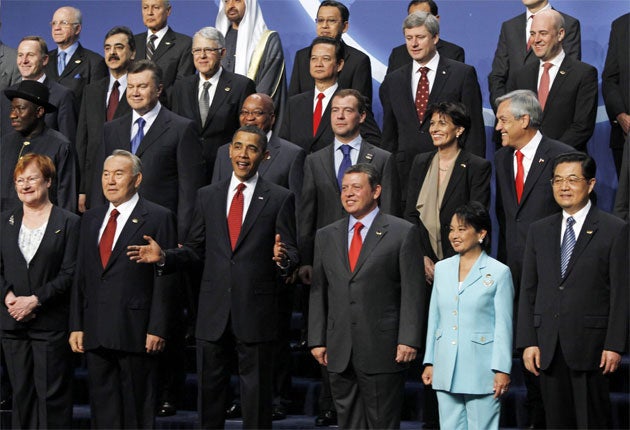
World leaders acknowledged for the first time yesterday the risk that lethal nuclear materials could trigger mass destruction if allowed to fall into terrorist hands. The heads of government gathered in Washington pledged that within four years they would lock down the vulnerable stockpiles, in part left over from the Cold War and found in more than 40 countries, including Britain.
"Two decades after the end of the Cold War, we face a cruel irony of history – the risk of a nuclear confrontation between nations has gone down, but the risk of a nuclear attack has gone up," Barack Obama told delegates at the largest gathering of world leaders in the US for more than 60 years.
A senior anti-terror aide in the White House insisted there was ample evidence that acquiring rogue nuclear materials to mount attacks on a fearful scale was a prime goal of al-Qa'ida.
The leaders of 47 nations left the summit bearing a communiqué giving voice to dangers Mr Obama has been highlighting since coming to office. Though only political, the breakthrough agreement included promises by the nations to ratify existing – and legally binding – treaties on protecting nuclear materials.
"Nuclear terrorism is one of the most challenging threats to international security, and strong nuclear security measures are the most effective means to prevent terrorists, criminals, or other unauthorised actors from acquiring nuclear materials," the communiqué declared.
Mr Obama said that a follow-up summit would be held in Seoul in two years, a choice that was clearly meant as a signal to North Korea that it, in common with Iran, can expect increasing pressure to fall into line with anti-proliferation guidelines followed by the rest of the world.
On the sidelines last night, the US and Russia signed a bilateral agreement to eliminate vast volumes of excess nuclear material which in theory could be used to make 17,000 atomic weapons. The protocol committed the two countries to dispose of 68 tonnes of weapons-grade plutonium beginning in 2018.
Russia used the summit to announce it would also shutter the last of its civil reactors using plutonium. The move was lauded by Mr Obama. "This important step forward continues to demonstrate Russia's leadership on nuclear security issues, and will add momentum to our shared global effort," he said. France's President, Nicolas Sarkozy, meanwhile proposed that any national leader who allows the transfer from their territory of nuclear material to a terrorist group should be tried in a UN international court.
Mr Obama noted that Canada and Mexico were among countries which had agreed in Washington to give up much or all of their stockpiles of highly enriched uranium. Italy, Japan, China and India were among states agreeing to set up centres to promote nuclear security and training.
"It has been an enormously productive day," Mr Obama said at the summit's end. "We have seized the opportunity and because of the steps we are taking as individual nations and as an international community the American people will be safer and the world will be more secure."
The summit communiqué was accompanied by a seven-page work plan outlining steps to help nations achieve the four-year deadline for all nuclear materials to be secured. David Miliband, the Foreign Secretary, admitted that it was an "ambitious time-frame" but expressed the hope it could be met.
Steps include a promise to raise the profile and funding of the International Atomic Energy Agency, the UN nuclear watchdog in Vienna. The amount of material in stock and theoretically vulnerable to theft is enough to make between 100,000 and 200,000 atomic bombs – about 2,000 tonnes of it. A device the size of an apple could devastate a whole city if detonated.
Countries housing these materials – some among them were part of the Soviet Union until its break-up – would have first responsibility to account for them and secure them. This, according to the working plan, may entail consolidating sites where the materials are found into one single site per nation or agreeing to the supervised export of them to other countries willing to look after them. Ukraine announced it would give up its entire stockpile of nuclear material which will be sent to Russia for processing.
Leaving the primary burden to individual states does, however, reveal a weakness to the mostly voluntary process that Mr Obama has initiated: there is no single gold standard for assuring that everything pledged by the leaders in Washington actually happens. It remains up to each of the governments, for example, to decide how to deal with those caught smuggling these materials over national borders.
It is precisely that scenario that most alarms the US and other countries. There have been 15 documented cases of clandestine attempts at smuggling and selling fissile materials since 1993. Georgia, according to some reports, uncovered a new nuclear missiles smuggling ring just last month.
The communiqué also underlined the importance of states with sophisticated monitoring capabilities coming forward to help others where security may hitherto have been more haphazard. Aid – and also money – will be offered to encourage countries to use less highly enriched uranium for nuclear energy generation by converting reactors to use low-enriched uranium instead.
Officials gave particular weight to the decision by the leaders to implement and speed up the ratification of the two existing UN conventions – the Convention on the Physical Protection of Nuclear Material and the International Convention for the Suppression of Acts of Nuclear Terrorism. Britain is one of only 21 countries that have ratified the former of the two treaties, for instance. The US has not yet done so.
In a somewhat ironic gesture, Pakistan told the summit it would be among countries providing services to other states to recycle old nuclear material to make it safe. Pakistan was disgraced six years ago when its top nuclear scientist, A Q Khan, so-called "Father of the Bomb", was caught selling technological secrets to North Korea and Libya.
Join our commenting forum
Join thought-provoking conversations, follow other Independent readers and see their replies
Comments