The toxic 'wonder plant' that split world food summit
Thursday, 5 June 2008
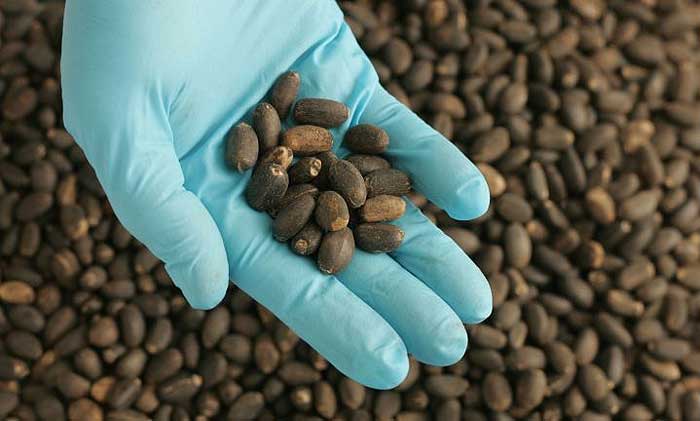
It's no beauty queen – the stems are long, scrawny and leafless and the pods dangle from the twigs like scorched testicles. Untreated, the seeds are so poisonous that as few as three can kill, while even a small amount induces nausea – hence the jatropha plant's nickname, "black vomit nut".
Despite its unprepossessing appearance, jatropha, whose pods contain inflammable oil, is one of a range of plants being intensively cultivated as biofuels. As it can grow in impoverished soil, requires little water and is inedible, its supporters claim that it cannot be said to be taking the place of food crops.
But now all biofuels, even the humble jatropha, are in the firing line. At the UN's world food summit in Rome yesterday it became clear that the responsibility of biofuels for soaring food costs that have sparked riots in 40 countries is the biggest point of contention. The US, which subsidises farmers to grow corn for ethanol production, claims biofuels account for less than 3 per cent of the 43 per cent rise in food costs over the past year. But the International Food Policy Research Institute said that they contributed 30 per cent to the rise between 2000 and 2007, while the International Monetary Fund says the figure is between 15 and 30 per cent.
Yesterday, the defenders of biofuels had their backs to the wall. "It is frightening to see attempts to draw a cause and effect relationship between biofuels and the rise of food prices," said President Luiz Inacio Lula da Silva of Brazil, which has been growing corn for ethanol for decades. "It offends me to see fingers pointed against clean energy from biofuels, fingers soiled with oil and coal."
Sir John Holmes, the British diplomat who heads a UN taskforce on the issue, said: "Biofuels are not taking the food out of the mouths of people, but we need to make sure that a balance is struck."
But on the fringes of the summit, campaigners claimed that even the jatropha bush is doing just that – depriving millions of the poorest farmers of the ability to feed themselves and their communities.
Henk Hobbelink, a Dutch agronomist with Grain, a non-governmental organisation that promotes sustainable agricultural biodiversity, said: "Jatropha has been presented as a way for poor farmers to produce fuel for themselves, and as a cash crop, by planting it on waste land. But what's happening is quite different from that. A handful of big corporations are growing jatropha in huge plantations, in optimum soil conditions and using a lot of water, to maximise the yield. Poor farmers who grow it on impoverished soil find they can't get into the market."
In India, jatropha farming has been heavily promoted by big companies as a way to help India achieve self-sufficiency in diesel production. But as usual the victims are the poor peasants. Shalini Bhutani, another member of Grain, said: "The first areas being targeted are the so-called 'wastelands', which gives the idea that the country will put to good use something that produces nothing at the moment... But what may look like barren pieces of land to outsiders provide sustenance for millions of people. They are the 'commons' and pasture lands of many communities."
The wasteland category, said Ms Buthani, also "covers almost all the 'orans' – traditional sacred groves – that are the lifeline of the 7.5 million pastoralists in Rajasthan". Tribal pasture in Orissa and Chhattisgarh is also being consumed.
Mr Hobbelink agrees that biofuels make sense for national governments trying to find sustainable fuel sources not subject to the price and supply vagaries of oil. "But if creating energy security means taking land from poor farmers – in countries like India where the government claims to be committed to helping people stay on the land – it just causes more problems," he said. And huge monoculture plantations cause just the same sort of pressure on ecosystems as other plantation monocultures like palm oil.
"The jatropha case just shows there is no easy way out of the present crisis," he said. "The only possible solution is to reduce fuel consumption."
Jatropha – the facts
* Dubbed the 'Wonder Plant', jatropha – which originated in Africa – is an inedible weed which has seeds that can be refined into biofuel.
* The poisonous plant's particular appeal is its hardiness; it can survive three years of drought and does not require high-quality soil to flourish.
* Notable supporters include the former senior economist to the World Bank, Sir Nicholas Stern, and Bob Geldof, who is working with Helius Energy, a British company developing the weed's use.
* Critics say that it does not yield enough fuel to be commercially viable and that farmers are finding it hard to find buyers. They are calling for further research.

Comments
16 Comments
I'm a big fan of The Independent, but this article sheds a lot of heat and very little light on the topic of Jatropha.
The Global Jatropha Evaluation Program, www.jatropha.wur.nl , led by Dr Raymond Longschaap of Wageningen University, is the best resource for informatiion on Jatropha and its plant genetics.
Jatropha means "medicine food" in Greek. Native to Central America and the Caribbean, it has been cultivated for its medicinal value since Aztec times, and was spread throughout the world by Portugese sailors. It is now one of hottest fields of research in plant genetics, with new "elite" varieties for biofuel and pharmaceutical use being produced regularly. Most varieties grown today for biofuels were produced in the lab at great expense and hardly qualify as "weeds."
Jatropha varieties vary from the extremely toxic to the edible. An ornamental variety known localy as "Florida Pistachio" is very popular with Florida home gardeners as a snack food.
Posted by Joelle Brink | 11.06.08, 18:19 GMT
"The US, which subsidises farmers to grow corn for ethanol production, claims biofuels account for less than 3 per cent of the 43 per cent rise in food costs over the past year. But the International Food Policy Research Institute said that they contributed 30 per cent to the rise between 2000 and 2007, while the International Monetary Fund says the figure is between 15 and 30 per cent."
This is absurd, in the US we increased corn production by 30% and only 10% of our production was used for biofuels, so we had a 20% surplus over next year? How does that cause a "shortage"? Only if you are a speculator, the increase in "demand" is only being caused by speculators, not real supplies. And the US government does NOT subsidize farmers to grow corn for biofuels, but they DID subsidize farmers to grow corn and then plow it back under the ground in order to maintain low production levels and artificially keep the price of corn up.
There is NO food shortage from Biofuels in the US!
Posted by Bob | 09.06.08, 21:45 GMT
The fallacy here is that ALL non-essential land use reduces food production.
Including golf courses, gardens, beef farming and car parks.
What would the oil company shills have us do? Ban all these?
I thought these guys believed in the free market!
Posted by Xeno | 07.06.08, 03:41 GMT
The Independent really don´t Know Brazil or Brazilian history. Sugarcane is the FIRST brazilian historical comodity since 1560 on.
Sugarcane as ethanol source has been investigated and used for more than 30 years. We have alchool fuel cars from long time and flex cars (patrol and /or ethanol ) are common cars in our cities. Corn ethanol are AMERICAN not brazilian . Sugarcane are so common now (not as in old days when only protuguese aristogracy could afford it - that is way protuguese sweets are so sweet - it as a posh thing). Sugarcane is an admirable crop and in brazil even the residues of rhe ethanol production ("bagaço) can produce energy. It is really a clean energy and it is a pity that the riches countries prefer to use the non-renovable polluted petrol energy.
Posted by Simone Shepherd | 06.06.08, 05:40 GMT
The Independent really don´t Know Brazil or Brazilian history. Sugarcane is the FIRST brazilian historical comodity since 1560 on.
Sugarcane as ethanol source has been investigated and used for more than 30 years. We have alchool fuel cars from long time and flex cars (patrol and /or ethanol ) are common cars in our cities. Corn ethanol are AMERICAN not brazilian . Sugarcane are so common now (not as in old days when only protuguese aristogracy could afford it - that is way protuguese sweets are so sweet - it as a posh thing). Sugarcane is an admirable crop and in brazil even the residues of rhe ethanol production ("bagaço) can produce energy. It is really a clean energy and it is a pity that the riches countries prefer to use the non-renovable polluted petrol energy.
Posted by Simone Shepherd | 06.06.08, 05:35 GMT
There is never an idea so good that it can't be utterly corrupted in practice. Biofuels is just the latest & most hyped example.
Posted by RAV | 06.06.08, 02:03 GMT
Jatropha curcas is traditionally grown as a hedge plant around homes and villages in many parts of Africa and could be a valuable source of income to small farmers. It could also be a source of fuel for diesel run water pumps, maize mills etc. in remote areas where diesel fuel is hard to come by.
Posted by Paul Latham | 05.06.08, 19:22 GMT
Myanmar, just a few months ago, the first harvest of jatropha beans came in after the Myanmar government had gone to great pains to force them to be grown upsetting many of their citizens because they replaced desperately needed food crops in many areas. And now the government has become a laughing stock for having grown the beans without having built refineries to turn them into biodiesel fuel. But when I look at the track of that storm heading into regions strictly controlled by the Myanmar military, Im reminded how in my line of work, when a government looks like its totally inept, theres often something missing from the story that makes everything fit together.
Its not complicated to make biodiesel fuel from jatropha beans. But if its done hastily or controlled by inept personalities that only care about the financial aspects of their endeavor where they dumped the waste from washing the pressed oil from the beans in acid into rivers or on the ground, there would be a huge amount of the kinds of pollutants that react with atmospheric water vapor to cause horrific storm movements flowing downwind or stream of where the refinery was located.
Posted by Bobby Fontaine | 05.06.08, 16:45 GMT
The article fails to mention that contact with jatropha causes skin cancer. It is easy enough to get information on this from Google. Not something that the companies involved would like to publicise I suppose. Jatropha used to be planted as a type of hedge around food crops because wild animals (wisely) stay well away from it.
Posted by Michael | 05.06.08, 16:33 GMT
Your correspondent used the term "Inflammable" to describe this seed's oil. Whilst this may be technically correct (or not depending on its flashpoint) the term is redundant. Please use "flammable" in future.
Posted by paul crossland | 05.06.08, 15:51 GMT
16 Comments