US persuades Security Council to impose new Iran sanctions
Washington gets tough with Ahmadinejad despite deal brokered by Turkey and Brazil
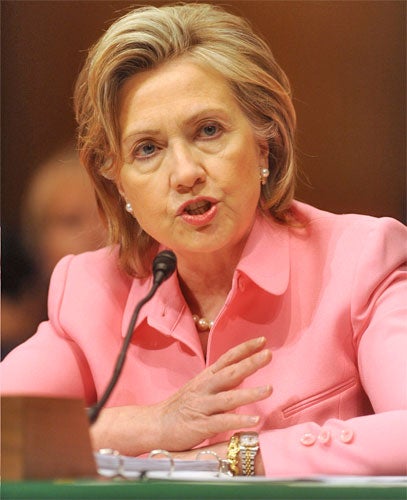
Washington claimed it has reached an agreement with its allies, including China and Russia, for tough new sanctions against Tehran. Sweeping aside a putative deal announced by Brazil and Turkey on Monday, which was meant to assuage Western concerns about Iran's nuclear activities, the US Secretary of State, Hillary Clinton, claimed that a draft sanctions package tabled to the full UN Security Council last night had the endorsement of all five of the permanent members – France, Britain, Russia, China and the US – as well as Germany.
Far from being dissipated by the declarations by the leaders of Turkey and Brazil on Monday, the drama surrounding Iran and its nuclear intentions seems only to be escalating. It remains to be seen whether Mrs Clinton can hold the coalition of six key states together. There were signs elsewhere that China may yet be harbouring doubts.
Mrs Clinton made the announcement in testimony to the Senate Foreign Relations Committee, which is pushing for unilateral US sanctions on Iran that might prove more damaging to its economy than anything the UN Security Council will pass. The new US law, which might pass Congress before the end of this month, would build on existing American sanctions and aims to strangle supplies to Iran of refined petroleum products, including petrol for road traffic. Iran is one of the world's biggest oil producers, but lacks enough refining capacity so relies heavily on imports of gasoline.
By tabling the draft UN resolution last night, the US was resisting any perception that the Brazil-Turkey deal would somehow weaken international resolve to implement new sanctions.
"We don't believe that it was any accident that Iran agreed to this declaration as we were preparing to move forward in New York," Mrs Clinton said. "The fact that we had Russia on board, we had China on board, and that we were moving early this week, namely today, to share the text of that resolution, put pressure on Iran, which they were trying to somehow dissipate."
Reaction to the deal announced in Tehran on Monday was sceptical in all Western capitals. Iran agreed to export roughly half of its uranium stockpile to Turkey for enrichment into nuclear fuel outside its own territory. It appeared to be a watered-down version of an earlier deal that the UN thought it had negotiated with Tehran last year but which the Iranians then backed away from. The difficulty this time is that a significant quantity of low-enriched uranium would remain in Iran, which also gave no commitment to end the enrichment activities that remains the number-one demand of the foreign community. Diplomats quickly concluded that the deal's main purpose was to derail the sanctions efforts being led by Mrs Clinton.
"While we acknowledge the sincere efforts of both Turkey and Brazil to find a solution," Mrs Clinton said, "we are proceeding to rally the international community on behalf of a strong sanctions resolution that will, in our view, send an unmistakable message."
The chairman of the Senate panel, Democrat Chris Dodd, welcomed the move but said work on passing a law to allow for the unilateral measures by the US would go forward. "International sanctions make a lot more sense than unilateral," Mr. Dodd said. "And I think we all agree with that. But we're not going to retreat from the unilateral sanctions effort."
Three rounds of UN sanctions are already in place on Iran. The draft resolution going to the Council yesterday was likely to be more punitive, targeting in particular banks and other companies and institutions in Iran doing business with, or on behalf of, the Revolutionary Guard, which runs the military side of the country's nuclear programme. Iran says its nuclear industry is for civilian purposes only.
Western diplomats hope that by targeting the Guard, which was responsible for the suppression of pro-democracy protests last summer, the sanctions will win some degree of support from Iranian society even if they bring new pain to the population. The Guard also runs such public utilities as the airports.
In Beijing, the foreign ministry cautioned that "a peaceful settlement of the Iranian nuclear issue through dialogue and negotiation" is the priority.
Three decades of sanctions
After 30 years of relative international isolation, Iran feels as if it is in a political time warp. Economically, there are few visible effects. Tourists can't use their international credit cards and nervous fliers would be advised to avoid internal flights because the national carrier, Iranair, has for years had difficulty sourcing official spare parts from American manufacturers for its ageing civil fleet.
On balance, though, sanctions have been patchily applied and oil revenues have cushioned the quality of life for most inhabitants of the Islamic Republic. Economic problems are more a function of domestic mismanagement than trade restrictions, say analysts. The Revolutionary Guard Corps, an elite parallel army, has meantime developed an empire of trading interests, plus lucrative engineering and construction businesses, and operates front companies and banks throughout the Middle East and Central Asia to blunt the impact of any measures.
* The seizure of the US embassy in Tehran in 1979 prompted the first unilateral American sanctions against Iran. Diplomatic links have remained severed since, and most trade halted – although gifts, foodstuffs and carpets are exempted. In 1995, US companies were banned from investing in Iran's oil and gas sector, and foreign firms investing more than $20m (£14m) in Iran's energy sector in any given year were made subject to US penalties. Three leading Iranian banks were placed under US sanctions in 2001.
* Three separate rounds of UN sanctions over the country's failure to halt uranium enrichment have operated since 2006. The first banned the sale of materials for the nuclear programme and froze the foreign assets of individuals linked to it. The second extended the asset freeze to firms run by the Revolutionary Guard. Then in 2008 the UN increased the travel and financial squeeze on named individuals associated with the nuclear programme and banned the sale to Iran of items with joint civilian/military application.
* Separate EU sanctions now also apply to senior Iranian figures, including the head of the Revolutionary Guards, Ali Jafari, and experts in the nuclear industry are barred from obtaining visas for travel to any of the 27 member states. Iranian assets frozen in Britain under UN and EU rules total just under £1bn.
Join our commenting forum
Join thought-provoking conversations, follow other Independent readers and see their replies
Comments
Bookmark popover
Removed from bookmarks