US targets al-Qa'ida as Yemen faces civil war
Tribesmen have seized large parts of Taiz, Yemen's second-largest city, forcing government forces back to the palace and hospital
The US has stepped up its covert air war against al-Qa'ida in Yemen as the country appears to be descending into civil war and government authority disintegrates. US aircraft are reported to have killed militant suspects in south Yemen last week, and pilotless drones have been used in attacks against other al-Qa'ida targets.
Army units loyal to President Ali Abdullah Saleh fired shots into the air in the capital, Sanaa, yesterday, claiming that he is about to return from Saudi Arabia where he is in hospital being treated for wounds sustained in an explosion in a mosque in the presidential compound last Friday. US and Arab officials say a bomb was planted in the mosque, and the President was not hit by a rocket or shell fired by the opposition as they said originally.
Amid signs that government control, never strong in Yemen, is weakening, armed tribesmen have seized large parts of the second-biggest city Taiz, 150 miles south of Sanaa. Government forces are still holding a presidential palace and hospital in the centre of the city of one million people; tribesmen hold the rest.
A shaky truce is holding in Sanaa since the bomb attack that killed 11 presidential guards and wounded several senior officials as well as the President. US officials in the Saudi capital, Riyadh, had said he was burnt over 40 per cent of his body and it would be weeks, if not months, before he could exercise power.
But the government website claimed yesterday that "he has overcome health difficulties after successful surgery to remove shrapnel". A Saudi official was quoted as saying that he is undergoing cosmetic surgery to treat "light burns on the scalp". If President Saleh does return, fighting is likely to erupt immediately, but, even if he does not, military units commanded by members of his family and their allies will not give up power easily. The US and Saudi Arabia have been trying to arrange an orderly transition of power through the Vice-President, Abed Rabbo Mansour Hadi. The US says it is worried that al-Qa'ida will use the chaos to expand its influence, though the numbers of al-Qa'ida in Yemen have been put at about 300 to 400 in a nation of 24 million.
The defence ministry says that 12 suspected al-Qa'ida members were killed as government troops fought towards Zinjibar, a town in the south taken by militants last week. But critics in Sanaa say that President Saleh encouraged Islamic fundamentalist fighters to take over the town to frighten the US into again backing his government. Zinjibar, where 50,000 people once lived, is now said to be a ghost town.
The US has declared Yemen to be the most important stronghold of al-Qa'ida, but recent bomb attacks directed against the US from the country over the past year have been abortive. And even failed al-Qa'ida plots have a political impact on the US out of all proportion to their significance or likelihood of success.
A drone strike on 5 May was directed at US-born al-Qa'ida cleric, Anwar al-Awlaki, influential because of his intelligence, eloquence and command of English, and failed to kill him only because of a malfunctioning motor.
The al-Qa'ida leader Ayman al-Zawahri, believed to be in Pakistan, has declared solidarity with the uprising, saying on a video that Yemenis should not be tricked by the US and its Gulf allies "who want to replace one American agent with another".
Parts of Yemen are cut off from each other because of the collapse of security, so people are beginning to go hungry because basic foodstuffs cannot be delivered and there is a shortage of fuel, water, gas and electricity.
In Sanaa, shops have closed because of fear of fighting or looting and many government ministries are not functioning. The World Food Programme says that the prices of wheat-flour, sugar and vegetables have doubled since last year.
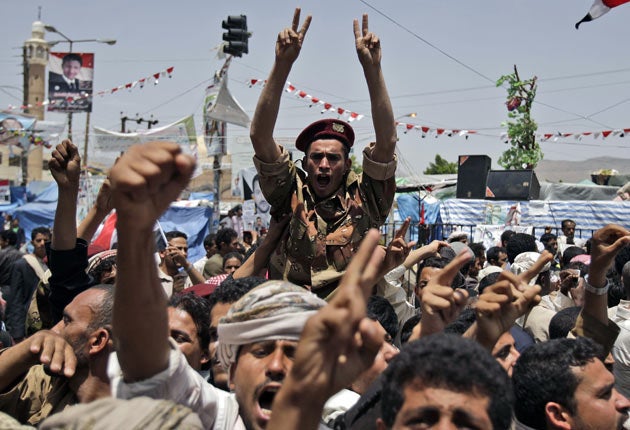
The street protests which first began to erode President Saleh's rule after he had held power for 32 years have been marginalised by other opponents of the old regime. These include important tribes and part of the armed forces. The protesters say they reject any deal with the pro-Saleh forces chanting "No to Saleh's return."
Join our commenting forum
Join thought-provoking conversations, follow other Independent readers and see their replies
Comments