Christina Patterson: Why can't intelligent writers talk sense about politics?
The Saturday Column
Sign up for the View from Westminster email for expert analysis straight to your inbox
Get our free View from Westminster email
We all, as Ken Clarke could tell us, sometimes say stupid things. Sometimes, we exaggerate. Sometimes, we overstate our case. Sometimes, we make a stupid comparison and then find our cheeks going red.
If you're a politician, and you say something stupid, and your boss also thinks it's stupid, you have to be punished. You have to go to radio studios, and TV studios, and on programmes you've never heard of, and tell anyone who's listening that if you offended anyone – though that's a big if – then obviously you regret it.
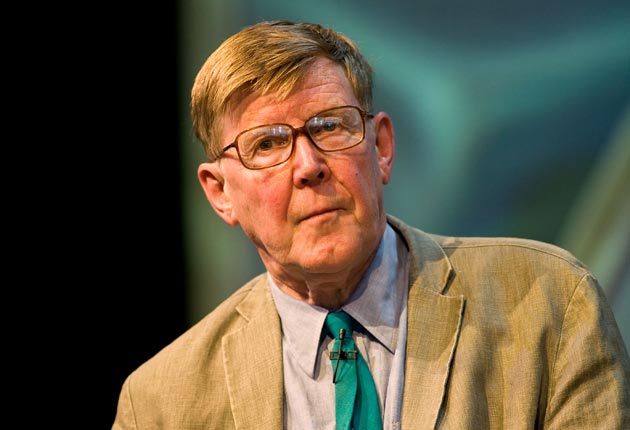
If you're a writer, and you say something stupid, you don't have a boss to tell you off. Perhaps that's why Alan Bennett, who's a brilliant playwright, and diarist, and screenwriter, and who's also a special kind of celebrity called a national treasure, has recently said something stupid twice. A few weeks ago, he said that closing a public library is "child abuse". On Tuesday, he said it again.
He was speaking at a benefit to raise legal costs to fight Brent Council's decision to close Kensal Rise library. He didn't say whether some kinds of child abuse were worse than others. He didn't talk about prison sentences for child abuse, or whether you could get a discount on your sentence for saying you'd done it. He just said that his local library had been very important to him when he was a child, and so he thought it was very important for other children to be able to go to one, and so he said that councils that cut libraries, because they needed to save money, were child abusers. And everybody in the audience clapped.
You can see why everybody clapped. It would be very nice if libraries weren't almost empty a lot of the time, and if children from inner-city estates stopped joining gangs and started reading Proust, and if the people who went to events at libraries weren't, like the audience for the Alan Bennett talk, largely middle-class. It would be very nice if there hadn't been a global economic crisis, and if a bunch of bankers hadn't wrecked the economy. It would be very nice if there wasn't a deficit and there didn't need to be any cuts.
It would also be quite nice if writers would sometimes say things that governments should do that weren't just about cuts. And if the things they didn't want governments to cut weren't always the things that helped them. It would be nice if they sometimes suggested things that governments should cut instead. Would they, for example, be happy to give up their cancer treatment to keep a library open? Or lose the local park? Or wait an hour longer at the bus stop? But writers don't seem to be very interested in things like budgets. They don't seem to be very interested in things like choices. They seem to think that what governments should fund is the things they like.
Artists don't seem to be very interested in these things either. Some of them say things like "the cuts aren't about giving money to artists" and some of them write things like "Stop cutting" on a piece of paper above a piece of slashed material and call it art. The artist who said that "the cuts aren't about giving money to artists", or who allowed someone to put those words next to an example of his "work", is called Patrick Brill, though he also calls himself Bob and Roberta Smith. You can see why it might be confusing to have all those names, but it's still quite hard to see why anyone would think that cuts were about giving money to artists. Unless they thought that everything was about giving money to artists, and they were cross that something wasn't.
The piece of slashed material next to the words "Stop cutting" was made by an artist called Yinka Shonibare for a campaign called "Save the arts". So was a piece by Patrick, Roberta and Bob. The piece, which the "Save the arts" website calls a "work", seems to be a sign saying "Art Gallery Closed". Underneath it are the words "Sunday, Monday, Tuesday, Wednesday, Thursday," and underneath them are the words "Admission £17.50". To someone who knows anything about words, this seems to be the kind of point that someone in a kindergarten might make if they were told to make a collage about cuts to the arts, but maybe to someone who knows about art it's very, very clever.
What the "Save the arts" campaign wanted was for people to sign a petition. The campaign, according to its website, is finished, but the "Visual Arts London Strategy Group" plans to continue to "advocate, promote and publicise" the "exciting and engaging" work it "delivers". The "I Value the Arts Campaign", run by the National Campaign for the Arts, continues, too. To take part in this, what you need to do is display a poster, add an icon to your web page or send a tweet. What the poster, icon, or tweet should say is "I Value the Arts".
I value the arts. I also value chocolate. I also value cakes. I value buses. I value hospitals. I value schools. I would very much like to live in a society that didn't have to make cuts to libraries and public services. I would also very much like to live in a world where good was rewarded and nobody was poor. Unfortunately, I, like Patrick, Bob, Roberta, Yinka and Alan, live in a society where what we get is what we're prepared to pay for, run by the government we vote for, according to the choices we ask it to make.
I'm not sure that you can expect artists, who seem very keen on words like "interrogate", and "notion", and "space", to say sensible things about politics. If they were good with words, then maybe they wouldn't have to slash pieces of material, or make pieces of "art" that look like placards. But I don't really see why writers, who are meant to be better with words than anyone else, can't sometimes say sensible things about politics. I don't understand why they think that a book is a complicated, difficult thing to make, but that running a country, or balancing a budget, is easy. I don't understand why they can write books that sound as if they were written by grown-ups, but make statements about politics that sound as if they were made by children.
It would be nice if some of the finest minds in the country could do a bit better than this.
The room you just have to get right
I am, I have to admit, a bit obsessed by politicians' kitchens. Ever since that Webcameron home movie of David Cameron washing up the porridge bowls (to which the most popular response on YouTube was "I want to punch him") I've drooled over every glimpse of sanded oak, gleaming glass and brushed chrome. I didn't know that people outside the pages of World of Interiors had kitchens like that. I certainly didn't know that politicians did.
At first, I thought it must be a Notting Hill, new Tory thing, but then, in the run-up to the election last year, I saw that Nick Clegg had a kitchen that looked exactly the same. And then, in a programme about the Milibands, I saw that everyone who ever met them, and who all seemed to insist on being interviewed in their kitchen, did, too. Then I realised that it wasn't a new Tory thing, but a new politics thing, like having to read PPE at Oxford, and having to work as a researcher, and having to be prime minister, or deputy prime minister, or leader of the opposition, by the time you're 43.
Now, thanks to a photo released this week, we can see that the new politics, new kitchen revolution has hit Downing Street, too. Michelle Obama and Samantha Cameron sat at a careful angle, so that we could get a proper view of the walnut flooring, integrated appliances and floating shelves. The kitchen, unlike the cupboard for baby Florence that Nick Clegg helped his boss fit together, was very clearly not from Ikea. The sofa cost £1,431. The coffee machine cost £500. The whole thing cost 25 grand.
It all looks jolly nice. It looks like the kind of kitchen someone would have if what they really cared about was that things looked jolly nice.
Wrestling with life's ups and downs
Wrestling, I think it's fair to say, wouldn't be my top choice of spectator sport (though it is, it's true, hard to think of one which would). But wrestling is at the heart of one of the most touching films I've seen this year. The film is Win Win. It's directed by Thomas McCarthy, who also directed The Station Agent, and it's about, or at least partly about, the effect that wrestling has on a man, a boy and a family.
It's also about mistakes. The central character, a wrestling coach called Mike, played by the wonderful Paul Giamatti (who doesn't look like Brad Pitt, but acts a great deal better), does, under pressure, something very, very stupid. When his sweet, feisty wife finds out, and Mike sees the sense of betrayal written on her face, he struggles to muster a defence. "I did not think," he says in the end, "it would get so complicated".
Increasingly, I seem to feel that about every single thing.
c.patterson@independent.co.uk
Join our commenting forum
Join thought-provoking conversations, follow other Independent readers and see their replies