Commentators

Mostly Cloudy with Showers 8° London Hi 9°C / Lo 5°C

Robert Fisk: Al-Qa'ida sends its warriors from Iraq to wage 'jihad' in Lebanon

Bomb attack in Tripoli has exposed the brutal infighting in the country's second city
Friday, 15 August 2008

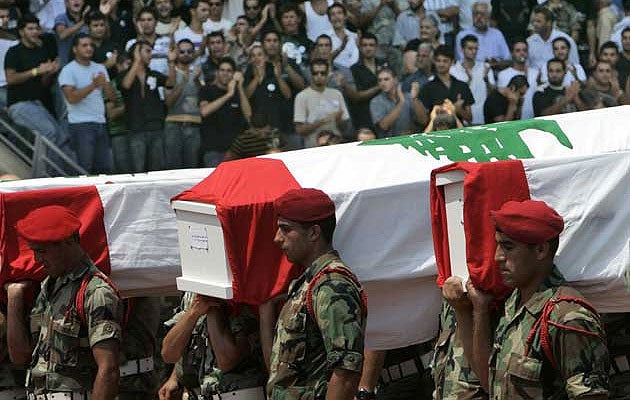
Lebanese military police carry the coffins of nine comrades killed in Wednesday's bomb attack in the northern city of Tripoli

AP

Lebanese military police carry the coffins of nine comrades killed in Wednesday's bomb attack in the northern city of Tripoli

Related Articles

Abdullah got it about right. Picking his fingernails in the ticket office of the local bus station, he lowered his eyes. He had seen everything; the severed arms and legs of Lebanese soldiers, the still uniformed but headless infantryman slumped out of the window of the minibus round the corner, and the bodies of all the little people who die when bombs go off here: the old man who sold sandwiches to the troops, the lemonade salesman, the child who polished shoes. All dead, of course. "Collateral damage" to the man who left the bomb in a bag on the pavement at 7.45am on Wednesday. "We think it was either Fatah al-Islam or some unknown forces," Abdullah said. "Why do you ask?"

Why indeed. Fatah al-Islam is a Salafist version of Sunni Islam, a weird al-Qa'ida satellite which held out against the Lebanese army in the Palestinian Nahr el-Bared camp north of here last year at the cost of 400 deaths and the flight of 40,000 civilians. Most Lebanese concluded that they were implanted in Lebanon's soil by Syria.

But Wednesday's bomb in Lebanon's second city, the ancient crusader port of the Chateau de Saint Gilles, disfigured by massive unemployment and grotesque advertising hoardings, was of Iraqi proportions: 15 dead, nine of them Lebanese soldiers, and 50 wounded.

Gunfire crackled like broken matchsticks across Tripoli yesterday as the local "martyrs" were buried. Most had been queuing for buses to the south, alongside the usual bus drivers – six of them – sipping coffee on the pavement. One of their number, Kasser Chebli, who had turned up as usual and begun to drink his morning coffee, woke up in hospital, minus one leg. On the streets, the printed funeral notes told their own story.

"The Martyr Mohamed Mustapha Mrai," it said in beautifully printed Arabic script above an army identity photo of the young man. "The martyr who died in the Tripoli bomb," the funerary notice added.

But who were Abdullah's "other forces"? A walk down Syria Street – and yes, that really is the name of this shattered, burnt- out, bullet-spattered thoroughfare – provides a few terrifying clues. It divides the large Sunni district of Tripoli from the tiny Alawite community. The Sunnis are generally loyal to Saad Hariri, son of the assassinated ex-prime minister whose Future Movement now forms part of the government in Lebanon.

The Alawis are, as the saying goes, an "offshoot" of Shia Islam and are close to Syria for a very obvious reason: President Bashar al-Assad of Syria is an Alawi and so are most of the powerful men in Syria.

The soldiers murdered in Wednesday's bomb were members of a large military force deployed after Sunni-Alawi sectarian gunbattles had killed 22 Lebanese and wounded another 68 in June and July alone. The battles still continue.

Syria Street is a shameful place of ethnic cleansing, of burnt-out apartments and smashed shops, of fear and unemployment. "Don't stand here any longer because you can be shot from the top of the side road," Rabih al-Badawi quietly informed me as we inspected the wreckage.

Rabih's business card says he is in "General Trading" – he is a Sunni and he sells lavatory fitings – but his "trading" took a blow this summer when he refused to pay protection money to local gangs. He takes me through his upper offices, carbonised, trashed, looted, his remaining windows starred with bullet holes. Outside, bullets crackle in the hot afternoon. It's like a return to the old Beirut of the war.

"Look at these shops," Rabih tells me as we stroll down Syria Street with a grotesque display of self-confidence. "This is Alawi-owned. Bullet holes in the door. This is Alawi. The same. These are Sunni shops: all burnt out."

Was all this, perhaps, the work of Abdullah's "unknown forces"? "I think this is the work of weapons' dealers," Rabih replies at once. "They want to sell guns. So here everyone needs a gun because everyone is frightened. So the place has filled up with guns. The army does nothing. Why not? Don't they know the names of the gangs? Don't they know who is behind this?"

I take a drive round the corner to the slums of the little Alawi community, and there is Ahmed Saadedin, sipping coffee opposite another row of "martyrs" pictures, this time of Alawis, who says, correctly, that at least 9,000 Alawi refugees have fled their homes here.

"The violence started after Hariri's assassination," Ahmed says. "When Syria's forces were here, all Lebanon enjoyed security." Which – if you forget the presence of 40,000 Syrian troops, two Israeli invasions and a 15-year civil war – is an absolutely correct statement.

The truth is that Tripoli has slunk back into the civil war, block after block of gaunt, workless homes in which the Salafists and the "al-Islamists" and the haunted young men who have returned from their "jihad" against the Americans in Iraq now nestle and ponder a dangerous, frightening future amid these disgraceful battles.

In Tripoli, the fears of every Lebanese are brought to fulfillment; it's the cold fear of those "outside forces" that roam throughout the Middle East.

Lebanon's bitter legacy

Independent from French rule since 1943, Lebanon has four million people made up of numerous religious groups. The 15-year civil war ended in 1990, but the country is still deeply unstable. The worst violence since the civil war erupted in 2006 when a month-long war broke out with Israel. When President Emile Lahoud's term finished in November 2007, the dispute over his successor led to a six-month power vacuum. Finally, in May, the former army chief Michel Suleiman was chosen as President, and on Tuesday a new cabinet was approved by MPs. The country has been shaken by political assassinations since the February 2005 killing of the former prime minister Rafik Hariri. The role of Syria, which withdrew its troops in 2005 after 29 years, has been a source of conflict. But this week Lebanon and Syria agreed to establish diplomatic relations.

Interesting? Click here to explore further

Comments

56 Comments

My only complaint about this article is stating that we were living in security under the Syrian occupation. The price we had to pay is much more important than any form of imposed security. We are facing Syria's & Iran's satellites without any help from any country or international body. We are a young, small nation, that cannot afford to spend on military growth at the expense of economic investments, from an already grossly deficited budget.
The Lebanese are not resistent by nature. In any other country, occupied for that long, and in such a humiliating way, you could bet on insecurity arising from opposition to the imposed fact.

Posted by Nino Frewat | 20.08.08, 07:34 GMT

Post a complaint

Please note all fields are required.

Contact details

Thank you for an honest view of the intriging situation prevailent in Tripoli.
Some of the comments are so misinformed and biased against anything that you write, I wonder if they really read your articles before posting their nonsense.
Al-quaiida might be looking another base for operating their sinister terror... that helps the west to keep on terrorizing their citizens!
All this to have more reasons to find new ways of more taxing for the never ending anti-terrorist war .

Posted by Mlalpin | 18.08.08, 19:15 GMT

Post a complaint

Please note all fields are required.

Contact details

Nick Birkin, did you actually read this article?? Where is Robert's argument in this article?!! He isn't presenting an argument, he is writing a report on what he is seeing and experiencing. If find it incredible how misinformed the Robert-bashing in the comments section is. You say he should present news in a format that shows all sides of the argument but he hasn't even presented an argument, he is just reporting! You say it is News of the World style non fact based prose - how many NOTW journalists are there in Lebanon, pray do tell?! I would be willing to bet that most NOTW readers (and reporters for that matter) have no idea what and Alawite is!

Posted by regan | 17.08.08, 11:07 GMT

Post a complaint

Please note all fields are required.

Contact details

It's all Jews' fault, right, Fisk?

Posted by Arik | 17.08.08, 10:57 GMT

Post a complaint

Please note all fields are required.

Contact details

Robert, you should have seen the following also:
1. This bombing was timed to send a mesage to the Lebanese President just minutes before he was leaving for his summit meeting with the Syrian President.
2. Now, who wouldn't want Lebanon and Syria to normalize mutual diplomatic relations and declare bygones as bygones? The United States and Israel would top the list of suspects. No one can deny their capacity and willingness to do so. They have done so over and over again.
3. Other suspects would be those who see themselves as having lost most in the process of national rapproachment which ended in the formation of a 'concensus' Govt in Lebanon. These could be foreign or local. If Foreign then once again USA and Israel would be at the top of the suspect list. If local then all who lost to Hizbollah (peacefully) would top the list, individuals as well as political parties/alliances. The 14th March alliance which are closely allied to the US would be suspect.

Posted by syed salamah ali mahdi | 16.08.08, 15:20 GMT

Post a complaint

Please note all fields are required.

Contact details

Hi Mike, sorry for the delay in posting a message to your responses. I had a look at honestreporting.com. It was very informative, well, I say informative, I think I mean bias. According to the website, not their mission statement, or the history of what they do, but the tone of their individual articles, anybody who critisies Israel, is incorrect, flawed, and bordering on being anti-jewish. Im Irish, and as somebody else has referenced the issues of Northern Ireland. The parallels are a bit shallow, but still to a minor degree, are valid.The point I make to my own nationality is that when the peace process was signed 10 years ago, the Rep. of Ireland also voted as a part of the process. Changing articles 2+3 of our constitution, brought up some 'hidden' nationalism. the point of all this is that all sides criticised each other, mis-trusted each other and for some, hated each other. Yet a dialoge brought about peace, the points on that website hinder peace as much as a carbomb.

Posted by Kenny | 16.08.08, 00:06 GMT

Post a complaint

Please note all fields are required.

Contact details

What is the Independent coming to?
Such News of the World dramatic, non fact based prose.
Is this objective journalism or a strange opinionated attempt to fill space?
What worries journalist today?
What stops you presenting news in a format that gives us as many sides to the story as possible?
A format that says , you‘re all educated to such a degree, we‘ll give as much as we can to allow help form an opinion.
As opposed to here‘s an argument to follow our opinion.

Posted by Nick Birkin | 15.08.08, 22:55 GMT

Post a complaint

Please note all fields are required.

Contact details

Yes, DocReality, the Jews (Zionists) are to blame. So Lebanon and Syria are going to establish dimplomatic relations? Amazing! Two Arab countries becoming friends?

Posted by ricardo levy | 15.08.08, 19:50 GMT

Post a complaint

Please note all fields are required.

Contact details

Well think about it; if Lebanon is at civil war and hezbollah is preoccupied with fighting with the Northern Lebanese, it opens the door for an attack on Iran, which has been Israel's, and the Neocons (here in the US) wet dream since overthrowing Saddam. If Hezbollah is being attacked from the North and the South, it puts them in a really bad position. Same way the US surrounded Iran on the East and West in order to attack (also have them surrounded from the south as well).

Posted by Jeff | 15.08.08, 18:01 GMT

Post a complaint

Please note all fields are required.

Contact details

Reading the previous comments I'm tempted to surmise the fascist left have found a natural home at the Independent. What is it about the title of Robert Fisk's piece that leads anyone to drag the Jews into the frame?
Islam has been at war with itself for 1,400 years as any historian, and the historic record, will tell you. Ali, whom the Shia follow, was assassinated in 661 AD by the Damascus-based Umayyad Sunni. They have been at loggerheads ever since.
Only paranoia and antisemitism can explain the introduction of Jews into this scenario.
I had no idea the Independent had turned into a conspiracy theorists' paradise.

Posted by rollwithit | 15.08.08, 16:15 GMT

Post a complaint

Please note all fields are required.

Contact details

56 Comments