Robert Fisk: Churchill reckoned the Japanese preferred war-war to jaw-jaw
The advance down the coast of Malaya made steady progress and the British had insufficient forces there to stop it
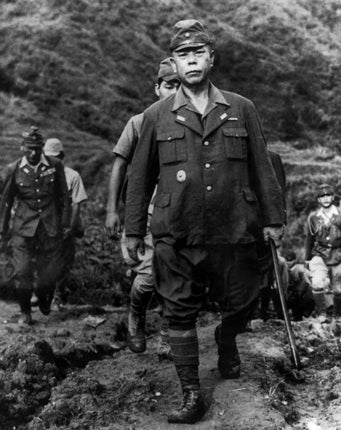
The Japs hit us first. I had to come all the way to Malaysia to discover this. In fact, the very first Allied victims of the war in the Pacific were not at Pearl Harbour.
They were Flying Officer Bedell and his crew from 205 Squadron RAF, who were monitoring the progress of a Japanese battle fleet from a Catalina aircraft. The fleet was heading for the remote northern beach-head of Kelantan in what was then Malaya. After dark on 7 December, 1941, Lieutenant General Tomoyuki Yamashita's 25th Imperial Japanese army began shelling the Malayan beaches – but the Japanese air force was still 70 minutes' flying time from Pearl Harbour.
Much as I would like to claim this as a Fisk scoop, it's not. A lot of research by Bert Lossen, Pierre-Emmanuel Bernaudin, Leo Niehorster, Akira Takizawa, Sean Carr and others – and most notably Datuk Nik Mohamed Salleh of the Malaysian Historical Society – ferreted out the simple fact that, time zones apart, Malaya was attacked before America's Pacific naval base. There is no record of Winston Churchill's immediate reaction to the Malayan landings. All accounts record that he was dining at Chequers on the evening of 7 December with John Winant, the American ambassador to Britain, and Averell Harriman, President Roosevelt's special envoy to Europe, when the BBC broke the news of Pearl Harbour.
Winant recalled how Churchill leapt to his feet and was going to call the Foreign Office to declare war on Japan "within the minute" – an idea he was talked out of on the grounds that you cannot declare war on the basis of a news broadcast, even one by the BBC. Churchill then rang Roosevelt. Britain, he was convinced, was now saved. At last the United States had entered the war. Admiral Isoroku Yamamoto, who planned the Pearl Harbour attack, reportedly said afterwards that: "I fear all we have done is to awaken a sleeping giant and fill him with a terrible resolve." He was talking about America, not Britain. And it did not seem to occur to Churchill then to check what was happening in that sleeping but failing giant called the British Empire.
The Brits did try to stop the Japs from landing. The first soldiers to meet General Yamashita's army were Indian troops of the 8th Indian Infantry Brigade under – of course – a British officer. These soldiers had mined and wired the beaches and even built a collection of pill boxes – whose wreckage still exists – but were overwhelmed. Thus began the long withdrawal down the peninsula of Malaya to the final humiliation of Singapore on 15 February, 1942. How soon after the BBC broadcast did Churchill learn of the landings at Kelantan? Certainly, the Admiralty in London must have known – could they not have warned the Americans?
After all, on the previous day – December 6th was a Saturday – there was a conference in Manila between Admiral Thomas Hart, commander of the US Asiatic Fleet, and Admiral Sir Thomas Phillips, the British naval commander in the Far East, at which an American naval officer entered the room to report that an Australian reconnaissance Lockheed Hudson flying out of Malaya had spotted the Japanese fleet. Flying Officer Ramshaw had seen six cruisers, seven destroyers and at least 25 transport ships steaming in the general direction of Malaya.
It was enough for the Brits to turn the Repulse – on a trip to Darwin – around and head her to Singapore. And as we all know, the Repulse, along with the Prince of Wales, were be destroyed in less than a week. Churchill had himself been aboard the Prince of Wales on his first meeting with Roosevelt and liked her captain, the same Thomas Phillips who was meeting with Hart on 6 December. Told that both ships were lost and that the captain of the Prince of Wales had gone down with his ship, Churchill asked the Admiralty for confirmation. When they replied that, yes, the Prince of Wales had gone down, all Churchill said was: "Poor Tom Phillips."
As British troops steadily abandoned their airfields and river fortifications down the peninsula, the first Chinese Malay guerrillas – Communists, naturally enough – found that many British soldiers had abandoned their arms under fire in the night-time rubber plantations. The Chinese Malays hoovered up hundreds of weapons, arms they would use against the Japanese and then later – during the post-war Malayan "Emergency" – against the British.
As Malaysian historian Datuk Salleh records – "Datuk", by the way is a formal title for anyone in Malaysia, meaning "the honourable" – "the British had now ordered the complete evacuation of British forces from Kelantan. The Japanese advance down the west coast of Malaya made steady progress and the British had insufficient forces there to stop it". Even their troops trains were being scourged by Japanese fighter-bombers.
In all, the Japanese lost 3,500 men in the battles, less than a tenth of them in the initial fighting at Kelantan. Just three divisions of 55,000 Japanese soldiers beat a British and Commonwealth army of 130,000. It was further proof to Churchill that the British soldier – so resolute in the First World War, so immune to mutiny (unlike the French in 1917) – might have lost his fighting spirit in the Second. As a Malaysian friend of mine said to me in Kuala Lumpur a few days ago – not without a dark smile – "it all proved to us that little Japanese yellow men could beat big English white men..."
As for Yamamoto, of course, American fighter planes ambushed his aircraft over the Solomon Islands in April, 1943, and he plunged to his death in the jungle. And on a personal note... some years ago, I was telephoned in Beirut by a polite young Japanese journalist in London to discuss the Middle East. She said her name was Yamamoto. Aha, quoth Fisk, that was the name of the admiral who got his rightful comeuppance in the Second World War when the Americans shot him down. "Yes", she said with equal politeness. "He was my grandfather." Speechless – for once – was "Datuk" Fisk.
Join our commenting forum
Join thought-provoking conversations, follow other Independent readers and see their replies
Comments