John Rentoul: Brown in the arena is risky but brave
The Prime Minister's decision to agree to a televised leaders' debate reveals the confidence of an experienced political bruiser
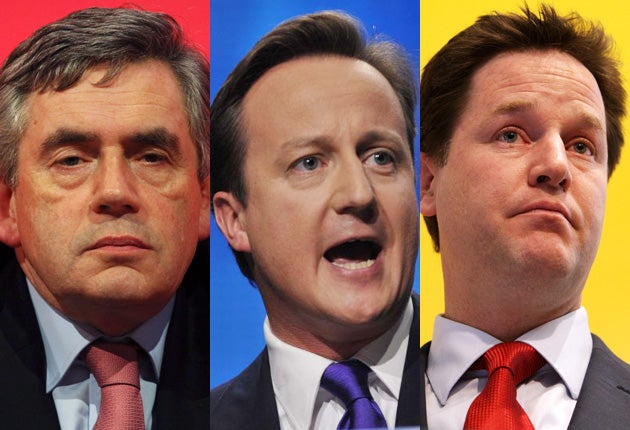
Televised election debates will never happen in this country, because it will always be in the interest of one party leader to take part and, therefore, not in the interest of the other. It's a classic zero-sum game. Or so I thought. That will teach me to assume that politicians are rational. Last week, Gordon Brown, David Cameron and Nick Clegg reached agreement with the broadcasters on the format for live debates during the general election campaign.
I reckoned without that element that makes politics so interesting and human: risk-taking. Usually it is the incumbent prime minister who has more to lose and therefore refuses to take part. Or, rather, sends a representative to talks with the broadcasters who adopts what is now known as the Chinese negotiating position – appearing to agree with everything but having to refer back to the boss and then coming up with objections and eventually a disingenuous excuse for saying no and blaming it on everyone else. In 1992 it was John Major who made his excuses by proxy and avoided a televised face-to-face with Neil Kinnock (and Paddy Ashdown). Five years later, the tables had turned and it was Major who challenged Tony Blair to the contest. Blair sent in Derry Irvine as his obfuscator-in-chief to complicate the negotiations to a standstill. Major may have been Prime Minister but, as his former friend Norman Lamont tactfully pointed out, he was in office but not in power. Blair was already, in effect, in power and was not taking any chances. "It was risk minimisation," one of his closest aides admitted to me afterwards.
This time, it is harder to calculate the advantage. Cameron is blessed with the more pleasantly appealing television persona; yet Brown has authority. He may have had a rough time over the past two and half years, but he still comes across as both in office and in power. All the same, Cameron seemed to have the upper hand. For a long time it has been a simple rule of thumb that, if Cameron is on the television a lot, Conservative support in the opinion polls rises. So I had assumed that the Sky News campaign for the debates was part of the new Murdoch-Cameron front. I thought it was one of those silly stories about the political process rather than the substance that would allow the Murdoch media empire to embarrass its old friend Brown and ingratiate itself with its new friend Cameron.
But then the Prime Minister said yes, and it turned out that the parties and the broadcasters had even agreed a formula that would allow the Liberal Democrat leader a role. Oh well, back to the old drawing board, as the alien in the Looney Tunes cartoon says when his fiendish contraption blows up in his face, leaving him looking quizzically at the viewer through a coat of soot.
Time to recalibrate the rational choices calculator and conclude that Gordon Brown thinks it worth taking the risk. Certainly he has little to lose. And Cameron's very plausibility as a television performer may now be counting against him in the expectations game that is so important in the media's facile judgement of "the winner" of each debate. It may also be that Brown takes seriously the sort of criticisms made of Cameron by people like me, who point out the thinness and contradictions of the Conservative programme, and thinks that the Tory leader would be vulnerable to point-by-point debate. If so, I fear that he is confusing Mock the Week with Socratic dialogue. Television debates are all about tone, sound bites and timing, not the contrast between the first two points that Cameron made in his Newsweek interview last week were: one, double the bonus for soldiers in Afghanistan; and, two, tackle the deficit.
The other thing that has happened, though, is that something has lifted Brown's confidence. He deployed humour to good effect at Prime Minister's Questions a few weeks ago – never mind the playing fields of Eton, the most telling was the unrehearsed put-down of Clegg, saying that he was sure Barack Obama would be grateful for the endorsement of US Afghan strategy. That is the kind of thing that works well in debates. Then Brown had a good Copenhagen. It may not have looked like it when the Chinese blocked anything but the most feeble deal, but he knows he did a fine negotiating job, and earned the respect of other world leaders. Kevin Maguire, the Daily Mirror's political editor, even noticed during an interview the other day that Brown seems to have stopped biting his nails.
Brown has, it seems, finally relaxed into the job. He seems to have decided that he is comfortable with being the underdog in the election campaign, and that he will fight it as well as he can. For him, all the risks of the unexpected are on the upside. Perhaps he takes heart from Ryan Giggs winning the BBC Sports Personality of the Year from the smoothie favourite Jenson Button. Or from Rage Against the Machine coming from nowhere to upset Simon Cowell's Murdoch-like certainty that he had the Christmas No 1 sewn up. Rage Against the Machine would indeed be a curiously fitting analogy for Brown's attempt to position himself as the feral underdog, the insurgent challenger against the media-political establishment that thinks the election is over already.
I think it is mad but feel bound to admire the man's spirit. I do not believe that people vote for underdogs when it comes to big elections. I know that people vote for Jedward or H'Angus the Monkey or even Harriet Harman when they think that the outcome of the election is unimportant. But I do not think that they vote as a joke or a way of expressing themselves when it comes to choosing a government. The underdog posture seems like another motivate-the-core-vote strategy.
If the party leaders were the "rational actors" of economic theory, then Cameron and Clegg should say Yes to televised debates and Brown should say No. It seems likely that, if the voters are exposed to Brown versus Cameron in full face-to-face detail, even with Clegg in the middle, they will gravitate to the fresh face and fiscal responsibility. But you have to give Brown credit for finally coming out fighting.
John Rentoul blogs at www.independent.co.uk/eagleeye
Join our commenting forum
Join thought-provoking conversations, follow other Independent readers and see their replies
Comments