Mary Ann Sieghart: The dreamers who gave us the eurozone stand condemned
This was a policy blunder born of arrogance and insouciance at the highest levels. And it can't easily be reversed

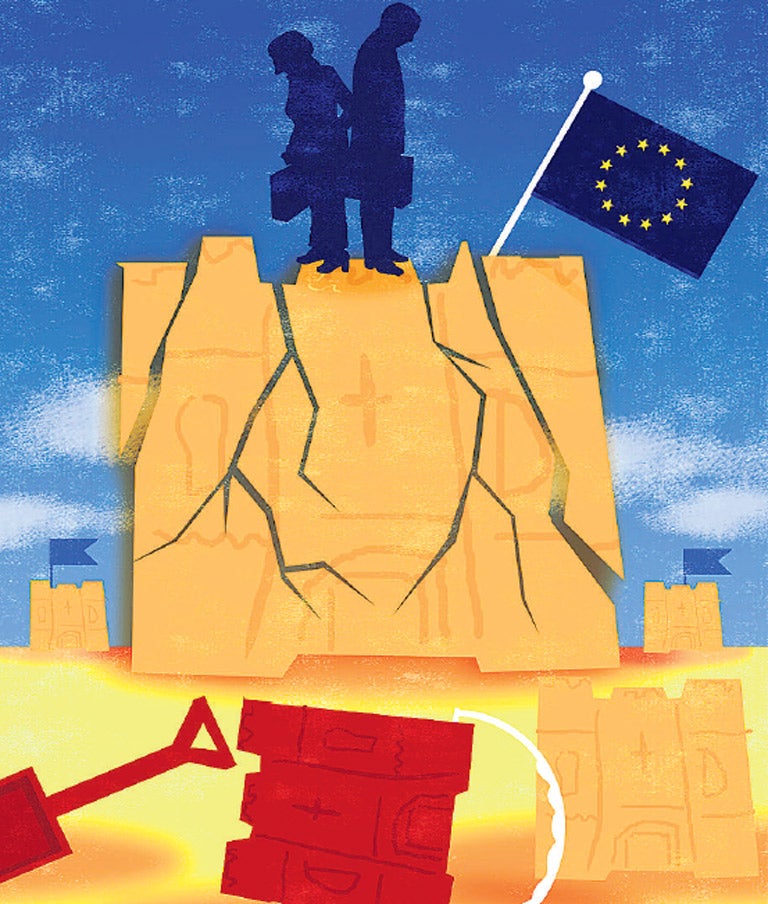
An elderly man in France was arrested last week for supplying faulty breast implants to 30,000 women. Yet an elderly man in Germany is still free to enjoy his retirement despite having wrecked the lives of more than 500 million Europeans, with repercussions for billions more around the world. Not only that, but Helmut Kohl has been feted by an American President as "the greatest European leader of the second half of the 20th century". He should instead be found guilty of the greatest policy blunder of the second half of the 20th century.
The formation of the euro has more than a little in common with the PIP implants scandal. In both cases, rules were deliberately broken, dreadful consequences were easily foreseen, and a culture of wilful blindness and moral negligence prevailed. In both cases, untold human pain has been caused, with little chance of redress for the victims. But at least in the case of PIP, someone is being held responsible. In the case of the euro, not a single politician has suffered for his negligence.
In the PIP scandal, corners were cut in pursuit of profit. In the euro scandal, corners were cut in pursuit of a foolish dream of forced European integration. The grand idea of Kohl and the then French President, François Mitterrand, was that Germany's identity would be subsumed into that of the EU. And what has happened? European disintegration looks more likely than ever, and Germany is now so powerful that the rest of the eurozone has to bow down before it.
Kohl and his fellow European architects can't claim that they weren't warned. They had a dry run at a common currency with the exchange-rate mechanism. The ERM tied all its currencies together at a fixed rate to the Deutschmark. In 1992, the system was tested to destruction when Britain and Italy were forced to leave it, unable to cope with the interest rates the ERM imposed.
At least, though, the ERM allowed different interest rates for different members. The even greater sin of the euro was that it imposed a uniform interest rate for the whole eurozone. That allowed Greece, Portugal, Spain, Ireland and Italy to borrow at rates practically as low as Germany. No wonder they built up mountains of debt. It was a free ride which is now proving monumentally expensive for the citizens, banks and governments of Europe and the wider world.
As an excellent programme on Radio 4 yesterday illustrated, the politicians were culpable on every front. Allan Little, in Europe's Choice, spoke to a technocrat, Jacques Lafitte, who admitted that everyone knew the southern European states weren't ready to join a single currency. But as he put it, there was a "big political corruptness problem. No one wanted to point a finger at another member state in case they pointed the finger at you some day."
Joachim Bitterlich, a senior foreign policy adviser to Kohl, admitted to Little that they bent the rules to allow Italy in. Italy's debt was around 120 per cent of GDP, when the Maastricht criteria for membership of the euro stipulated a maximum 60 per cent. But as ever, politics trumped economics and Italy was admitted, opening the door to Spain, Portugal and Greece.
In Greece, the figures were cooked as thoroughly as a charcoal-grilled kebab to make the public finances look as if they met the criteria. But who can blame the Greeks when the main drivers of the euro, France and Germany, were so badly behaved? In 2003, both countries spent too much and their budget deficits rose above the 3 per cent limit. They simply persuaded friendly finance ministers, including Gordon Brown, to vote for no penalties to be imposed.
As a result, a policy that was supposed to lead to convergence did exactly the opposite. Germany got richer, as it exported its goods to the debt-fuelled periphery countries. They, meanwhile, became more and more indebted, and less and less competitive. Now they face years of depression, a generation of worklessness, riots on the streets and the possible breakdown of democracy.
Kohl's tactics were always to increase European integration in small steps, hoping the voters wouldn't notice too much, and using crises as excuses to force the pace. He knew perfectly well that a monetary union couldn't survive without economic and political union – and now the first is being used to drive through the second two, against the interests and wishes of voters.
For whatever eurozone leaders may say today, fiscal pacts are much harder to enforce between countries than within them. Here, London and the South-east subsidise northern England, and England subsidises Scotland. But we've been part of a common nation for 300 years and there are still Scots who don't want to be told what to do by an English Prime Minister, and English taxpayers who begrudge stumping up for them.
So imagine how much harder it is for Germans and Greeks. Greece yesterday refused to accept a German proposal for an EU budget commissioner to be able to veto its taxes and spending. It resents the intervention of Horst "the Third" Reichenbach, who heads a European Commission taskforce for Greece. This isn't surprising when, in living memory, under German occupation, Greece lost more than 300,000 Athenian citizens to starvation, tens of thousands more to Nazi reprisals, and 80 per cent of its Jews to the death camps. We're hardly talking about England and Scotland, whatever happened at the Battle of Culloden in 1746. Meanwhile, it's equally unsurprising that German voters are determined not to play the role of London and the South-east to the spendthrift Greeks.
This currency union was never going to work unless all its member states felt as strong a common bond as the English and Scottish do. Instead Kohl and Mitterrand believed that lashing the countries together would suffice. It was a stupid idea born of arrogance and insouciance at the highest levels, and it was never going to work. It was at least as likely to lead to the dangerous rise of the far-right – exactly what Kohl was trying to lay to rest.
Some policy blunders can easily be reversed. This one can't, and millions of European citizens are now paying Kohl's price in unemployment, crashing living standards and a desperate future for their children. Someone must be held responsible for the predictable catastrophe caused by this grand idea. Mitterrand is now dead; at the very least, Kohl and his fellow architects should be disgraced.
Join our commenting forum
Join thought-provoking conversations, follow other Independent readers and see their replies
Comments