Steve Richards: A step into the political unknown
The day Gordon Brown triggered the most unpredictable election for decades
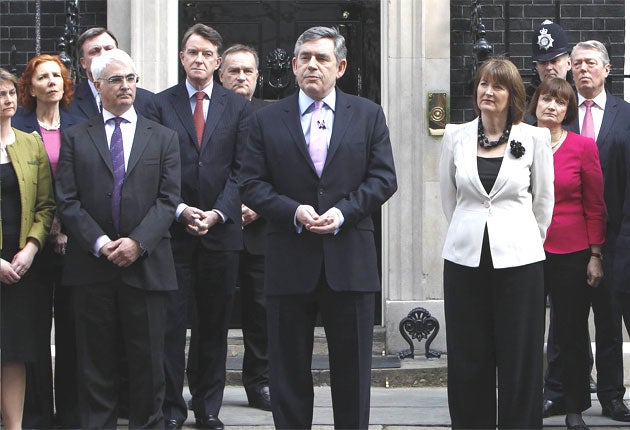
"The Queen has kindly agreed to the dissolution of Parliament and a general election will take place on 6 May." For a Prime Minister who agonised almost fatally over whether to call an early election more than two years ago Gordon Brown delivered the momentous words with a sense of calm inevitability. In the end Mr Brown had no real choice about the date of the election as he had already waited until nearly the last possible moment. But although there is no surprise that the trigger was pulled, what follows is unknown. What will be the prevailing narrative? Above all, who will win? No one knows for sure as the least predictable election for two decades gets under way.
Yesterday the leaders and their strategists were in control. It will not always be the case. There are more wild cards in this election than normal, but on Day One the choreographers pulled the strings and the players danced to carefully composed tunes. Brown returned from his appointment with the Queen to deliver his opening message with his ministers around him. The words and the image were a compressed summary of Labour's planned campaign with Brown stressing the personal and the political. He declared as he has many times before that he came from a middle-class family and an ordinary town in implied contrast to his main opponent. He went on to highlight a key theme: "Nothing should put the recovery at risk".
Partly Brown is seeking a 1992 election in reverse, when voters stuck with the Conservative government out of fear that the alternative would be worse. As he spoke, Cabinet ministers, some of whom contemplated removing him at the beginning of the year, nodded approvingly. They will play a big part in the campaign. With Brown's ratings low Labour will emphasise its experienced team as Harold Wilson did with some success in the two closely fought elections in 1974. Whether members of the current team shine quite so brightly as Wilson's did then is another matter, but they have experience of government.
David Cameron can make pledges, but he cannot pluck experience from the air. Instead Cameron plays the "change" card, hoping that inexperience seems fresh and new. He launched his campaign with the Thames and Westminster as his backdrop, surrounded by youthful party workers on the South Bank, a subtly discreet distance from a discredited Parliament.
The contrast was vivid, Cameron alone without his top team compared with Brown surrounded by his Cabinet. His message also sought to compress his entire campaign: Avoid another five years of Brown by opting for "hope, optimism and change". Cameron's autumnal tone of unremitting bleakness has lightened. As the weather improved markedly yesterday the Conservatives' leader came close, tonally, to reviving his early political metaphor, the one that got lost in his austere response to the economic crisis. In standing for optimism and hope Cameron was letting the sun shine once more. As if to prove the point he headed for a hospital in Birmingham, hoping to convey an unswerving commitment to the NHS as well as to spending and tax cuts, a delicate balancing act.
The Liberal Democrats' leader, Nick Clegg, chose a more subdued backdrop for his opening thoughts. At his party's headquarters in Westminster he told staff that the bigger parties stood for the old politics while they represented the new. Later he was on the campaign trail with Vince Cable, the party's Treasury spokesman and, polls suggest, the voters' choice to be Chancellor of the Exchequer. Clegg and Cable will be something of a double act during this campaign and pose one of the tantalising questions that will determine the outcome of the election. Will Cable's popularity and Clegg's defiant anti-Westminster message help the third party to retain seats won last time when they had a defining theme, their opposition to the war in Iraq?
Yesterday there was no time for unanswered questions as political choreographers had their day. The announcement of an election is enough of a highly charged story to meet the demands of 24-hour news and the internet. Each of the leaders' moves were reported with an unusually deferential tone. At one point one of the news channels reported: "Breaking News: Gordon Brown To Arrive At St Pancras Station Shortly." Rarely in his turbulent premiership has Brown moved with such imperious sway. A viewer from Mars might have assumed that the arrival at a railway station was as significant as that of a commander in a military campaign.
In some ways it was. Brown was heading for Kent and to marginal seats that will seal his fate. But soon the choreographers will lose full control and they know it. All of them fear the impact of the internet, one of the wild cards of the election. One strategist loses sleep over the prospect of an obscure candidate uttering reckless words that are recorded on a mobile phone and placed on YouTube. The televised debates are another new factor. They have the potential to transform the narrative of the campaign. Smaller parties too will play their part, perhaps taking votes from the bigger ones with unpredictable consequences. Above all opinion polls will shape the mood, giving life to one party performing well and draining others of hope.
That is to come. Yesterday there was a palpable sense of energy, hope and liberation across the political spectrum. Gordon Brown must have wondered at times whether he would ever reach this point, leading his party into the election campaign. Now he is off and there is no going back. For a leader behind in the polls the start of the campaign, with its rituals, formalities and sense of purpose, is a form of relief. Yesterday one of his advisers spoke of Brown being calm, laughing and telling the occasional joke. Whatever happens next he has made it to this point when his internal enemies had been determined to stop him.
Cameron has waited even longer as leader to fight the campaign. He has served as Leader of the Opposition for a longer period than Margaret Thatcher or Tony Blair, a test of patience, endurance and agility. Now the finishing line is in sight, a form of comfort in itself.
The Liberal Democrats have had three leaders in this parliament, a sign usually of deeper problems afflicting a party. But they seem to have resolved them for now as Clegg enters an election in a context that is as near to ideal for a leader that struggles sometimes to be heard. The possibility of a hung parliament means his words will be taken seriously. The prospect makes him important whether or not one party wins outright when the votes are counted in more than four weeks' time.
There will be no rest for the leaders and many others until then. Soon the current discredited Parliament will be dissolved, a cathartic moment in itself. But thousands of candidates will seek election, in some cases giving up jobs in the hope of being elected. The election is under way and it will be a long, sometimes wild ride, a robust affirmation of democracy and a chance to hold politicians to account at a time when too many voters are inclined to turn away.
Join our commenting forum
Join thought-provoking conversations, follow other Independent readers and see their replies
Comments
Bookmark popover
Removed from bookmarks