Steve Richards: It was in Clegg's moment of triumph that the seeds of disaster were sown
The Lib Dems' dream of electoral reform, which seemed so close to realisation, becomes an elusive fantasy
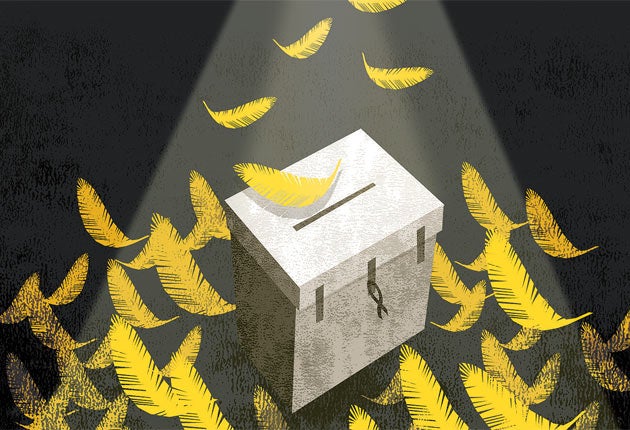
Nick Clegg's wildly oscillating political career takes its deepest dive downward. This weekend a year ago he was fleetingly the most powerful politician in the land, the leader of a third party in a position to sway tumultuous events. Now Clegg fights for his party's survival as a distinct and potent national force. The rejection takes a particularly brutal form.
Liberal Democrats are suddenly much weaker in local government. Their dream of electoral reform, which seemed so close to realisation, becomes an elusive fantasy once more.
As so often in politics, the seeds of near destruction were sown at what seemed like a moment of swaggering triumph. In the aftermath of the election Clegg was hailed for negotiating a brilliantly ruthless, cunningly executed deal with the Conservatives. In retrospect he was exhausted, anguished, slightly bewildered, and in the grip of fast-moving events. The Conservatives got all that they wanted – crucially, support for their plans to wipe out the deficit in a single parliament and for a programme of public-service reform that implied a revolutionary recasting of the relationship between state and citizen.
The subsequent simplistic accusations of betrayal that were applied to Clegg were wide of the mark. He is a committed public figure who at times has fought assiduously behind the scenes for fairer policies. Even over tuition fees, the policy that might yet come to undermine him fatally, he worked long, arduous hours for a fairer repayment scheme.
Clegg is culpable on the less emotive issue of judgement. Still a relatively inexperienced politician, in an intoxicating situation during and after the election, he made a series of misjudgements. The first was to allow the Orange Book wing of the Liberal Democrats to dominate the negotiations with the Conservatives.
Whatever his own ideological inclinations Clegg leads a party that is – or was – supported by what Harold Wilson used to call euphemistically in relation to Labour a "broad church". In some ways it is broader than the impossibly divided party that drove Wilson to the edge in the early 1970s. Some of Clegg's unruly congregation, those that are used to singing social democratic tunes, played no direct role as synthesis was reached between Cameron and Clegg. In those heady days, the party, with its daunting layers of assertive internal democracy, gave the go-ahead and was right to do so. Turning down a chance to govern would have been perverse. But in his brief phase of mighty omnipotence, Clegg could have secured terms to avoid some of the landmines that have exploded since.
The second misjudgement relates to the first. The agreement was hailed too enthusiastically as a great ideological fusion. We were told a little too persistently how exciting it was for ministers of both parties to discover how much they agreed with each other. Recently Paddy Ashdown has argued, with some force, that noble compromise in the national interest is misread as betrayal. He is also being a little disingenuous.
At first tonally, and to some extent in terms of substance, the mood music was one of a great coming together, a coherent, robust coalition of the radical right. Clegg should have calculated ruthlessly a year ago that he would need Labour voters and former Lib Dem supporters from the left of centre to vote with him for electoral reform. With the referendum in mind he needed to caress them as much as his new friends on the right. Instead, in those distant early days he showed transparent disdain for Labour, for the centre-left and for economic policies that his party had broadly supported before the general election. In his first parliamentary performance as Deputy Prime Minister, Clegg went as far as arguing that the previous Conservative government had a better record on manufacturing than Labour. It was not Clegg's role to defend the erratic Conservative administration that was wiped out in 1997.
To some extent he was trapped by circumstance, by an understandable strategic assessment, and by his own beliefs. When Clegg became leader, he worked on the assumption that at some point the most likely relationship would be with Labour, probably with both parties in opposition. As it turned out, the only practical arrangement after the election was with a Conservative Party that had become more socially liberal under Cameron's leadership but otherwise clung to many of the Thatcherite convictions that had taken hold in the 1980s.
Clegg decided that his first objective would be to show that a coalition could work and so he opted for a show of seamless unity that combined heroic self-discipline and artless naivety. Sometimes the unity was helped by the fact that Clegg was genuinely as enthusiastic as his Conservative colleagues about the contentious agenda.
The Conservative wing of the Coalition hopes the coming together of unavoidable circumstances, strategic calculation and ideological conviction will bind the Liberal Democrats in the same way in the coming years. The Conservatives have much to cheer as they reacquire national dominance in stages, seizing power stealthily. Yesterday William Hague pointed out that the Coalition was working well and that there were fewer tensions between the two parties than when a single party ruled. This is a dream message for the Conservatives and increasingly a nightmarish one for the Liberal Democrats who need distinction. They are being punished for being part of a government of the radical right, or one that is perceived as such. Emphatically their leadership insists that this is a progressive, liberal administration. In which case, they must explain why Conservative voters are staying loyal to their party in remarkably strong numbers while support for the Lib Dems has collapsed.
In the immediate aftermath of this weekend's trauma, Clegg will be committed to a series of genuinely radical measures, in some cases braver and more progressive than those attempted half-heartedly by the previous Labour government. Unlike Blair/Brown, he dares to utter the word "redistribution" and will exclude the low-paid from income tax. His objectives for improving social mobility are almost revolutionary in their sweep, not least in his hope to attract poorer students to top universities.
Brown ran a mile over this issue at the first whiff of gunfire. Clegg marches on, although the Conservative wing will block him at some point. He is a radical constitutional reformer and turns his sights on the Lords. He is incomparably more progressive about crime, prison reform and banks than Labour was in government. This is one of the big tests in the coming year. Can Clegg prevail in policy areas that trouble Cameron's party? If he can, or indeed if he fails noisily, his party might regain distinctiveness and perhaps discover common ground with Labour.
For Ed Miliband there is even more motive to "reach out", a phrase he deploys regularly but imprecisely. For him the results were mixed, with an earthquake in Scotland that could permanently change the political landscape. A leader of the opposition needs a tangible triumph from elections in order to gain momentum and a sense of significance. Miliband did not get it. He will read with frustration those columnists who predicted meltdown for Labour in the build-up to the general election now writing that he is doing nowhere near well enough. But whatever wrongly apocalyptic forecasts were made, he cannot claim to have swept the board. Instead, the board highlights the fracturing of the anti-Conservative forces.
A non-Conservative party continues to rule with increasingly confident Conservatives. In Clegg's oscillating journey it is not easy to discern from where the next soaring high will come.
s.richards@independent.co.uk
Join our commenting forum
Join thought-provoking conversations, follow other Independent readers and see their replies
Comments