Tim Lott: Are Vettriano, Lloyd Webber and Dan Brown really so naff?
Our judgements about art and culture are beset with insecurity and anxiety
I love Jack Vettriano and own two originals. I think Andrew Lloyd Webber is a genius. My favourite book of the last decade was The Da Vinci Code. The Queen musical, We Will Rock You, is one of the best tickets in the West End. I have seven Capodimonte figurines on the windowsill in my kitchen and my favourite artist of all time is Salvador Dali.
How does this information inform the reader's view of the writer? I am either a philistine, a postmodernist, or someone entirely confident in their own taste. Naturally, I am anxious to point out that some of the information in the first paragraph is false (I will reveal which parts later). But why am I anxious to point it out? Because I think that someone is judging me. And there probably is – even if it's only me.
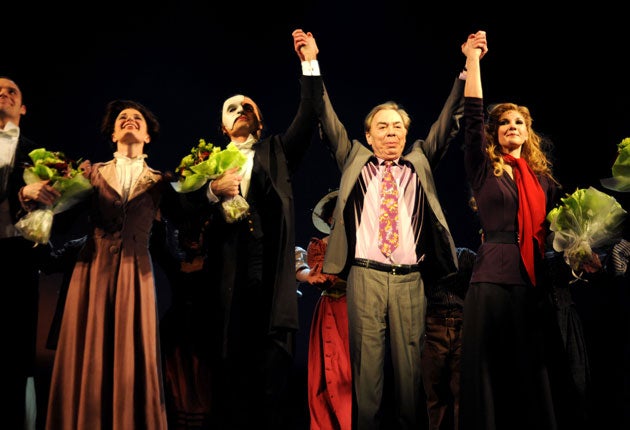
These reflections are prompted primarily by the opening of Lloyd Webber's new musical last week, Love Never Dies, which was panned even before its opening night. Bloggers dubbed it "Paint Never Dries" after seeing preview performances, branding it "dull" and "po-faced".
Some highbrow critics, on the other hand, were surprisingly flattering, one describing it as "Lloyd Webber's finest show since the original Phantom". Others roundly slated it. How much these judgements were genuine, or a result of cultural snobbery, or a conscious defiance of cultural snobbery, it's impossible to say. But it is a fact that it is very difficult to write about most forms of culture in this country without being infected by these considerations of status anxiety.
"Lloyd Webber" has become a kind of synonym for "naff". Ask yourself, dear reader, how many of your friends are big Lloyd Webber fans? Probably not many. That isn't a coincidence. Judgements about art and culture are impossible to separate from the judgement about social status.
It's a complex equation, however. For instance, the person who would not be seen dead driving a five-year-old car or wearing anything but designer clothes – let's call them "material aspirants" – might well read a Jeffrey Archer book without worrying in the slightest about whether he was a "good" writer. These materially aspirant middle classes are anxious to assert that they are no longer "povvoes" or lower middle class, but prosperous consumers. They are liable to be unselfconscious about their taste in art and literature, but highly self-conscious about their choices of interior design, clothes or car because it is from these sources, and within their peer group, that they derive status.
Then there are cultural aspirants. They are also members of an emerging middle class, but their sensitivities are about coming from a culturally, rather than materially impoverished, background. The culturally aspirant are anxious to assert that they are not – or not merely – no longer poor, but that they are no longer philistines. Culture is as much an advertisement for them as it is a source of enjoyment.
There is a third group – the genuine cultural elites who sit on boards, deal art, curate galleries and write published criticism – who are genuinely self-confident. But this is a tiny, if influential, minority. The first two groups make up the bulk of the modern middle class.
The material aspirants tend to get much more attention than the cultural aspirants, because material advance is so much simpler to measure. But there has been a huge, across-the-board change in people's taste and education in the past 20 years. People like better food, consume higher culture, read smarter newspapers. Yet they are insecure. To look wealthy is simple compared with looking cultured.
This mass cultural shift towards the desire for "educated taste" has led to historic levels of cultural insecurity. Who can doubt that many of the people who drag themselves through a Booker winner are doing it out of a sense of "self-improvement" rather than a real hunger for literature? Similarly, a significant portion of the audience sitting through any production of Krapp's Last Tape are there because it makes them feel a cut above.
Are things different abroad? It's difficult to know, but I suspect that the French and Italians, say, are far less worried about what people think of their tastes. This is partly cultural arrogance (they know they are classy while the English live in dread of their own crudity), but also blissful ignorance. Many Europeans, steeped in a superior history of painting and music, are still clear about what they mean by "art", in a way that we are not. But then, those same cultures are not necessarily up to speed where the cultural lines are more confused. Could Tracey Emin's My Bed have been created, and received such a response, by an Italian artist working in Florence? It's doubtful.
There is also an element of witlessness in European artistic self-confidence. Who has not sat in a continental café or bar listening to god-awful Europop and watched the cheery students nod along and mouth the words in a way that any self-respecting student in England, trained in intelligence and irony, would never contemplate?
Our half-informed knowingness and our cultural insecurity is not entirely a negative. It's what makes us interesting. But it's painful. And it generates battle lines everywhere. For instance, there is a lot of outrage among Vettriano fans that there isn't a single painting by their hero in any publicly funded gallery in Scotland. Can you sympathise with their anger? No? Then is their opinion worthless because you judge it to be vulgar?
This is the paradox at the heart of cultural criticism in Britain. The post-modern belief that all quantities are, in a sense, equal, and therefore democratic, is routinely paid lip service. However, ranged against that public belief is the private and institutional belief that there is such a thing as absolute Quality, and the great and the good know what it is. This is hypocrisy in action – but it's in a good way, because both points of view, in their way, make sense.
It is clear that if someone enjoys a popular cultural product such as Love Never Dies, it should be acknowledged it as a "valid choice", since they get a genuine cultural experience out of it, and it will produce authentic emotional response. It may be privately seen as cheap or vulgar, but this will not be stated, and that is how it should be. The doors of culture must be wide to allow more people in than the gatekeepers of the elite would have once allowed, yet at the same time standards must be maintained. Because, self-evidently, quality does exist. What it actually is can be open to endless debate, but it is a fact. If you want to argue that Take That are as important as Beethoven, you can do so, but no one will be really convinced, however much they construct plausible-sounding arguments around the idea.
In the machine of modern culture, hypocrisy is the most effective oil to help keep the wheels turning. The people who walked out of the opera Tamerlano at the Royal Opera House last week because Placido Domingo could not appear will be silently condemned by those who think the opera is not simply about the presence of singing celebrity. Those who walked out themselves won't care what those who condemn them think – they won't even be aware of it.
Elite critics are typically faced with obliviousness in the face of their scorn, and that's also healthy. The oblivious mass get to live out the postmodern reality (that you are entitled to like whatever you happen to like) – and the elite get to live within their absolutist reality (that there is something called "art" and they know what it is). The people who are squeezed in this equation are not the elites or the plebs but the culturally aspirant. People like me, I suppose, who grew up without books or art or theatre, and do not find a middle-class lifestyle sufficient compensation for a inherited lack of cultural information. We live always in the knowledge that our choices may be the "wrong" ones.
Which brings me to the hardest part of the article, in which I admit which parts of the first paragraph were true. There is no Capodimonte on my windowsill, no Vettriano on my wall. I think Dan Brown is more a typist than an author. But I do think Jesus Christ Superstar is one of the best musicals I have ever seen, I loved We Will Rock You, and my favourite artist really is the deeply unfashionable Salvador Dali.
Can I – as a cultural arriviste and outed vulgarian – be taken seriously? It probably doesn't matter – to you. But to people like me, people who wouldn't be seen dead at a Lloyd Webber opening, it's not Love that never dies, but Insecurity.
Join our commenting forum
Join thought-provoking conversations, follow other Independent readers and see their replies
Comments
Bookmark popover
Removed from bookmarks