Church's call for religious judges is rejected by Court of Appeal
A senior judge delivered a stinging rebuke to the former Archbishop of Canterbury yesterday as he rejected demands for Christian discrimination cases to be heard only by judges with a "proven sensitivity and understanding of religious issues".
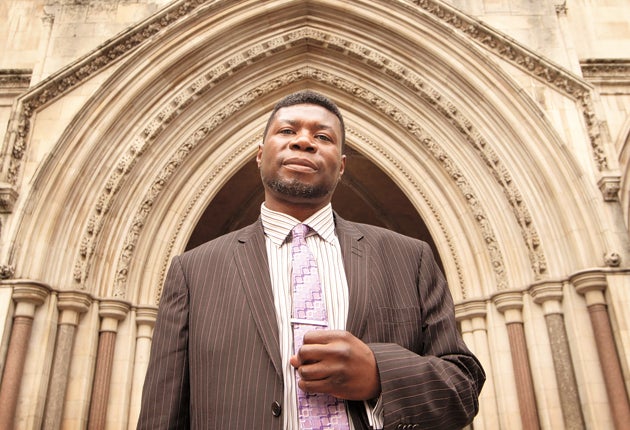
Gary McFarlane, a devoutly Christian marriage counsellor who used to work for the charity Relate, went to the Court of Appeal yesterday in an attempt to overturn his sacking two years ago after he refused to provide sexual advice for gay couples.
The 48-year-old's request, which was backed by Lord Carey, the former Archbishop of Canterbury, asked the court to consider creating a panel of five specialist judges to hear religious discrimination cases being brought the courts.
His case was bolstered by an extraordinary attack on the impartiality of the judiciary by Lord Carey, leader of the Church of England from 1991 to 2002, who wrote a letter to the court warning of "civil unrest" if judges continued to hand down what he described as "disturbing" and "dangerous" rulings in religious discrimination cases.
But yesterday Lord Justice Law rejected Lord Carey's argument describing it as "divisive, capricious and arbitrary." In his judgment, which amounted to an impassioned defence of the judiciary's ability to rule on all issues regardless of their complexity, Lord Justice Law warned that any attempt to create special religious courts would be tantamount to developing a theocracy.
"We do not live in a society where all the people share uniform religious beliefs," he said. "The precepts of any one religion – any belief system – cannot, by force of their religious origins, sound any louder in the general law than the precepts of any other.
"If they did, those out in the cold would be less than citizens, and our constitution would be on the way to a theocracy, which is of necessity autocratic."
The judgment is a major blow for a small but growing number of primarily evangelical Christians who have tried to use the courts to protect and further their rights. At the centre of many cases is the thorny issue of balancing gay rights against the rights of faith groups who believe homosexuality is wrong.
In a statement last night, Lord Carey attacked the judge's decision: "The judgment in the McFarlane case is deeply worrying and continues a trend on the part of the courts to downgrade the right of religious believers to manifest their faith in what has become a deeply unedifying collision of human rights."
Some Christian groups have grown despondent over a series of recent judgments which they think show that the court system is inherently biased against them. Two recent cases brought by employees who were ordered to remove their crucifixes were thrown out by the courts. In both instances judges decided that Christianity – unlike other religions such as Sikhism and Judaism – does not insist on believers wearing specific faith items.
Christians have, however, won a series of legal and parliamentary battles recently. Earlier this year the High Court overturned a ban on a Catholic adoption agency which refused to place children with gay couples. Unelected Anglican bishops also played a crucial role in the House of Lords' decision to reject new equality legislation, which would have made it harder for faith institutions to dismiss gay employees.
Although faith communities have become increasingly litigious in recent years, not all Christian groups are pleased to see such a high number of cases end up in the courts. Steve Clifford, general director of the Evangelical Alliance, one of the largest evangelical umbrella groups in the country, said Christians were often too willing to opt for litigation in place of dialogue.
"When Christians paint a portrait of persecution, not only do we diminish the very real suffering that our fellow believers across the world experience, but we force ourselves to the margins."
Secularists welcomed yesterday's judgement. "Fundamentalists are mounting one challenge after another in courts and Employment Tribunals," said Terry Sanderson, president of the National Secular Society. "They are trying hard to undermine the laws that protect gay people from discrimination. They are seeking a hierarchy of rights that places Christian dogma over the rights of people to fair treatment. They must not be allowed to succeed."
Join our commenting forum
Join thought-provoking conversations, follow other Independent readers and see their replies
Comments