Imran Khan: A cricketing hero with his eye on political glory
He has become Pakistan's most popular politician, but he has as many enemies as friends
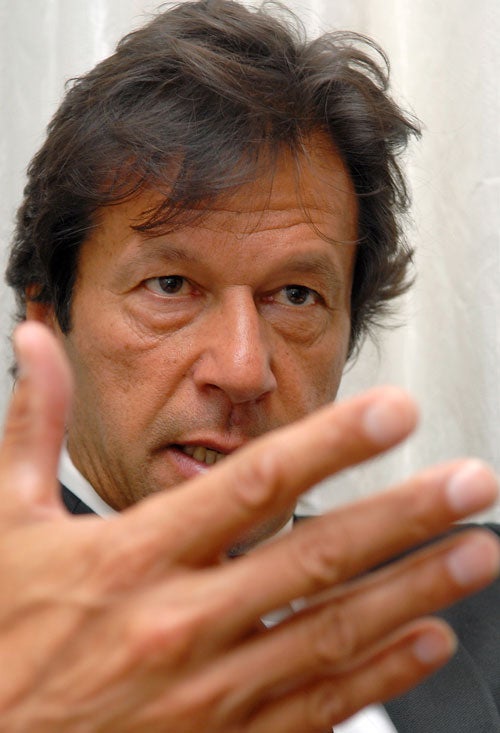
Some years ago, on a visit to London, Imran Khan was confronted about his spacious property outside Islamabad. How does it behove the former cricket legend to speak of Pakistan's poor, a student demanded to know, when he lives in "a palace"? "Don't you dare call it a palace," Khan snapped back, in mock outrage. "It's paradise."
The prized hacienda is on a hilltop. Manicured lawns sweep around the red clay-roofed, golden ochre-walled home. Inside, rooms are airy and lightly appointed. Vaulted ceilings encase a tasteful mix of stiff wooden chairs and soft white sofas.
The view, at least, is plausibly Elysian. During the day the sun splashes over the Himalayan foothills in the background, and shimmers on the nearby lake. But Khan now covets a different home. Faintly visible in the distance, down in the direction of the capital, lies the Prime Minister's residence.
"We'll win the next election," Khan insists, in characteristically self-assured tones. "There's going to be a very strong movement behind us. I can already sense it." With the prospect of elections as soon as April, he is already busy courting votes. Indeed, his "overthrow the government, save the country" campaign is agitating for a snap poll.
The optimism, he says, is not misplaced. After years in the political wilderness, a flurry of polls say the country's most popular cricketer is now its most popular politician. Last month a Pew survey showed 68 per cent of people view Khan favourably – five points ahead of his closest rival.
In the industrial town of Faisalabad last month, Imran Khan drew a mostly young crowd of some 35,000 people. The voters he's targeting are under 30, in a country where the median age is just 21. And women.
At a recent Islamabad protest, two-toned heels clattered alongside young men's trainers. "The women are watching political talk shows now," says Khan, a regular guest on cable news channels, "they're more popular than soap operas." Columnist Ayesha Tammy Haq calls it the "weak in the knees club". If Imran Khan capitalises on that, she adds, he could get half the vote.
There is a craving for change, Khan says. "Everywhere I went, people stopped me and said, 'Imran sahib, you have to save the country.'"
From the comfort of opposition, Khan rouses his crowds with angry talk of the incumbents' failure. Faced with bleak prospects, some young voters are attracted to promises to revive the economy. And in a fiercely anti-American climate, Imran Khan's nationalist pique soothes widely held feelings of wounded pride.
Yousaf Salahuddin, a childhood friend, says that is Khan's appeal. "It's still like colonial times. Our politicians believe our success lies in bowing to the Americans," he says. "Imran is different. He's not against America or Americans, but he certainly wants his country to have some sense of sovereignty or independence."
Khan also hopes to harden popular perceptions of the political class as inept, distant and venal. "This isn't a democracy, it's a kleptocracy," he alleges, indignantly. President Asif Ali Zardari and former Prime Minister Nawaz Sharif, he alleges, represent the status quo.
"These people are the same. Neither pays tax, their interests are outside, they don't want tax reforms, they don't want justice, they don't want the rule of law."
In the past, Khan's message has failed to secure votes, as traditional parties proved resilient. He recalls his first campaign, in 1997. "It was the charge of the Light Brigade," he says, smiling at his five-month-old party's seatless humiliation.
"Imran was bowled for a duck," critics irresistibly crowed. In 2002, he was the last man at the crease, winning the party's only seat. And at the last election, he never left the pavilion, boycotting the 2008 polls.
Khan likes cricket metaphors. "I always fight till the last ball," says the all-rounder who led Pakistan to its only World Cup in 1992. "When I became captain, I made the team fight. We would come back to win from impossible situations."
He tries to cast his political exertions in a similar light. "Just holding the party together," he says, "was the biggest struggle I went through in my life."
As a captain, he would lie sleepless in bed, reviewing matches for mistakes. As a politician, the only regret he concedes is siding with former military ruler General Pervez Musharraf when he ousted Sharif in a 1999 coup. "I actually believed the man was sincere," he says. Instead of ending corruption, Khan says, grasping politicians were rehabilitated. "Ali Baba was tossed to one side, and the forty thieves were back in."
Critics, however, blame him for much more. In recent years, Khan has opposed the "war on terror". While he insists it has exacted a ruinous toll on the local economy and inflamed militancy, he is accused of being soft on the Taliban. Musharraf once called him "a beardless terrorist". At protests, Khan has joined forces with the extreme right. Another criticism is that Khan is a captain with no team. He is the only figure of national recognition in his party. The others seem to view their leader with unquestioning awe. A weak batting line up will be vulnerable against entrenched local favourites, especially on trickier, rural pitches.
The latest accusation is that the umpire is partial to him. Sharif's party holds that the powerful military establishment is discreetly manipulating events in the cricketer's favour. He bristles at the charge, and recalls how "match-fixing" smoothed Sharif's first ascent to power.
"How do they explain the polls?" he demands. "Is the ISI manipulating Pew and YouGov polls, too? This the first sign of their panic setting in. The establishment may need me, but I don't need the establishment."
The party, he concedes, is popular in the army. "According to their internal poll, we have 80 per cent support," hesays, citing a private source. But the only meeting he says he had with a senior general was over six months ago. "I went to see General Pasha about terrorism only," he says, naming the head of Pakistan's ISI spy agency. "And Pasha agreed with me, that if we disengage from this war on terror, we'll be able to control the terrorism inside Pakistan."
As Prime Minister, how would he deal with an overweening army? For over half Pakistan's history, it has ruled directly. For the rest, it has cut away at civilian power backstage.
"Look at Erdogan and Turkey," Khan says admiringly. "The army was the status quo in Turkey. What happened there was a powerful, democratic government, which has roots in the people, and moral authority, put the army in its place."
Imran Khan: A short history
* Born 25 November 1952, Lahore, Pakistan
* Studied at Keble College, Oxford, where he captained the university's Blues cricket team.
* In 1992, he captained the Pakistan cricket team to its only World Cup title.
* In 1995, he married Jemima Goldsmith, the daughter of the UK billionaire Sir James Goldsmith. The couple, who have two sons, divorced in 2004.
* Since retiring from cricket, he set up a charitable cancer hospital in memory of his mother.
* In 1996, he founded Pakistan's Movement for Justice, a political party, and served as its only parliamentarian in 2002.
Join our commenting forum
Join thought-provoking conversations, follow other Independent readers and see their replies
Comments
Bookmark popover
Removed from bookmarks