James Lawton: Insatiable hunger of the Little Master sets him apart as a true cricketing great
On Sunday he was the enduring gift to cricket, a reminder that in the modern age, one great player had survived all the game's demands
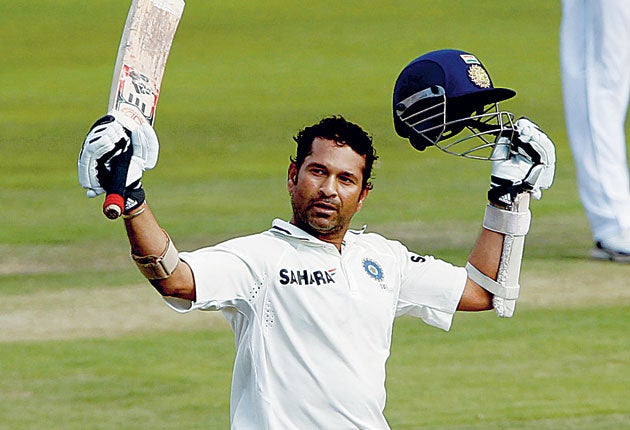
Bollywood is awash with praise for the hero of the nation, the "Little Master" or, as the Indian Air Force have it, honorary Group Captain Sachin Tendulkar, and with one inevitable and starry consequence.
Already we can make one guess at the final scene of the blockbusting movie for which some Bangalore entrepreneur is no doubt happily planning to cough up at least a large slice of the cost of Blackburn Rovers.
Anyone who saw Tendulkar reach the astonishing mark of 50 Test centuries in a brilliant but unavailing attempt to save the first Test against South Africa at Centurion can see it now: the Little Master nudges away for a single and then raises his bat and his eyes to the thunder clouds sweeping across the Veldt.
On his face is not so much a smile of triumph and satisfaction but a deeply spiritual and serene glow. It may be very Indian, very Tendulkar and very sublime but also something that surely was not so hard to share by anyone who just happened to be seeing it from the middle of an Occidental white-out.
The life and times of the Little Master haven't always been quite so filled with the most refined of glory, of course.
A few years ago the same people who now rhapsodise over his astonishing career, who point to an ultimate pillar of brilliance and consistency, were saying he had become a bad lot, inimical to the smoothly successful future of the world's No 1 Test team, a flawed comrade and a broken talent.
He ran a gauntlet of controversy. He was accused of ball tampering, self-obsession and there was a terrible row over the decision of the Indian government to waive import charges when the Fiat company handed him a Ferrari with which to enjoy moonlit drives around his native Mumbai.
Yet the Indian cricket authorities, who have not always looked like the last word in far-seeing administration, and certainly not in the matter of preserving the Test arena in which Tendulkar's gifts are most appropriately showcased, were wise enough to grasp that some men have earned the right to choose their own moments to leave the stage.
Having scored 1,539 Test runs and seven centuries at an average of 85.50 this year, and with another Test due to start on Boxing Day, Tendulkar is plainly unlikely to do this soon.
"There have been some difficult times and you can never be sure how long you are going to keep the best of your ability," he says, "but as long as I play cricket I will have the belief that I can do something. If I cannot believe that it is time to go."
He was saying pretty much the same thing 18 years ago – when he was a mere 19-year-old – after scoring a quite beautifully sculpted 165 against England at Chennai, another milestone in a year when he scored 640 Test runs at a Bradmanesque average of 91.42.
Eighteen years is a long time to remember individual strokes but those of the Little Master still glow in the memory. No stroke was beyond him. He cut, he drove, he glanced, and all of it is quite imperishable in the memory. He brought up his century with three fours in five deliveries from Devon Malcolm. England's captain Graham Gooch, the victim of a prawn curry on the eve of the Test – England were already languishing one Test down – glumly conceded that we might have been watching the future of cricket.
If it was true, there had to be infinitely worse prospects.
Afterwards, Tendulkar spoke of his gratitude for the support he had been given by his High School coach and mentor back in Mumbai, Ramakant Achrekar. "It is one thing to be given good talent," he said, "but it is no good if you do not have someone to show you how to develop it, protect it – and there is one thing I am certain about. I will always work to bring out my ability because the feeling I have today could not be bettered. It is very satisfying and exciting to play Test cricket so young and to do well."
The coach drove hard but cleverly. After hours in the nets the Little Master sometimes showed a hint of fatigue and when it happened Achrekar placed a rupee on the top of his stumps, something to be claimed by the first bowler to knock them down – or to be kept by Tendulkar if he remained unbeaten. Today, among all his trophies, there are 13 small coins.
On Sunday he was so much more than India's hero. He was the enduring gift to cricket, a reminder that in an age when we are entitled to worry about the relentless squeezing of the game's pips with endless competition stretching from Twenty20 to the Test game, at least one great player had survived all the demands.
Tendulkar's most brilliant contemporary, Brian Lara, complained bitterly about the pressures of playing the game around the world and through every year. He talked publicly of his fear of burn-out. Ricky Ponting, who is nearly two years younger and a distant second in the list of Test century-makers with a mere 39, may be whipping Australia into a fierce stand against England in the Ashes but his batting appears ruined.
Yet Tendulkar, son of a novelist and a professor, plainly has more chapters to write. The style may, necessarily, have been modified from the day of that batting vision in Chennai, the shots are more deliberate and the action a little less fluent, but it is still easy to understand why the great Bradman looked at the young Indian and saw more of himself than in any other player he had ever seen.
Before the Don died he picked his team, the one he would be happy to play in for eternity, and of the modern players only one was chosen. It was the Little Master who made the sports world stop this last weekend with another example of how it is when the greatest of players refuse to yield the best of what they have always represented.
India, like starry old Bollywood, was agog. But they were surely not on their own. This was a man operating beyond any border but the one that defines the greatest of sportsmen.
The right winner, but Beckham's BBC award was straight out of the 'X Factor'
There was reason for as much relief as celebration in the victory of AP McCoy in the BBC's Sports Personality of the Year competition.
McCoy, of course, is the worthiest of winners and it is just the way of the world that he needed to win the Grand National before 15 years of astonishing brilliance, and endurance and courage, was rewarded by a public which is bombarded by corporation hype before the making of the vote.
But what the Beeb, and those who believe that if sport is a triviality it is a magnificent one, must surely reflect on now is the cloying absurdity of much of what passes for an examination of great sports achievement.
What, for example, could we have made of a victory for second-placed Phil Taylor, an engaging enough fellow in his way and a phenomenal thrower of darts, in front of the greatest jump jockey who ever lived. There would also have been other excruciating examples of skewered values, and we could have called any number of aggrieved witnesses, not least Mark Cavendish, Amy Williams, Jessica Ennis, Lee Westwood and Graeme McDowell.
No one can dispute the warmth of feeling for David Beckham – or say that it was his fault that the BBC decided that he should receive, at the age of 35, a lifetime achievement award before a list of more appropriate candidates of quite interminable length.
It was still, however, a populist touch straight out of the X Factor file. Beckham's old manager Sir Alex Ferguson might have been a rather more divisive choice but that of course would have been quite another story.
Join our commenting forum
Join thought-provoking conversations, follow other Independent readers and see their replies
Comments