Ian Herbert: Unfashionable he may be, but Benitez offers best value to Chelsea
Talking Football: Benitez did spend a lot on transfers, but he more or less matched Wenger in recouping his outlay
New managers are like a package with the gift wrapping still on – full of the mysterious joys of the new. Used managers are like charity shop books – the small pencil mark on the inside cover revealing the full extent of the devaluation, which is considerably greater if the spine is creased. Hiring one of them doesn't feel too comfortable. Once their stock is perceived to have fallen, it is very hard to lift again.
This point emerges very clearly in a study of English football managers by Stefan Szymanski, professor of sports management at the University of Michigan, whose collaboration with Simon Kuper produced the excellent Soccernomics, three years ago. Of course, the old school frowns on the notion of applying data to the question of who might be the elite performers in sport, but that's not how many of football's thinkers view it. Ask Mike Forde, Chelsea's performance director, or John W Henry, Liverpool's principal owner. Since managers tend to be the custodians of other people's fortunes, the appliance of science doesn't seem unreasonable.
Szymanski analysed the accounts of four-fifths of English professional clubs from 1973 to 2010 and identified those managers who consistently overachieved. The statistic to look out for in these exercises is always a club's league position relative to its wage bill and Szymanski's work proves, if evidence really were required, the immense value added by Sir Alex Ferguson, Arsène Wenger, the pretty extraordinary David Moyes and Bob Paisley, who tops the list with his six league titles and three European Cups.
But the most revealing part of the study is the names it throws up of those managers, operating almost entirely out of the media realm, who consistently deliver more for their clubs than their player wage bills suggest they might. They include Steve Parkin, currently assistant to Phil Parkinson at Bradford City; Ronnie Moore, newly reinstalled at Tranmere Rovers; Martin Allen, sacked last month by Notts County. And right in there among them is Paul Sturrock, a very fine manager, as every Southend United fan will tell you, with their side sitting third in League Two, but now a charity shop case if ever there was one.
Sturrock's Premier League moment came and went even faster than the time it took Andre Villas-Boas to drop Frank Lampard. In the spring of 2004, while in the process of steering Plymouth Argyle to a second successive promotion, he was hired by Southampton to replace Gordon Strachan. He was gone 13 games and six months later, after falling out with the chairman, Rupert Lowe.
Sturrock knows that there will be no second chances now. It is two years since he disclosed that he is contending with Parkinson's disease, though he was written out of the gilded Premier League company long before that for reasons which relate most to public perception. "Most people tagged me that I'd failed in that environment," he said recently, though perhaps, as Kuper has observed, it has more to do with what in the collective British mind, the ideal football manager should be.
Looks, ethnicity, charisma, mystique and legendary playing status all help. Kuper cites Christian Gross – unknown, bald, Swiss, yet successful when he left Tottenham Hotspur – as a case in point, though Steve McClaren, whose Twente side are maintaining their Eredivisie challenge, could be forgiven a wistful nod.
And so – to the point of this story – could Rafael Benitez. The suggestion that the 51-year-old might be the next Chelsea manager was being dismissed almost as soon as it surfaced last week, as one good night for Athletic Bilbao against a moribund Manchester United was enough to see Marcelo Bielsa elevated as a contender on a back page or two: the latest wrapped-up present, to English minds.
It is rather unfashionable to extol Benitez's virtues. He's a lot less smooth than Villas-Boas or Jose Mourinho and somehow always seems to find himself having to defend his reputation in that rapid English of his. As a guest on Saturday's Football Focus, for instance, Benitez was first asked to offer his tribute to Moyes, who had just told the programme Benitez's Liverpool had had "unbelievable resources over the years". Asked if Moyes should be the next manager at Tottenham Hotspur, a role which the Spaniard could be forgiven for fancying, he faltered. "You can't do yes and no, can you?" it was put to him.
But let's forget fashionable commentary and just stick to Szymanski's assessment of Benitez, which establishes that he overachieved relative to the wages at his disposal at Liverpool and that he sits sixth in the table which measures managers' spending on wages relative to the other 91 English clubs – behind Paisley, Ferguson, Kenny Dalglish, Wenger and Sir Bobby Robson in descending order. (Sadly, an absence of accounts from Nottingham Forest keeps Brian Clough out of the study.)
Benitez did spend a lot in the transfer market, though the definitive financial analysis of Premier League managers, Paul Tomkins' book Pay As You Play, demonstrates that he more or less matched Wenger in recouping his outlay on signings, during his six years at Anfield. Overall, he lost £3.8m in the market. His early period was characterised by the struggle of his chairman, David Moores, to finance the club. He got what he wanted (Fernando Torres, Yossi Benayoun, Javier Mascherano, Lucas Leiva, Ryan Babel) in 2007, though his signings from 2008 were less successful – and because of a gathering ownership crisis he could not reinvest money from selling them.
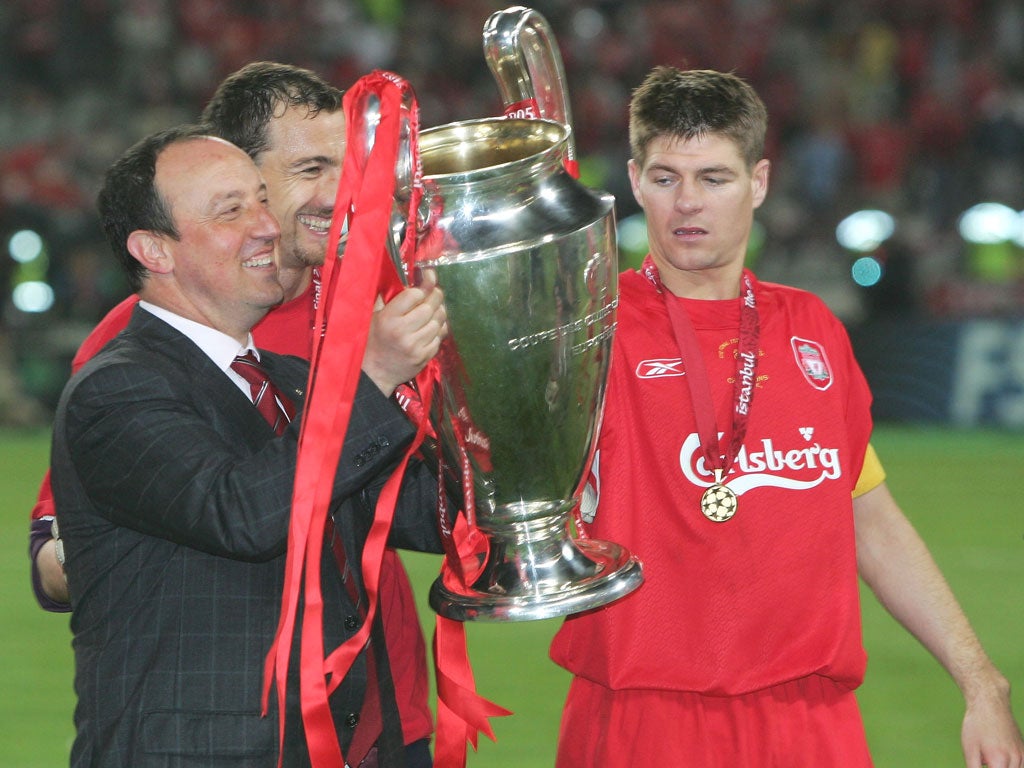
History seems to have airbrushed out the fact that Benitez, just like Villas-Boas, imbued a side that seemed to have no right to European silverware, Valencia, with the ability to win a Uefa Cup and a domestic title, and that he, unlike Mourinho, delivered a European Cup to England.
The collective memory instead seems to be of a complex man engaged in that very public war with American owners, whose proprietorship was only revealed in its full, gory entirety after he was gone. It is three years ago this week that Ferguson said of Benitez: "I would need to read more of Freud before I could understand all that went on in his head." The next day, Benitez won 4-1 at Old Trafford, with Torres operating at heights he has arguably never scaled since, and he emerged to say: "I read about Freud when I was at school and university." There is an anti-intellectual strain in football which does not take kindly to a comment like that but his numbers stack up all right. They suggest most emphatically that Benitez is not a charity shop case and that Chelsea should take a look.
Time to let go of the Suarez saga
Four years of writing about football tells me that the sport is not beset with racism and that we're far better served asking why 50 per cent of young black men are unemployed – to cite the most significant news story of the weekend – than prodding around any more at the conduct of Luis Suarez.
But I also know of two Liverpool youth workers who will tell you that one of the consequences of the Luis Suarez/Patrice Evra controversy is that some of their young black boys are no longer attending games.
This is because the saga has given the tiny minority who do like to discriminate on grounds of colour an excuse to voice their opinions at a football match. No surprise that the boys don't feel too comfortable with that.
Which is why, however indignant Glen Johnson might feel about his team-mate's treatment, those who won't let go are bringing the game into disrepute.
Join our commenting forum
Join thought-provoking conversations, follow other Independent readers and see their replies
Comments