Lehmann thanks England for lesson in tolerant living

Sign up to Miguel Delaney’s Reading the Game newsletter sent straight to your inbox for free
Sign up to Miguel’s Delaney’s free weekly newsletter
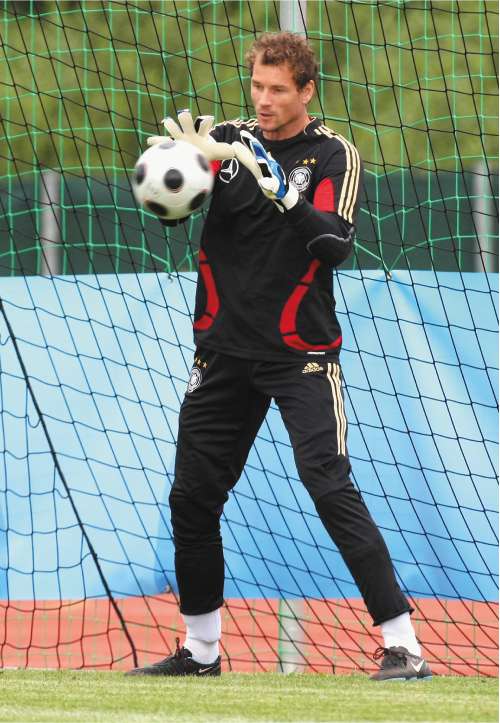
Jens Lehmann has delivered a relatively glowing account of life in England, which he gave up this week to sign for Stuttgart. The former Arsenal goalkeeper, who is now preparing to play for Germany in Euro 2008, said living in England had made him and his family more tolerant and flexible in outlook. This was despite being called "a Nazi pig" by opposition fans at away games.
Lehmann, who spent five seasons at Arsenal, his second foreign stint following a season with Milan in the late Nineties, said his family had "enjoyed our life in London very much".
In an interview with Cicero, a German political magazine, Lehmann said: "First we learnt English well. We moved three times and always had to adapt to new things.
"You become much, much more tolerant [in England]. Through the many people of different origins you get more cosmopolitan. You realise that as a German you have been accustomed to certain procedures and a way of thinking, such as everything needs to be on time and needs to work. In England it is different. If you've lived five years in London you're used to a different life.
"My children have become small Europeans," he added. "They speak English and have – due to their language skills – no problems in adapting at all. At the beginning, the best friends of my small son were Afro-Americans. You don't often have that in Germany. But in England you learn that you are a foreigner yourself and need to adapt. You approach 'so-called foreigners' much more tolerantly and unprejudiced.
"In England everything is liberalised. Within certain boundaries and rules everybody can do what he likes. Maybe London's society has a different tempo, a different dynamic. London is fast, productive, creative but it is not England. If you want to transfer that to football, you could say: in the four big English clubs and maybe in the one or two behind them there is a top level. Everything that comes after that rather mirrors English society. It's honest, fair and hard, sometimes also fast, but not always so perfect."
Lehmann observed that the English were much more flexible than Germans, but added, "that has consequences". He said: "People need to drive longer to reach their place of work or they even have to move. Old habits are abandoned for the benefit of things that are doable. That's different in Germany where there is fear of change, of globalisation. Nowhere in Europe do you feel globalisation as strong as in England.
"The English have similar angst like the Germans. The average Englishman often feels unsettled because he sees more and more – qualified – foreigners coming into the country. They take something away from him. For example, I took away the position of an English goalkeeper.
"On the other hand it's good that foreign capital has been coming into the Premier League. The TV ratings are higher, the attendance figures are bigger, the turnovers have increased. Nobody can say that the engagement of foreign investors has had negative effects."
Lehmann said he had faced anti-German abuse, but had not been upset by it. "At every away game, behind the goal, there were spectators who shouted: 'You Nazi pig'. But you must not take that too seriously. It's only very few fans who shout something like that. Basically the fans respect every player."
Lehmann played 199 matches for Arsenal, but only 13 last season. This lack of playing time has raised concerns. In a recent poll only 43 per cent of German fans thought he should be the Nationalmannschaft's goalkeeper. He still topped the poll as dissenters were divided over his main alternatives, Hannover's Robert Enke and Rene Adler, of Bayer Leverkusen.
Lehmann made mistakes in the draw with Belarus last week and many Germans expect him to prove error-prone in Euro 2008. He is nevertheless a certain starter for their opening match against Poland in Klagenfurt on Sunday.
Also likely to play is Thomas Hitzlsperger, the former Aston Villa midfielder, now at Stuttgart. The 26-year-old left Villa, after five seasons, in 2005. He was less complimentary about life in Britain. "The English drink a lot of tea – at some point even I had five cups of tea a day," he said. Hitzlsperger, whose knowledge of the NHS was probably gleaned mainly through the media, added: "Healthcare [in Britain] is a catastrophe. There are people who tear out their teeth by themselves because they can't afford to see a doctor. The state of the hospitals is awful." He also suggested, wrongly, that hospitals turn away people who cannot pay for treatment.
Of the lingering anti-German sentiment, Hitzlsperger interviewed in Schulspiegel: "That they don't like Germany is probably due to their strange historic awareness. They still think that all Germans would be Nazis. I had to fight this prejudice for a long time.
"Every now and then the supporters of the opposing team greeted me with the Hitler salute [an act which is illegal in Germany]. It happened not very often and then I tried to ignore it. What could I have done differently? I could not have stormed into the fan block and reprimanded them."
Subscribe to Independent Premium to bookmark this article
Want to bookmark your favourite articles and stories to read or reference later? Start your Independent Premium subscription today.
Join our commenting forum
Join thought-provoking conversations, follow other Independent readers and see their replies