
Sign up to Miguel Delaney’s Reading the Game newsletter sent straight to your inbox for free
Sign up to Miguel’s Delaney’s free weekly newsletter
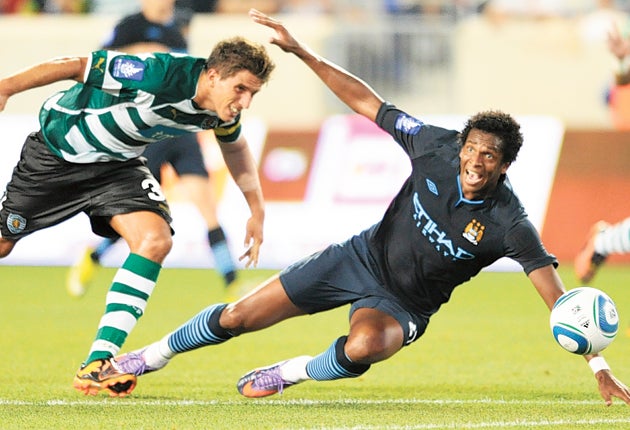
Perhaps it is fitting that Manchester City played their first pre-season match in New York; there is no city on earth more in love with ambition and dreams. It has been 30 degrees and more, hot enough for Roberto Mancini, his hair cut short, to dispense with the club scarf that accompanied the manager through every game of his first half-season at Eastlands.
By summer's end, he will have overseen the biggest spending spree of any English club, ever. David Silva, Yaya Toure, Jerome Boateng and Aleksandar Kolarov have arrived; James Milner and Mario Balotelli are coming. Landon Donovan and Ramires have been mentioned. It is impressive but to use Sir Alex Ferguson's description of Eric Cantona, the man who ended Manchester United's long trek to the championship, which, if any, is "the can-opener?"
In Roman Abramovich's first summer, seven years ago, Chelsea spent £106m on footballers ranging from the excellent – Joe Cole and Claude Makelele – to misfits like Juan Sebastian Veron and Adrian Mutu. By September, Mancini could have spent more than £130m of Abu Dhabi United's oil money. For that kind of outlay, Sheikh Mansour will expect some silverware; it took less than three years for Jack Walker to turn Blackburn into the Premier League's most improbable champions, from a starting position in the second division. Abramovich was presented with the trophy No18 months after signing his first cheque.
When Sheikh Mansour and his Abu Dhabi United group took over Manchester City, the talk was of how he would not be looking for a quick fix or a short circuit to the title, although if the banner on Old Trafford's Stretford End detailing their years without a trophy is not taken down come May, Mancini will probably be gone.
The spending of his predecessor, Mark Hughes, was recognisably organic, adding solid, mostly British talent to the mix with a strong emphasis on an academy producing young players of real promise. Then there was Robinho and the £100m bid for Kaka, which in the words of City's chief executive, Garry Cook, the Brazilian "bottled". At a lunch for northern football managers at Haydock Park, Hughes was asked that while it was obvious where Vincent Kompany, Nigel de Jong and Gareth Barry fitted in, where did the ideas for Kaka and Robinho originate? Hughes rolled his eyes.
Mancini is more of a political animal, more pliable than Hughes, less ready to bristle when the idea of a director of football – although Brian Marwood is not called that – was mentioned. Some of his spending has followed the Hughes model. Adam Johnson and Milner fit into the "best of young British" mould while Jerome Boateng is the third Hamburg footballer after De Jong and Kompany to exchange the Nordbank Arena for the City of Manchester Stadium. Mancini was deft enough to buy Boateng before a World Cup in which his performances for Germany would have pushed up his price.
It is rare, as Mancini acknowledged, for Manchester City to be offered any kind of value. Everyone knows how deep their pockets are and his recent transfer work has been to bring in footballers for the Champions' League, men whose presence makes the futures of academy products like Stephen Ireland, Nedum Onuoha and Michael Johnson suddenly look bleak. That is the price of revolution – there will be less Manchester in Manchester City.
Still, £41m on Yaya Toure, who was judged very surplus to requirements at Barcelona, and Kolarov, who has one year left on his contract at Lazio, is a lot. Balotelli is a football bungee jump, thrilling but dangerous.
Craig Bellamy can be charmless but, compared to Balotelli, he is Trevor Brooking. To spend £30m on a 19-year-old, whom his then manager at Internazionale, Jose Mourinho, rated "close to zero" after one performance against Roma, is a risk. Asked to comment on his team-mate, Dejan Stankovic replied: "What do I think of Balotelli? How much time have you got? You need to see inside his head, he is like a child."
Having had their fingers charred by Robinho, a footballer whom Pele said before his £32m move from Madrid to Manchester was mentally unstable, it seems odd to imagine City would roll the dice again. To borrow a word from their chief executive, it would be a signing with "bottle".
Perhaps the key is that Balotelli, a frequent victim of racism, who grew up in Sicily of Ghanaian parents, has never been especially loved. If he signs, City should probably not find him a house in Northenden, a rather dreary suburb near Manchester Airport, which is where they suggested Robinho should live. Earlier, Balotelli had seemed enthused by the prospect of moving to Naples, "a beautiful city with beautiful sunshine," he said. Manchester will be rather different.
The combination of Balotelli, Emmanuel Adebayor, Carlos Tevez and, in the unlikely event he stays, Bellamy, is like nitro-glycerine. Mancini's relations with Tevez and Bellamy have not always run smoothly and Manchester City's one-time captain, Richard Dunne, told Milner he might spend a fair time on Eastlands' benches. It may be a price worth paying for a league championship but the combination of millionaire footballers and too much time is a dangerous one.
Mancini may be a smoother operator than Hughes, whose unwillingness to pick up the phone to David Moyes ensured the transfer of Joleon Lescott from Everton was a bitter one, but Manchester City have managed to rile Aston Villa over the Milner transfer and annoy Mancini's former club, Inter, over the Balotelli deal, mainly because City did not say yes to the first number their president, Massimo Moratti, thought of.
They will not mind that either at Eastlands or in the Middle East. Their job is to smash up the cartel, not to cuddle up to it. As Arsène Wenger is fond of saying, men like Ferguson say nice things about you when you are no longer a threat.
Subscribe to Independent Premium to bookmark this article
Want to bookmark your favourite articles and stories to read or reference later? Start your Independent Premium subscription today.
Join our commenting forum
Join thought-provoking conversations, follow other Independent readers and see their replies