When Saturday Comes: Philosophy football
The launch of When Saturday Comes in the mid-Eighties helped give fans a bright voice in a dark age. Its intelligence is why the 'half decent' magazine has lasted 25 years, says David Stubbs
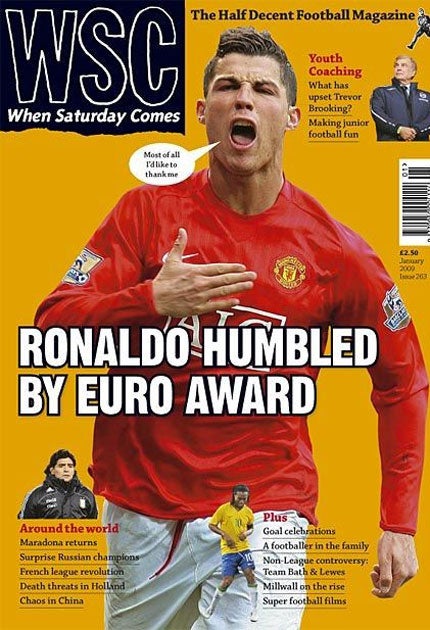
In today's super-saturated, Super Sunday climate in which football seems inescapably, blaringly dominant, it's hard to imagine the pariah status of the game back in 1986. English clubs were banned from all European competition, with Liverpool fans blamed for the Heysel stadium disaster in which 39 fans lost their lives prior to the 1985 European Cup Final (one commentator declared that with things having come to this, it was time to "let football die"). Owing to a television rights dispute, no football was broadcast at all in the first ten weeks of the 1985-86 season. ITV didn't bother reporting midweek results, considering them unnewsworthy. Racist chanting was regarded as a fact of life, while Margaret Thatcher, for whom football stadia were a nest of "enemies within", was entertaining a scheme of ID cards for supporters.
Then along came When Saturday Comes. Conceived by Mike Ticher and Andy Lyons, two record store assistants with a background in music fanzines, it aimed to give a voice to an unheard type of football supporter – the non-hooligan, non-racist fan, probably politically conscious, probably into left-field indie music, a knowledgeable and stoical, long-suffering fan who resented the notion that following football meant you were a belligerent, knuckle-scraping, train carriage-destroying bonehead.
"We were defensive about football at the time, about it being seen as law and order problem," says Andy Lyons, who still edits the magazine 25 years on. "There was a sense it was time to fight back. And it so happened that a lot of people were thinking similarly."
There was, as Lyons observes a "fanzine boom" in the mid-1980s, with each club now boasting its own alternative take on matters, from the wittier, more jaundiced fan's view. As with When Saturday Comes – the title of an Undertones song – they often took their cue from music where small labels, local scenes and 'zines arose from a need to take the thing that they loved back into their own hands, rather than passively watch the stadium dinosaurs of old. So it was in football.
The comparisons eventually break down – small clubs such as Leyton Orient and Oxford United weren't football's Clashes and Joy Divisions, languishing in the lower divisions on principle or because they played a non-commercial, more challenging style of football. Indeed, as Lyons points out: "The typical football fan's experience is low-key, downbeat, a series of disappointments." From this, coupled with the typical fan's insistence on returning for the same treatment, season in, season out, arises the rueful humour that is part of the magazine's stock-in-trade.
Yet WSC also blazed with eloquent intensity and conscientious rage at what they regarded as the neglected state of the game. Stigmatising fans was the lazy option, but as the Bradford disaster of 1985 had shown, and Hillsborough would go on to show, the real crisis facing the game was crumbling infrastructure and the bumbling indifference of the footballing authorities. Fans were not perpetrators but victims – sometimes tragically so.
Things improved after a fashion in the 1990s, when a combination of Sky money, Gazza's tears, Euro 96 and even Nick Hornby's Fever Pitch combined to make football both popular and respectable. Having initially been invited as consultants on the prototype, offbeat youth-orientated 90s TV show Standing Room Only, WSC were a touchstone for the rebirth of the football cool in that decade, which culminated in Baddiel and Skinner and the whole "Three Lions" celebratory mood.
But Lyons is rather cool about the whole "cool" thing. A meeting with a representative of IPC Magazines which might have seen them make a transfer to a big-name corporation was scuppered, he recalls, by the rep's insistence on referring to George Best as "Bestie" – so finely calibrated is the WSC sensibility. In any case, insists Lyons, "We never would have made it if we'd set out to make it a commercial venture." Lyons has no truck with football's more laddish wing, either. "We don't review hooligan books, for the same reason we don't review children's books."
What also preserves the magazine's independence is their editorial reluctance to enter into the sort of quid pro quo arrangements that guarantee access to players. "We can't do that thing of asking them about their new computer game or boots launch. We can't do things that would make us look ridiculous in the eyes of our readers." That said, the magazine has been read by thoughtful players – among those spotted perusing it have been Dennis Bergkamp and Ryan Giggs, Tony Galvin (the former Spurs man with a degree in Russian) and Pat Nevin.
WSC's content is quite unlike that of any magazine. The media blah about the latest Rooney outrage, John Terry controversy or "big club in crisis" story is coolly dispatched in an editorial or a review of the month's press. The magazines casts an eye over football globally, yielding sometimes inspirational, sometimes bizarre stories of the way the game is conducted and administered in other parts of the world, as well as examining in sympathetic detail the struggles of lower league clubs.
Another feature is "Match of The Month" where writers such as myself are packed off to cover not the obvious "big" fixtures, but to write up games such as Millwall versus Carlisle and to marvel at the grim devotion that impels a brace of fans to make a 600 mile round trip on a cold Tuesday night to see their team lose 1-0. All of this content is dotted with cartoons, spoof and retro items and a general lightness of touch which offsets any possibility of excessive nerdiness or worthiness.
WSC did not exactly thrive on the 90s football boom, which caused more anxiety than cheer to its ever-sceptical writers and readership. It survived, however, which is more than most new magazines of the era did. As Tom Davies, WSC contributor and former editor of the fanzine the Leyton Orienteers observes, "There were a lot of new, glossy football magazines in the 90s – WSC counted them in and counted them out again."
Today, the rise of football blogs provide more potential rivalry but WSC sits well with the internet. Ian King, of the 200percent website is one of many who regards it as an institution to be cherished rather than supplanted. "Its lasting influence can be seen all over the net – there are now hundreds of blogs that carry the key characteristics of the magazine." WSC has a strong web presence of its own, with a high-powered messageboard covering a range of topics including politics, music and cinema as well as football.
If there is a concern, it's that the readership is growing old with the magazine. However, while obscure allusions to ancient indie groups such as the Wedding Present might not have the same cachet with 20-something readers, they find themselves disaffected by a game that is now systematically marginalising them, with a new culture of protest coalescing around the non-league, and teams such as AFC Wimbledon and FC United, born out of that.
Moreover, as Tom Davies points out, the new bosses are the same as the old bosses. "Ken Bates was around in 1986, he's still around today. The need for WSC is as great as ever."
David Stubbs is a regular contributor to 'When Saturday Comes'
Back of the net – four great WSC moments
The opening issue manifesto
In which a new sensibility was born: "What is it about certain clubs which attracts so many players with big noses? Does anyone in football actually like Ron Saunders? These are the sort of questions I've always wanted the answer to but no publication ever tells me." – Mike Ticher
The post-Hillsborough editorial, 1989
"Complaints about safety and comfort were ignored because they were being made by supporters. Official action will be taken now, because the same points previously raised by fans are now being made by the government and the media. Their stupidity and cowardice over a long period of time allowed Hillsborough to happen."
'Power, Corruption and Pies'
The perfectly-titled anthology of WSC journalism which included contributions from Roddy Doyle, Harry Pearson, Nick Hornby and Simon Kuper, among the magazine's distinguished alumni.
'No Love, No Joy'
Taylor Parkes's now-legendary 2007 review of Tim Lovejoy's autobiography, which dominates the most-read articles section on WSC online the way Dark Side of The Moon dominated the 1970s albums charts:
"Part autobiography, part witless musing, and one more triumph for the crass stupidity rapidly replacing culture in this country. Hopelessly banal and nauseatingly self-assured, smirkingly unfunny, it's a £300 T-shirt... a YouTube clip of someone drinking their mate's vomit. Its smugness is a corollary of its vacuity."
Join our commenting forum
Join thought-provoking conversations, follow other Independent readers and see their replies
Comments