Stanley Gene: How old a man is Stan?
No one knows his age, but the Papuan great will provide a big test for England in the World Cup tomorrow. By Dave Hadfield in Townsville, Australia
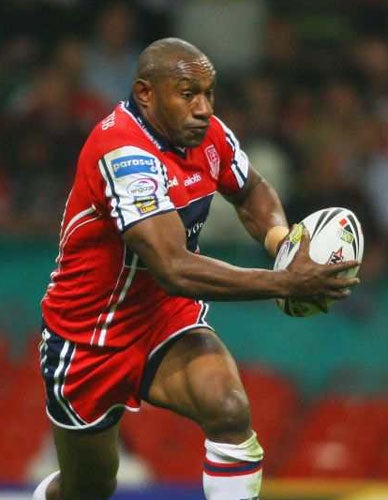
Few issues in rugby league are as guaranteed to bring on the silly season prematurely as the question of Stanley Gene's age. The apparently timeless Papua New Guinea vice-captain is in Australia for the World Cup, which begins with his country's game against England in Townsville tomorrow. And the very sight of his weathered features has been enough to trigger a type of Dutch auction in the Australian media, on the theme of "How old a man is Stan?"
Those who have played or coached against him in England, where he has plied his trade since 1996, have been queuing up to be solicited for their best guess as to his age. The former St Helens centre, Jamie Lyon, settles for "pushing 40". The one-time Castleford and Wigan coach, Stuart Raper, goes for 41. The former Leeds coach, Graham Murray, and the ex-Wigan forward, Bryan Fletcher, have raised the bidding to 45.
"He's still a good player, though," adds Fletcher. "It's like tackling a piece of titanium." They have nothing on his Wikipedia entry, however, which says he could be anywhere between 32 and 58!
All wrong, says Stanley himself. "I'm 34 – I wouldn't tell you a fib." But he has studiously avoided ever producing a birth certificate to prove it.
In fairness, there were probably few birth certificates being issued in the Goroka area of the New Guinea Highlands 34 years – or however long – ago when he was born. Instead, people just look at Gene's battered warrior features and draw their own conclusions.
"People say that PNG people look older in the face," he told Australian journalists by way of explanation. "But I seem to be playing better football every year. I'm like good red wine."
Hull Kingston Rovers, the club he first joined after coming to England for the 1995 World Cup, would agree with that. They were so keen to re-sign him for next season that they appealed for and got a special dispensation from the new restrictions on overseas players. Stanley, they argued, was an adopted Humbersider.
This is his second stint with Rovers and he has also played for Hull, Huddersfield and Bradford. Wherever he has been, he has been a firm favourite with the fans, who might not be able to pronounce his name – it should rhyme with "many" rather than come out like the gene in Gene Autry – but chant it anyway.
No other player from the one country where rugby league is the national sport has been as popular in an adopted land, not even the Kumuls' current coach, Adrian Lam, when he was at Wigan. That does not mean that there were no teething troubles in a strange country, making the transition from village life among subsistence farmers to the bustle of a European city – even Hull.
In his autobiography, Daydream Believer, published this year, Gene tells a number of stories to highlight his own naivety in an unfamiliar culture . There was the time that a Hull angling shop decided to sponsor him with state-of-the-art gear after he claimed to be a keen fisherman. He was taken to a local stretch of river, but in the excitement of the moment reverted to the techniques he knew at home and threw several hundred pounds' worth of fibreglass rod at the fish. Even more embarrassing was the time he encountered a bidet for the first time at a team-mate's house and did not quite know what it was for, but used it for what he guessed was its function.
From those unpromising beginnings, Gene has become Britain's favourite Kumul, although he goes home once a year to his village near Goroka. His own affection for England will not stop him trying to embarrass them on Saturday. PNG have been given the dubious status of makeweights in the high-powered Pool One, where they are expected to be beaten by England, New Zealand and Australia.
Anything they can do to upset those calculations will make them instant heroes at home, where normal life will stop for the games on television. Apart from Gene and his Hull KR team-mate, Makali Aizue, they have seasoned, capable players like their captain, the Salford utility back, John Wilshere, and Canberra's Neville Costigan.
Few things are straightforward in Papua New Guinea, however, with its patchwork of diverse tribes and languages."He's probably the key to our team," says coach Lam. "Not only is this his third World Cup, he's played over there for more than 10 years and has a lot of knowledge about English players. And our local players really look up to him, because he shows that this is not just about playing in a World Cup, it could be about making a whole new life for yourself."
The England coach, Tony Smith, knows that the oldest Kumul is also the most battle-hardened and potentially the biggest threat to his side. "He's just a real competitor. He can play like a prop or he can play like a half-back," says Smith, who coached him at Huddersfield. "We know what we have to expect from Stanley."
Gene himself hopes that his own worldwide experience can inspire a new generation of Papuan players, including some of those who will be on the field at Townsville and in the games against the Kiwis and the Kangaroos over the next two weeks.
"It's a really tough group – full of quality," he says. "But we know we can win games here. A lot of us had very tough upbringings in PNG and we're not scared of anyone."
Papua New Guinea: Short history of nation in love with League
* Papua New Guinea, which only became independent from Australia in 1975, has a population of six million and boasts over 850 indigenous languages – more than any other country on the planet.
* The country is joined to Indonesia and covers 178,704 square miles, roughly the size of Sweden. It is so rugged in places that planes are the only viable mode of transport.
* The capital, Port Moresby, was once voted the worst place to live out of a list of 130 world capitals.
* Sea shells are no longer the currency of Papua New Guinea, as they still were in some regions until the 1930s.
* Rugby League is regarded as Papua New Guinea's national sport. During the 2000 World Cup a TV audience of two million – a third of the population – watched the Kumuls lose to Wales in the quarter-finals.
Join our commenting forum
Join thought-provoking conversations, follow other Independent readers and see their replies
Comments
Bookmark popover
Removed from bookmarks