Evidence grows that sport is a productive path for dyslexics
Tom Lewis's show at the Open boosts the theory of a link between on-field success and the medical condition
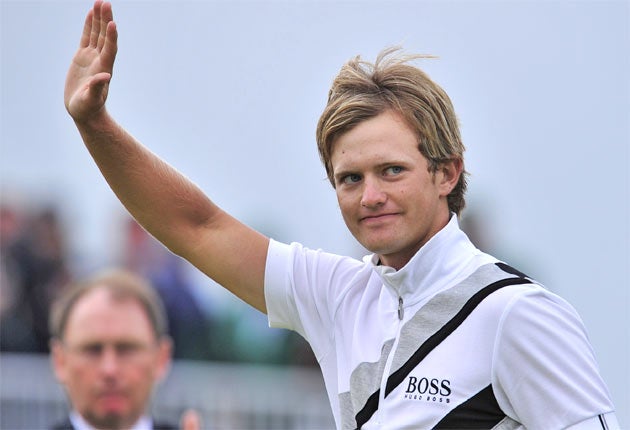
When the young amateur Tom Lewis dominated the first day of the Open at Royal St George's last week, one element of his story slipped by almost unnoticed: that he suffers from dyslexia.
In the press conference that followed his opening-round 65, the lowest round ever compiled by an amateur in the 151-year history of the Open, Lewis admitted: "I didn't really enjoy school. I was dyslexic and I did not really enjoy that side of it, so I was happy to leave when I was 16."
Dyslexia is generally described as a "learning difficulty" and a "developmental disorder", which particularly affects reading and spelling, and is thought to afflict around 10 per cent of the population.
What is perhaps less well known is the belief that there can be compensatory benefits to the condition, that dyslexics may suffer in the classroom but prosper in another environment.
Business is one area that appears to attract more than its fair share of dyslexics, such as the Virgin chairman, Sir Richard Branson. In 2007, a study by the Cass Business School in London found that 35 per cent of entrepreneurs in the US showed signs of dyslexia. Earlier this week, The Apprentice winner Tom Pellereau described having dyslexia as being a "massive positive".
There is also evidence that sport could be a productive path for many dyslexics. Some of the greatest, most talented sportsmen of their generation, maestros such as Muhammad Ali, Magic Johnson, Sir Steve Redgrave, Sir Jackie Stewart and Carl Lewis, found it hard to read the many plaudits that came their way.
First of all, sport is one area where dyslexics can compete with their classmates on the same level. Then, if they do well in a sport, the desire to excel grows as they see the benefits to their self-esteem, and subsequently gain the approval of their peers.
Stewart, whose dyslexia went undiagnosed until years after he retired as a Formula One driver, believes there is a definite link. He told The Independent: "I was labelled thick at school but sport saved my life. I could have turned to alcohol or drugs to escape the situation, but I found something I was good at.
"Having lived for years with a considerable inferiority complex, it was fantastic to be good at something. That made me so determined to be better than everyone else. There is no doubt that I committed myself to it more than the others. I had that drive and determination to prove myself. And I was also fearful of losing, because I knew very well what that felt like."
Former Scotland rugby international Kenny Logan is another leading sportsman who is happy to talk about his dyslexia. Logan said: "For me it was about feeling comfortable. Put me in a classroom and tell me I had to write an essay, I would just want to get out of there. But playing rugby was where I felt comfortable. I was told I was thick and stupid at school, that gave me a determination to prove I was worth something."
However, there is more to it than simply a desire to prove people wrong. Elite sports performers talk of having an advantage in terms of visualisation, spatial awareness, creativity and memory. They seem to have an innate "feel" for their sport, and are more likely to trust their instincts than some of their peers.
Educationalists talk about dyslexics needing to be taught a different way, and that is something that Stewart discovered during his celebrated career, in which he won 27 grands prix and three world drivers' championships.
Stewart said: "The old Nürburgring had 187 corners per lap, and I can still give you every gear change, every braking distance on each of the 187 corners. But I can't say the alphabet. I could do the same for every racetrack. I could go back the following year and within two or three laps I would be able to tell what little changes had been made here and there."
Stewart's recollection of every twist and turn is an example of a very strong visual memory, a common theme with dyslexics. Dyslexic baseball star John Buck, catcher with the Florida Marlins, can remember hundreds of different batters and their respective weaknesses, not from memorising their names but by recalling their shoes, their kit, their stance. Logan said he could remember various opponents by the way they stood or moved.
Logan said: "I saw the game differently, better than some other players. I also had this ability to try things that others didn't. I think of it as a gift and I wouldn't change it. Dyslexics are very creative people, who come up with ideas."
Fortunately for Tom Lewis, golf is also a sport where strong visual skills can be a distinct advantage. The American Ryder Cup player J B Holmes, who was diagnosed with dyslexia during his first year of university, said in 2009 that arriving at a golf course triggers an extensive bank of useful memories.
"Once I get on a golf course, I can usually remember all the holes, where they placed the pins before and where my shots went," Holmes said.
There is little scientific proof to back up the anecdotal evidence that dyslexia can be a positive advantage, but some neuroscientists believe there are indications that the brains of dyslexics may show heightened development that gives them greater creativity, and an ability to see the whole picture.
Oxford University's professor of physiology John Stein, brother of TV chef Rick, is chair of the Dyslexia Research Trust and suggests the idea that dyslexia has some positive aspects has validity. In a 2001 paper on dyslexia, he wrote: "It seems possible that great artistic, inventive, political and entrepreneurial talent may be commoner among dyslexics than might be expected."
Tom Lewis's remarkable round of 65 at the Open, and his cool confidence in talking about overtaking another son of Welwyn Garden City – Sir Nick Faldo – and his record of six major championships, hinted at great potential. Having struggled with his dyslexia for years at school, Lewis may now find his weakness can become a strength.
Famous sporting dyslexics
Football
Paul Merson Played for Arsenal, Middlesbrough, Aston Villa and Portsmouth in a professional career spanning 18 years.
Cricket
Paul Nixon Leicestershire wicketkeeper who won 19 one-day international caps for England from 2007.
Rugby Union
Kenny Logan Won 70 caps for Scotland.
Scott Quinnell Former Welsh back-row forward who featured in both League and Union, representing his country in World Cups in both codes.
Golf
Sandy Lyle Most famous for his 1988 Masters win and spent 167 weeks in the world's top 10 between 1986 and 1989.
J B Holmes American known as a big hitter with two PGA Tour wins. Played in the 2008 Ryder Cup.
Athletics
Carl Lewis Won nine Olympic gold medals and was recently elected to the New Jersey Senate.
Bruce Jenner American gold medal-winning decathlete.
Formula One
Sir Jackie Stewart Won the world drivers' championship on three occasions.
Johnny Herbert Competed in Formula One between 1989 and 2000, winning three races including British GP.
Boxing
Muhammad Ali Three-times world heavyweight champion, considered by many as the greatest sportsman of all time.
Swimming
Duncan Goodhew British Olympic gold medal winner.
Basketball
Magic Johnson Highly decorated American player.
Diving
Greg Louganis Olympic gold medal-winning diver and HIV awareness advocate.
Rowing
Sir Steve Redgrave Olympic hero who won a gold medal at five consecutive Games; he also won three Commonwealth golds and nine World Championships.
Join our commenting forum
Join thought-provoking conversations, follow other Independent readers and see their replies
Comments
Bookmark popover
Removed from bookmarks