James Lawton: Ballesteros finally finds degree of peace in serenity's embrace
Some feared he would never live with the idea that his glory had passed beyond recall
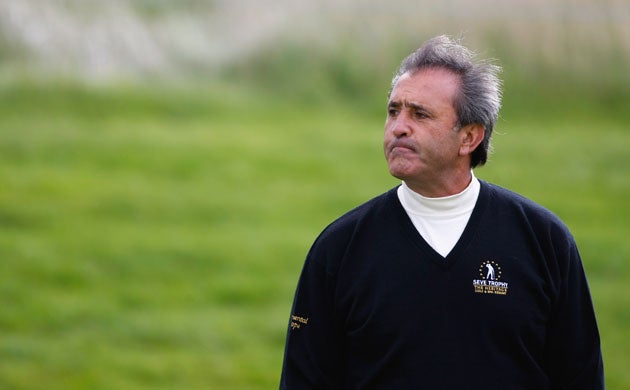
It is a little strange but also moving in that way you sometimes cannot quite pinpoint when Seve Ballesteros speaks of serenity from the La Paz hospital in Madrid.
Certainly he seems to have found a degree of it, along with the courage that always marked him out as one of the world's great sportsmen, as he faces up to the discovery that he is now beset by a brain tumour.
It is touching because if all the millions, who will never forget the joy and anticipation he brought to them as he strode over the brow of a fairway like some latter-day conquistador, could over the last decade or so have offered him one gift by way of repayment, it would have been precisely that of serenity. Not serenity to fight the kind of health problem that can ambush any of us any day, any hour, but the decline of sunlight and confidence which came when a game donated to him by the gods was suddenly withdrawn.
The serenity, maybe most of all, to accept that some battles have to be ceded, some cards surrendered, because to do otherwise risks not only your defeat but your destruction. That shocking abridgement of his capacity to play golf beyond any earthly norm, flair that was so wildly innovative and instinctive it was often surreal, began not much less than 20 years ago and at times it has been terrible to see.
Sometimes, frankly, so terrible that not only the overly sensitive were obliged to avert their eyes.
That is what Ballesteros's former wife, and mother of his three children, Carmen, did near the second tee at Augusta in 1997. By then the demons that had started their encroachment on his spirit soon after his last glorious statement of genius anarchy at Lytham in 1988, when he won the last of his five majors with shots from some of the most unlikeliest places on the course, were so rampant he seemed utterly at the mercy of a group of jeering rednecks.
It was when Ballesteros hooked his drive and the hoots of derision came in that Carmen turned away and if her body language had contained any more despair she would not only have closed her eyes but also shielded her ears.
For the longest time Ballesteros believed he could rise above the torment of backache and find again the kind of golf which knew no bounds. When, at the age of 50, he finally accepted that it would be forever elusive, and gave a farewell press conference at Carnoustie last year, the pain that came with the knowledge that he could no longer conjure enough optimism to step up to a golf tee at any other time than the dead of night, was surely relieved by the fact that the kind of suffering he endured in places like Augusta, where he became the youngest player to win a Green Jacket in pre-Tiger days, had come to an end.
For a while, on quiet days at a major you would wander off into some corner of the course to see how he was doing. Almost invariably, it was a foolhardy exercise. Sometimes there was a flash of the old brilliance, a shot from the rough which defied most of the laws of geometry and sometimes also gravity, and it would be accompanied by an old gleam in his eye. But then that was probably the time to leave him because at the end of the round the numbers on the board would tell, you knew it in your bones, of new disasters.
Once, early in the process, I asked him whether he had considered taking a break from the game. His form was wretched but his last major title was just a few years old. Perhaps, given his intensity and the pressure he had been absorbing since he had first emerged as a fierce and precocious Spanish national hero, he might benefit from a period of reflection, a certain sniffing of the roses of the Iberian winter. Ballesteros was appalled. "What are you saying?" he demanded to know, and, then, "Are you saying I can no longer play."
No one was saying that, of course – for who could have generated such temerity? – but then you wondered if the blazing eyes and the tormented expression were not suggesting that we were at the dawn of a legitimate question. Such speculation became reality soon enough, and there was perhaps something even worse. It was the idea that Ballesteros might not ever live comfortably with the thought that his glory, like that belonging to every great performer, had passed beyond recall – that his life, irretrievably, had become a bone-yard of spent exhilaration.
Yet in the crisis that has come to him these last few days, there has been at least a hint of a more philosophical and composed Ballesteros. The flood of affection that has poured into the hospital from all over the world has plainly been of comfort, reminded him, if he had forgotten somewhat in the darkest days of his divorce and the death of a girlfriend and the accumulated angst that life can bring in less dramatic circumstances, that he had indeed touched so many hearts with his extraordinary talent and, not least, his competitive cojones.
"I have always sympathised with those people who face illnesses. Therefore, I want to remind them that with bravery, faith, serenity, confidence and a lot of mental strength, we have to face any situation, no matter how difficult it is," he said.
Maybe it remains only to pray that this proves more than a noble epitaph to one of the most engaging, and thrilling, sportsmen who ever lived. Seve Ballesteros, at the worst of times, has always been full of life. Serenity? Perhaps not so much, but for this he has, no doubt, reached into the bag at precisely the right time.
Hamilton must look closer to home in search for answers
Lewis Hamilton wondered aloud what he could say before fairly brusquely dismissing what really amounted to another one of those disturbingly frequent days which might be categorised as disastrous visits to the office.
Though his world title lead has been shaved to five points, he is still plainly equipped to land the world drivers' title that he allowed to slip away in his first sensational season. But most worrying is that the great performers would not have speculated on how they might explain a raw and distinctly sub-par performance. They would have been rather harder on themselves, especially in view of the fact that they had been plainly equipped with the best and fastest car.
Hamilton has phenomenal talent but for all of it to be developed and properly rewarded he clearly needs to hone a few of the qualities that helped to make legends of men like Juan Manuel Fangio and Stirling Moss, Ayrton Senna, Jackie Stewart and Michael Schumacher. He has to be a lot less forgiving, not so much of unjust officials and unscrupulous rivals but, more than anyone, himself.
What more could he say? Sorry might have been the place to start.
The pain of a hero's departure
It was only by chance that while removing the weekend mountain of newsprint I was overcome with the fierce pain that comes when you learn that the first of your heroes has gone. The news shouted out from the obituary pages of Saturday's Independent.
So Harry Bath was dead. He played rugby league for my father's hometown team of Warrington in the Fifties. He was an indestructible forward who had a surprising delicacy of touch and kicked goals as though they were so many precisely launched mortar shells. He was an Australian who for a time owned, along with his compatriot, the legendary wing Brian Bevan, a substantial part of what used to be known as South Lancashire. When he kept a pub for a while, before returning to Australia to prove himself a coach of great insight and toughness, I was taken there for a glass of lemonade and the unmatchable glory of being in the same room as my hero for a minute or so.
He retired from coaching a long time ago, complaining of a dwindling of skill and the fact that so many stars had become robots. He was almost as wide as he was tall, which only partly explains why for some of us the world has seemed a much smaller place these last few days.
Join our commenting forum
Join thought-provoking conversations, follow other Independent readers and see their replies
Comments