Olympic canoeing: Our man has never been so out of his depth
Robin Scott-Elliot took the plunge to test the London 2012 canoeing venue that's already open to the public. But did he sink or swim?
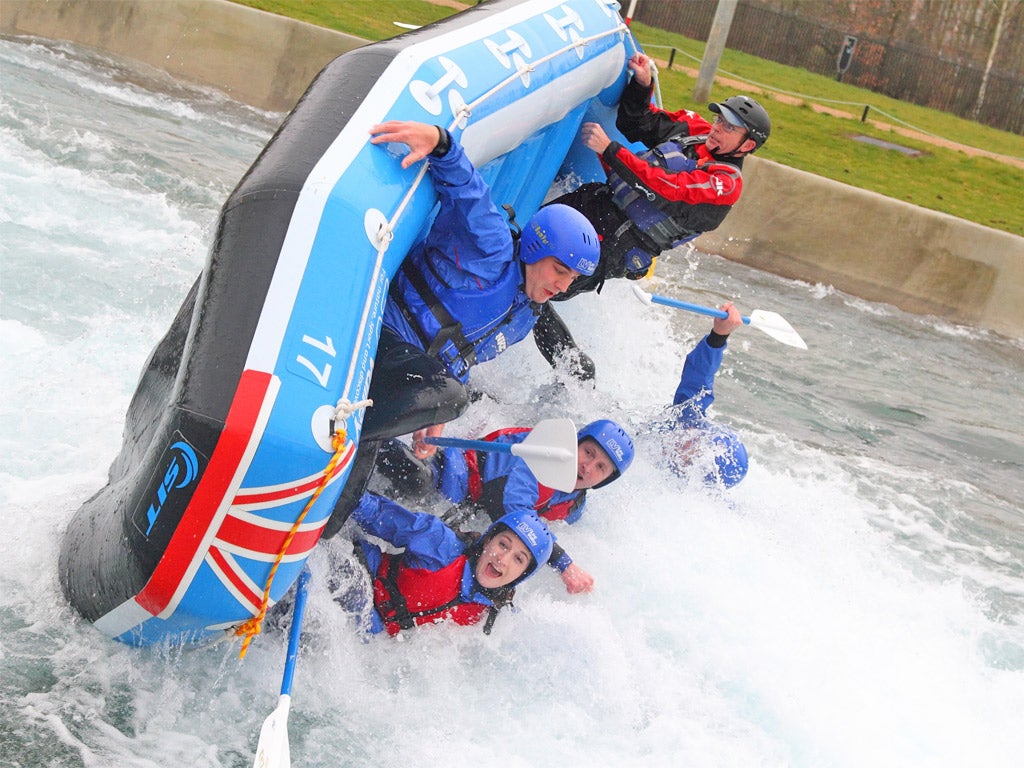
"It's a tough course," says Campbell Walsh. The Scot is a double Olympian, winner of a canoeing silver medal in Athens eight years ago. He casts a practised eye out of the window towards where a pool stirred only by gentle eddies offers no indication of the watery chaos that lies beyond its mouth. An angry winter sky squats over the Lee Valley on the edge of London. "Did you go in?"
I did. Right in, wrong way up. It was the wet thud of the raft dropping on my helmet that forcefully suggested the right way up. For a moment there had been nothing but swirling white water, bitter enough to snatch the breath away, and a gnawing panic, before the raft – the novice cannot be trusted in a canoe – was swept on and I careered into one of the concrete blocks that jut into the man-made waterway and clambered out. Fifteen cubic metres per second rage down the 300m course, enough to fill, appropriately enough, an Olympic-sized swimming pool every minute.
"To navigate from the top to the bottom if you're experienced is not a big deal," says Walsh, "but in terms of slalom, where you are trying to be precise and every second matters then it's powerful water and very continuous."
As per the Olympic motto, each Games has levered the benchmark in Walsh's sport that bit higher and the course, created at a cost of £31m a few miles to the north of London, has already earned global plaudits. "Beijing was a tough course," says Walsh, "but one of the good things about here is the water flow is more consistent. It does not have unexpected surges – in Beijing two of the most powerful stages were really inconsistent. You could get knocked off line and it was not your fault. There were a lot of complaints. This is challenging but there is no section that is unfair."
Since last March, Walsh, who comes from Bridge of Allan, the small Scottish town where Terry Butcher made his home when he moved north, and the rest of the British team have been based at Lee Valley. Walsh now lives less than a mile from the facility in Waltham Abbey having relocated from Nottingham, the previous base for British paddle sports.
The team train twice a day, six days a week. In between, the centre is open to the public, the only Olympic venue that already allows anybody (provided you can shoehorn yourself into a wetsuit – extra thick at this time of year) to have a go over the very route the elite athletes themselves career down. There is a secondary, more gentle, course too, built with the future in mind. There, the plan is, the next generation can be reared, with ages eight and upwards taking to the water.
Come Games time, temporary stands will hold 12,000 spectators for five days of competition but the first key date comes in April when the British trials take place. There is one place in each category – the men's canoe single and double and the men's and women's kayak. Mess up in the trials and any Olympic hopes are consigned to a watery grave. "I want to make sure I'm there," says Walsh, who has since joined David Florence, another Scot and a canoeing silver medallist in Beijing, in Australia for warm-weather training.
There was no warmth in the valley last week. The support staff were swaddled in jackets as they dotted the banks filming their charges. In between runs, the athletes waited their turn in the pool at the top of the course bobbing easily in their canoes like aquatic minotaurs. In Beijing, the Chinese jealously guarded their course, with access for visitors restricted until the immediate build-up to the Games. Lee Valley has proved more accommodating and teams from Poland, Australia and Slovenia have already visited, and been impressed. More will follow but, the odd week in Australia aside, the day-to-day experiences of being at home will aid Team GB come Games time. "Practising on the water on a daily basis makes a big difference," says Walsh. "It helps you get into tune with the features."
It takes little more than a minute or so to head straight from top to bottom; the canoeists take longer, having to zig-zag from gate to gate, some of which require them to come up water. The concrete blocks are secured to rails so can be extended from the banks to alter the course – the exact Olympic course will not be set until the start of competition. Sudden drops of varying height to each section create watery traps and it was into one of these I tumbled.
"One after the other there is something trying to knock you offline all the way," says Walsh. "It's technically and physically challenging, and as you get more fatigued it gets more technically harder towards the bottom end." That is if you reach the bottom end.
Join our commenting forum
Join thought-provoking conversations, follow other Independent readers and see their replies
Comments