On the brink of historic change, but will China see the light?
James Lawton on a momentous day for Beijing - and the world
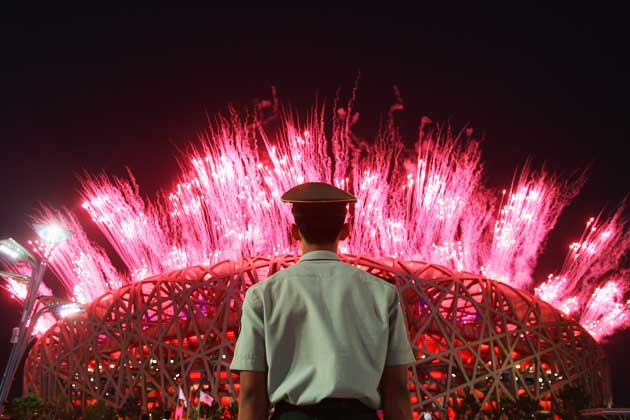
China, the nation that invented fireworks, will today write in the smoggy sky above this ancient city an extraordinary statement of belief in its future – and its defiance of an ever-increasing tide of international criticism.
There will never have been such a show – or such dramatic symbolism – when the 29th summer Olympics opens in the futuristic "Bird's Nest" stadium. With another batch of protesters cleared away from Tiananmen Square, and the United States President and arch critic, George Bush, one of 80 watching heads of state, the button will be pressed on the ultimate pyrotechnic spectacular.
Traditionally, the details of an Olympic opening ceremony are guarded to protect its potential impact and the Chinese have been no exception. However, glimpses of early-morning planning in the deserted streets of the small hours indicate the city will be swept from north to south, from the stadium, through the Forbidden City and Tiananmen Square, by giant formations of brightly coloured dragons. In their path, it is being said by many Chinese and some foreigners most closely involved with the breathtaking economic and social developments of the past decade, will be the old Beijing of the huddled Hu Tongs – alley ways – and the old China. The symbolism, at the estimated cost of £50m of the £20bn Olympic investment, they say is pure Chinese.
It is as though the nation which for so long resented its exclusion from the councils of the world, and centuries of foreign exploitation, is saying that what we will see is not so much the opening of another Olympics but the marking of a new world – one in which China, like that other superpower, America, will just have to be taken on its own terms, whatever the misgivings of foreigners.
Wang Jie, a 26-year-old painter, sat yesterday in a park near Tiananmen Square, which was recently fashioned on the site of a maze of Hu Tongs, which once housed thousands of people, and said: "We are proud to hold the Olympics and we are looking forward to them, but we do not feel we have to please anyone ... or explain ourselves. We have our own business, like the rest of the world, and will do it.
"Maybe the world has a quaint picture of the old China but we want progress. Hu Tongs might look nice on a picture but they are not nice to live in. They are hovels. We want better houses, better buildings, and a better future and this has nothing to do with the Olympics."
It is a view confirmed by Rory McGowan, the 44-year-old Irishman who has played a key role in building the new skyline of Beijing. Mr McGowan, a structural engineer and design leader in the construction of the "Bird's Nest" stadium, the Olympic Aquatic Centre, which this week won a rave reaction from the world's best swimmer, the American Michael Phelps, the stunning Central Chinese Television (CCTV) tower and the new airport, said: "What people don't seem to understand is that so much of what they see out there really hasn't got that much to do with the Olympics.
"The Olympics merely provided an immutable deadline for some of the infrastructure that was needed to keep pace with other developments. It has to be remembered that no country in history has ever undergone the changes that this one is now dealing with.
"In the next 20 years between 200 and 300 million Chinese will move from the countryside to cities, many of them newly developed. There was never for a second a question that China would take on the Olympics without being sure of what they were doing. The Olympics may be costing around £20bn, but it is just a fraction of the cost of what is happening around the city and the country." Mr McGowan, who has been in Beijing for five years as the East Asia director of the London-based Arup organisation – which was also involved in the building of the Sydney Opera House, the Pompidou Centre, Hong Kong and Tokyo international airports and the London Eye – is currently involved in the planning of a new city on the island of Dontang a few miles across the estuary from Shanghai – site of Expo 2010.
"The Chinese are looking for world-class models for the urbanisation which is going to be vast in the next few years. A causeway is being built for Dontang and the anticipated population is around 1.5 million. There are four more model cities, each with a population of a million, at the planning stage. Yes, there are human rights issues in this country but the Chinese are saying, 'this is our business and we'll sort it out', especially in respect of Tibet.
"For most Chinese, Tibet is simply a non-issue. Maybe down the line there will be a settlement, something like home rule, but even the Tibetans, I gather from journalist friends who went up there, are saying, 'look, clear out, we'll deal with it ourselves'.
"The Chinese are now obsessed with the future – and they do realise they have some massive issues like the movement of population, the environment, economic development – there is so much to do, they feel, that if you mention Tibet it is almost like asking them where they are going to put the sofa."
Where they are going to put their people, and their resources, is, though, not a perfect consensus.
Hang Zhao, Mr McGowan's young personal assistant, says she will probably enjoy the excitement of the Olympics but she is not sure that the cost of them could not have been put to better use. The daughter of an army man who lost his privileges after the convulsion of the Counter Revolution in the Eighties, she also worries about the loss of traditional values. "I can see a lot of Old China disappearing and I don't really want to see that. So many people were moved to make way for the Olympics and the old Hu Tongs are in danger of disappearing."
Her boss makes the point that though certainly there was a lot of disruption of old communities in Beijing at the approach of the Olympics, most of it was inevitable and would have happened anyway. "Perhaps a million people have moved in recent years, but only a fraction was a result of the Olympics." He lives in a Hu Tong area near the centre of Beijing and employs an ayi, the Chinese term for a nanny.
"Obviously you do not want to see a culture disappear and I would be very disappointed if that happened. There are so many different views here, and many feel like Hang Zhao that the money could have been better spent on something other than the Olympics but it is not always as simple as adding A plus B. I think China did realise it had to clean up its image... and it also knows that a successful Olympics could do a lot to change perceptions of the country – and affect attitudes about buying Chinese goods.
"I believe the Chinese have been very clever. They know the value of psychology and there is no doubt that the Olympics can be important in how a lot of the people here think of themselves.
"I'm very proud of the CCTV building," he says. It stands huge in the smog-smudged sunshine just across Beijing's Third Ringway from his 30th floor office. "When I look at it I believe it is facing the future of China – not its past.
"In the Nineties we were all a little in awe of the Japanese and a lot of people wanted to copy them. Well, I have to say that in engineering the Chinese are better able to absorb the demands of advanced work.
"In fact I think in the near future in places like London there are going to be a lot of signs saying things like National Engineering Company of China."
Meanwhile, as the sportsmen and women of the world parade in the "Bird's Nest" stadium, and the flags of all the nations unfurl, the Chinese masters of the fireworks prepare to light £50m worth of blue touch paper. They are confident they will light up the world. Their world, that is – the one which now, and perhaps for some time to come, is the only one that really matters.
Join our commenting forum
Join thought-provoking conversations, follow other Independent readers and see their replies
Comments
Bookmark popover
Removed from bookmarks