Tanni Grey-Thompson: Paragon of the Paralympics
For this supreme athlete, champion of the disabled and life peer, London 2012 is a chance to make her voice heard – and change people's lives

Sign up to our free sport newsletter for all the latest news on everything from cycling to boxing
Sign up to our free sport email for all the latest news
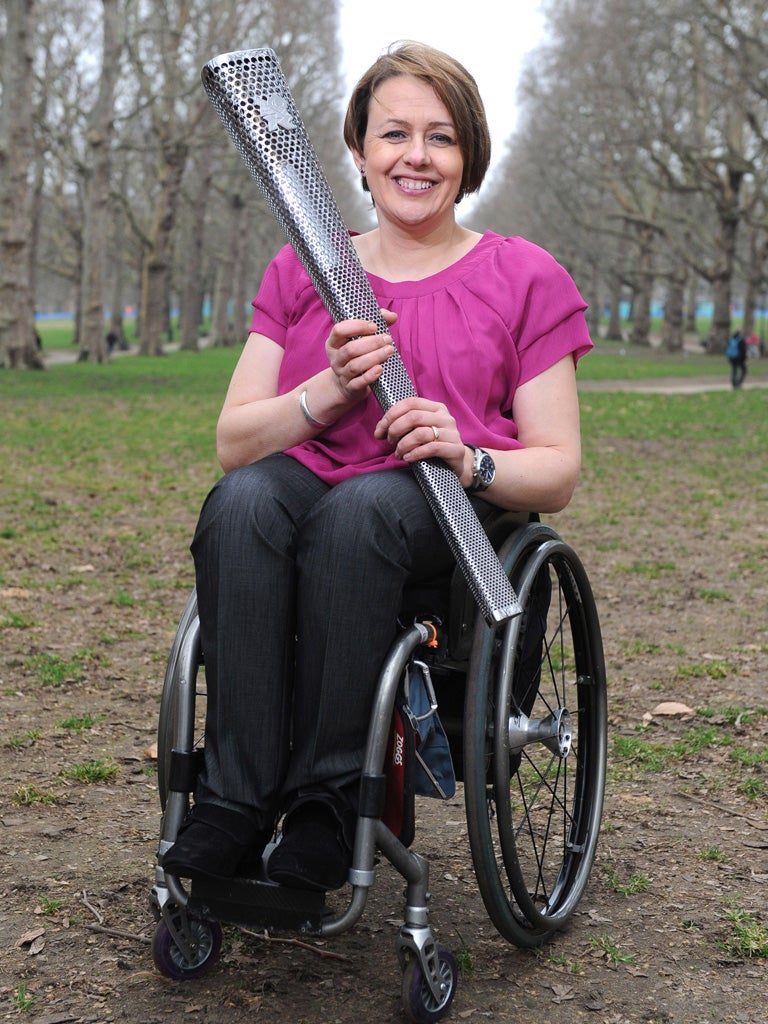
There is no greater champion of the Paralympic movement than Dame Tanni Grey-Thompson, nor is there a more articulate spokesperson for the rights of disabled people. In an uncomplicated world, these two compartments of her life would exist in perfect harmony. That they now cannot is largely a consequence of this week's announcement that the Paralympics are to be generously sponsored by the IT services multinational Atos, reportedly to the tune of $100m.
Grey-Thompson, 11 times a gold medallist and unequivocally Britain's greatest as well as our most famous Paralympian, ought to be cock-a-hoop. As she well knows, the International Paralympics Committee has struggled to find a corporate sponsor for its showpiece Games, and $100m, albeit over 10 years, is a landscape-changing sum. And yet, to many disabled people in Britain, Atos is the most offensive of four-letter words. Its healthcare arm in the UK, under contract to the Department for Work and Pensions, oversees the controversial "work capability" tests for people claiming incapacity benefits, thousands of whom have already had their state aid withdrawn. Two of the more good-humoured of the online responses to the news suggested that maybe the Olympics should now be sponsored by Black September terrorists, and the Eurovision Song Contest by the Taliban.
As for Grey-Thompson, she warned a week ago, without mentioning the four-letter A-word, that disability benefit cuts would undermine the loudly proclaimed legacy of the Games, which is to facilitate greater access to sport for disabled people. It is a legacy that she herself has said should be as durable as concrete, and yet there will, it seems, be cracks in it from the start.
She pointed out that disability living allowance (DLA) had been crucial in enabling her and many other disabled athletes to compete, and that the cutbacks, part of the Government's welfare reforms, would inevitably affect Paralympians "who have higher living costs as a result of their impairment". Britain's greatest Paralympian added that the leading disabled athletes might get financial help from sponsors if they lost their benefits, but many others would find it difficult to compete. "I know someone who is on the edge of qualification who has had her DLA removed," she said. "It impacts on her ability to get involved in society, not just sport."
This was a characteristic show of empathy, yet Grey-Thompson's own involvement in society could hardly be fuller. She was made a dame in 2005 but raised to the peerage in March 2010, and has since been a notably vigorous crossbench member of the House of Lords. She sits on more committees, and is patron of more charities, than she would shake a stick at, if only she had time for stick-shaking.
She was born in Cardiff on 26 July 1969, with spina bifida, to Peter Grey, an architect, and his wife Sulwen. Her given name was Carys, but as a baby she was so small that her older sister Sian called her Tiny, which evolved into Tanni. Now her own 10-year-old daughter is called Carys. A daughter, a husband (research chemist Ian Thompson) and a seat in the House of Lords were not, to put it mildly, part of the future predicted for her in 1970s Cardiff. Even as a young girl, she realised that expectations were adjusted downwards when people talked of what she might achieve in life.
Those people, however, did not include her parents. She says now that her first experience of what politics could achieve came when her father used the 1981 White Paper on education to get her into a mainstream secondary school. Peter Grey was determined that his daughter, largely wheelchair- bound from the age of seven, would not be presented with limited horizons. They certainly did not share the view that she would never marry; indeed, the early funding of her athletics career came from the money they had saved for her wedding.
It was watching the wheelchair race in an early London Marathon that made her yearn to have a go, and she duly joined an athletics club in Bridgend. But she and the other wheelchair racers had to improvise, using the ramps at a nearby multi-storey car park to do sprint training. "The girls who were on their break would be the spotters, to ensure that any car user who dared to use our car park didn't get in our way," she later recalled.
The road from that car park would lead to the Paralympic Games, although her achievements there began modestly, with a bronze medal in the 400m at Seoul, in 1988. By the time she won the 400m at Athens in 2004, having earlier in those Games also won the 100m, she had 11 golds and five silvers to go with that solitary bronze.
The Paralympic movement had started as early as 1960 but took years to make encouraging strides: in 1980, the Soviet organisers refused even to hold a Paralympic Games, insisting that there were no disabled people in Moscow, and even in 1988 the media coverage was more than a little patronising.
The watershed was the 1992 Games in Barcelona. Tickets for the Paralympics were so much cheaper than for the Olympics that the Catalan spectators, eager simply to indulge their passion for sporting contests, packed the arenas. And as respect for the Paralympics grew, so the condescension, with which all disabled people are familiar, receded. Yet it has never disappeared.
"I've learnt to deal with the people who think I'm brave and marvellous," Grey-Thompson once told me, "but I also get told that if I believed in God I would be able to walk again, or that I'll be able to walk if I eat red kidney beans stewed with pineapple. Then there are those who think I can walk if I really, really try. And in the early years, I was often asked whether I trained. Er, yes, I do. I try not to bite people's heads off, though. There is a need for hard political campaigning but there's also a need for a softer edge, and I try to be the softer edge. People still say to me that Linford Christie wouldn't have done the 100m and the marathon. Well, no, he wouldn't. He's a runner. We're much more like cyclists, because our weight is supported through the chair like guys on bikes, and actually those guys would do an hour road race as well as the Tour de France."
Tanni Grey-Thompson competed for the last time as a wheelchair athlete five years ago this month, carrying into retirement a collection of honours, medals and records that made her friend Sir Steve Redgrave look like an under-achiever. That she never won the BBC Sports Personality of the Year award remains almost as much of a scandal as the fact that the year she came third, 2000, there was no ramp in place for her to ascend the stage. Not that she fumed with indignation, as so many viewers did on her behalf. Typically, she just thought it was funny.
She knew it was time to stop competing when she watched the 2007 London Marathon – in which she had competed 16 times, and won six times – and felt no urge to be on the starting line. But her competitive spirit endures, compounded now by a powerful sense of what is right. "I set out in a purely selfish way," she has said of her athletics career, "wanting to do only what was right for me, then somewhere along the way I realised I could help others as well. It annoyed me to see kids fighting for the same things I had fought for, like kit that fits."
It will be intriguing to see whether this remarkable woman now goes into battle against the main sponsor of her beloved Paralympic Games.
A Life In Brief
Born: Carys Davina Grey, 26 July 1969, Cardiff, Wales.
Family: Daughter of architect Peter Grey and mother Sulwen. Married to Ian Thompson since 1999, with whom she has a daughter, Carys.
Education: Graduated from Loughborough University in 1991 with a BA in politics and social affairs.
Career: Won her first Paralympic medal (400m bronze) in 1988 in Seoul. Has since won 11 gold medals and four silver at the Paralympics, set 30 world records and won six London Marathons. She is director of UK Athletics and was appointed to the House of Lords in 2010.
She says: "I don't expect to be swept into first class and treated better than everyone else. I expect to have the same experience, and that is often just not the case."
They say: "She has come to symbolise Paralympic sport at its very best." Richard Caborn, former minister for sport
Subscribe to Independent Premium to bookmark this article
Want to bookmark your favourite articles and stories to read or reference later? Start your Independent Premium subscription today.
Join our commenting forum
Join thought-provoking conversations, follow other Independent readers and see their replies