Team GB: Every stone turned in search of the missing one per cent
From cutting-edge training to toilet hygiene, Team GB's preparations leave nothing to chance. Robin Scott-Elliot reports
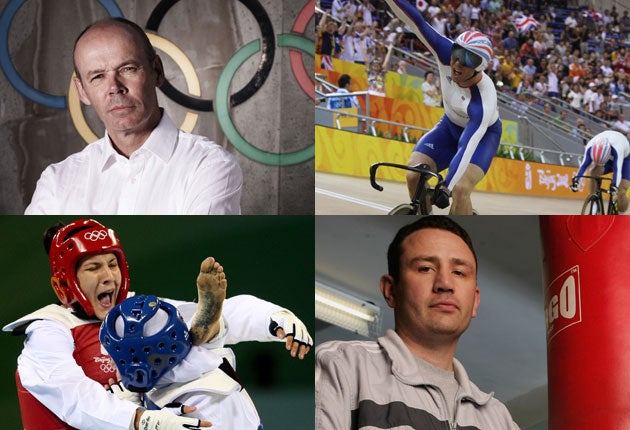
It's what Sir Clive Woodward likes to call "the one percenters". Lord Moynihan, chairman of the British Olympic Association, takes it even further. It's the "0.545 mindset" – the margin that separated five gold medals from five silvers in Athens 2004. They are talking about the same thing; the increasingly slender difference between success and failure at the Olympic Games.
Three years ago Team GB surprised themselves, and the rest of the sporting world, by finishing fourth in the medal table at Beijing, their best performance since 1924. Fourth was supposed to be the aim on home turf four years later and that success ahead of schedule has upped expectation for London's Games, now little over a year away. Fourth remains the target – China, the US and Russia are out of reach – but with a total of more medals across more sports than the 47 from 11 four years ago.
To achieve that the BOA, together with UK Sport, the English Institute of Sport (EIS) and the various governing bodies, have developed an exhaustive programme to ensure the British athletes who will pull on the Stella McCartney-designed kit – "they will look fantastic and feel fantastic," enthuses one BOA official – have every possible edge. "It is the one percenters that make a difference to a high-performing team," asserts Woodward.
Andy Hunt, the BOA's chief executive, describes it as a "new blueprint for success". "We have to maximise home advantage, have to think of every last detail," he says. "Every stone turned" has become the mantra of the management team that has a combined experience of 33 Olympic Games.
"The success of the Games will be judged by the success of Team GB," says Moynihan. "Funding, logistics, morale – we are very confident indeed that we can help the athletes deliver."
1 Oiling the wheels...
It starts with cold, hard cash. Britain's Olympic performance has improved dramatically since Lottery funding combined with the arrival of a series of key coaching and administrative figures – such as Dave Brailsford (cycling), David Tanner (rowing) and Richard Parks (sailing) – around a decade ago. The right people had the right amount of money to spend.
The 27 sports, with diving and swimming as separate entities, were given £264m for this Olympic cycle, ranging from £1.2m for table tennis to £27m for rowing (cycling, £26m, swimming, £25m and athletics, £25m, are the next largest). Sports are funded depending on their success at previous Games and the number of "podium athletes" they have – those who are considered medal contenders.
"A revolution," is how Brailsford, who has masterminded the phenomenal success of the cyclists, describes the effect of Lottery funding. Peter Keen, the director of performance at UK Sport, had his first Olympic experience as an assistant coach on the cycling team in 1988. He recalls how other teams seemed like "monsters from afar". They were better equipped and trained, giving them a telling advantage. "Now we are feared and envied by the rest of the world," says Brailsford. "We are making every single pound sweat towards a medal."
The sweating is important, as value for money is required when it comes to the handing over of Exchequer and Lottery funding. It leads to competition between sports – the sailors want to outdo the cyclists, and the boxing camp, who receive £9.5m, like to point out that, at £3m per medal from Beijing, they offer better value than rowing, whose medals came at a cost of about £4.5m each.
"It's fantastic how supportive government is to elite sport," says Tanner, who is preparing for a fourth Games as rowing's successful performance director. "We have no excuses. All our rowers can be full-time athletes [top performers receive backing of around £26,000 per annum]. It is not going to make them rich but they can concentrate on their sport."
2 Preparation, preparation, preparation...
Boxing provides one example of what Hunt pitches as unparalleled support. Since Robert McCracken, a former middleweight WBC world champion contender, took over as performance director in the wake of the Beijing Games, the staff make-up has been overhauled. They have a full-time nutritionist and a performance lifestyle adviser, as well as a psychologist, physiotherapist and conditioning coach. "It's not sweaty blokes in a gym, it's a proper elite programme," is how one member of the set-up puts it.
The Olympic cycle began with 1,200 athletes under the BOA programme. By Games time that will have been whittled down to 550, their selection announced at a series of sport-by-sport events between February and June next year. The BOA hopes that by drawing out the process it will foster interest beyond the usual aficionados. The ticket sales already point to broad interest in what is, for once, a genuinely once-in- a-lifetime opportunity. There is a palpable sense of excitement around the British team, whether it be hopeful competitors or an enthusiastically obsessive back-room staff. "You can touch it, feel it now," says Brailsford.
The BOA has begun setting up a base on the 13th floor of an office block in the Westfield Shopping Centre that overlooks the Olympic Park in east London. Analysts will fill one section, John Lewis-furnished rooms where athletes can meet up with family members away from the hubbub of the park another, a "British garden" another. No stone...
Before the various teams descend on the Olympic Village, they will pass through the holding camp at Loughborough University with accommodation in a neighbouring four-star hotel. There every member of the 1,300-strong British contingent – there are also 450 support staff and 300 volunteers – will be kitted out, a process that will take two hours. First in will be the rowers on 18 June. "They're big people so there will be seamstresses on site to do any necessary adjustments," says Mike Hay, the director of the preparation camp.
The plan is to dedicate a building for the kitting out and a ceremony – akin to the awarding of a first cap in other sports – to recognise athletes becoming Olympians. It is described by Hay as a "rites of passage" experience. They will also be briefed, live and via videos, by past Olympians on what to expect and by those, such as the Australians, who have experienced the unique pressures imposed by a home Games.
Hay's team are also considering assembling a replica of an Olympic Village room to aid the familiarisation process; another minute part of an immense and complicated jigsaw – anything that will ease progression towards the podium. The one percenters.
3 Analysis makes perfect...
Stafford Murray, a former squash player, now the head of performance analysis at the EIS, could be the poster boy for Team GB's back-room staff. Tall and bearded, he exudes a joyous dedication to his task as he explains how his roster of analysts – there is at least one for every Olympic sport and for the major ones, like cycling, three – can now access the footage they need from anywhere in the world. They pride themselves on the speed with which it can be delivered back to coaches and competitors in the Olympic Park.
For a sport like tae kwon do, Murray claims a "real-time turnaround". The coaches receive details of where their fighter erred within moments of bouts ending. In cycling too, coaches are shown a complex breakdown of races in the 30-minute intervals between rides. "They have to make massive decisions – critical decisions – and they are provided with the information they need to make those calls," says Murray.
In boxing, the EIS and researchers from Sheffield Hallam University's Centre for Sports Engineering have developed a unique system for recording a fighter's movement in the ring. "This is a great example of where increasing knowledge and understanding of the sport can give our athletes a real performance edge," said Dr Scott Drawer, head of research and innovation at UK Sport.
"In every sport," sums up Murray, "we can provide a profile of next opponents."
4 In sickness and in health...
Dave Reddin was one of Woodward's back-room staff who helped England to victory at the Rugby World Cup in 2003 and has joined him in the Olympic cause. He is a man for whom no detail is too insignificant. He places a small bottle of hand gel on the table. Alongside him sits Glenn Hunter, UK Sport's performance medicine man. They explain why they have changed their minds about gel and now want athletes to use foam instead because it gives longer protection against infection. Hunter also points out, with a grin, that they will be asking athletes to close toilet lids in the Olympic Village as that reduces the risk of infection.
"We regard athletes as Formula One cars, the smallest detail can make a difference," says Reddin. So water bottles will go through the dishwasher and be sterilised, and laundry decontaminated. Suggest that this is over the top and you are pointed towards the German rowing team in Beijing who were hit by an infection picked up in the village. They had arrived with big expectations and ended without a gold medal. "We have worked out that 10 to 15 per cent of athletes will be ill in a competitive environment and we want to reduce that," says Hunter.
The seriously injured are dispatched to the Intensive Rehabilitation Unit at Bisham Abbey. It costs £2,000 per week to put recovering athletes through a full-on programme. Thirteen athletes who won medals in Beijing – including the 400 metres champion Christine Ohuruogu – sweated through its regime. Last year 22 different sports made use of it, including Bobby White, captain of Britain's fledgling handball side. "You are pleased to get away," says White, casting a smile towards staff from the unit.
5 One for all and all for...
Beijing was a success for Team GB – how can it be viewed as anything else after the likes of Rebecca Adlington, Chris Hoy, Ben Ainslie and James DeGale followed Nicole Cooke to the top of the podium? But that was not enough for Woodward, who is displaying the same obsessions that won him a World Cup. "In Beijing," explains Woodward, "in essence we were not one team. We want a culture across all 1,300 members of the team."
His idea of five commandments (each coming in three parts) – performance, responsibility, unity, pride and respect – is classic Woodward, and it is impossible to assess its worth alongside the comparative bricks and mortar of analysis, funding and even closing lids on the toilet. But if someone of Brailsford's ilk buys into it – and he sat alongside Woodward nodding earnestly – that makes two coaches with weighty records.
It's left to another multi-garlanded coach to sum it all up. "The aspiration," declares Tanner, "is to do the best ever and I don't see why we shouldn't." Especially if preparation does makes perfect.
Join our commenting forum
Join thought-provoking conversations, follow other Independent readers and see their replies
Comments