All Black fans get their anguish in first
Winston Aldworth in Auckland has a familiar sinking feeling as New Zealand start World Cup build-up
If, as they say, the definition of insanity is doing the same thing over and over again and expecting different results, then this year I'm compos mentis.
After 24 years of approaching Rugby World Cups in a spirit of optimism, I've realised that expecting a knockout-round humbling for the All Blacks is the only protection against misery for a Kiwi rugby fan.
Indeed, 1987 has become New Zealand's 1966. For Bobby Moore hoisted on team-mates' shoulders, we've got a lovely photo of wee David Kirk holding the Webb Ellis Cup with his mates behind him in perfectly-composed, soft-focus bliss. It's a stirring memory. But in a nation where All Black success is considered the birthright of every fan, there's no escaping the fact that our last taste of World Cup glory came when mullets ruled the earth.
In our four-yearly disappointments, there can be solace in the circumstances of defeat. Indeed it always takes something special to beat the All Blacks – and more so at World Cups. The French comeback at Twickenham in 1999 is rightly regarded as one of the most astonishing turnarounds in modern sport. Well, bravo, mes amis.
And there was that business in South Africa in 1995 – the unification of a community putting aside a history of oppression to forge a collective spirit built around tolerance and reconciliation. Mmm, we're happy for you guys – really. But at the risk of sounding churlish, it's no fun seeing your sporting heroes – who were a bit crook on the day but ultimately were out-tackled – turn into the villains in a Clint Eastwood movie. Us, the villains? They're the Springboks, for crying out loud!
New Zealand's selectors have always drawn their teams from the deepest well of talent in world rugby. You might think that would be a good thing. But, while opponents get good at making do with whatever talent they can scramble together, All Black bosses of recent World Cups have fallen into an awkward mess trying to get all of the talent available to them out on the field. This is how, in 1999, John Hart shifted the world's best full-back, Christian Cullen, into the midfield. Cullen's move to centre opened the space for Jeff Wilson to shift from wing to full-back, with Tana Umaga (who, naturally, finished his career as a fine centre) coming into the side on the wing.
New Zealanders are an insular mob when it comes to rugby. We don't like to take advice from abroad on how to play the game we consider our own. And yet, looking at England's World Cup-winning side of 2003 and the Springboks of 2007, it's hard not to envy the certainty of selection. Clive Woodward could pretty much have named his starting line-up for the 2003 final as he chewed over Christmas dinner in 2002.
Conversely, the team Graham Henry sends out on the field this morning to start the Tri-Nations campaign against South Africa has only five players who featured in last year's Tri-Nations opener. And it's a reasonable bet that the All Black team that takes the field in the first play-off match at the World Cup (yes, we can at least take that for granted) will carry a similar number of changes.
Henry rarely names the same line-up twice in a row. Key players are automatic selections – no sane coach would leave out Daniel Carter, Richie McCaw or Mils Muliaina. But away from the certainties, Henry has developed a habit of flitting between players. Last week, Liam Messam was the perfect loose forward cover, today Adam Thompson gets the nod. No one's sure what happened to last year's, Victor Vito.
The more the names change, the more the doubt stays the same. They're all good players – Messam, Thompson and Vito would walk into most other sides. But the constant selection changes leave the public dreading a lack of cohesion and understanding when the heat goes on in the knockout stages. Around about the time when people choke.
An inability to pick through a treasure trove of players is far from New Zealand's only World Cup foible: we've still got a pathological aversion to drop-goals. Never mind that the finals of 1995 and 2003 were decided by the dull thud of a well-executed three-pointer. Or that John Eales' pragmatic Wallabies reached the 1999 final courtesy of a drop-goal.
Not for us, thanks. The All Blacks have landed just 12 drop-goals in Test matches in the professional era. Jonny Wilkinson landed 13 on his own in the calendar year of 2003. Henry says drop-goals are back on the menu, though, and acknowledges the beauty of winning ugly.
"It's a good word that, winning 'ugly'. There are things we can add to our game, and are going to add to what we do on the field, that can hopefully keep us a step ahead. The game we play in 2011 is going to be different to what we did in 2010. If that means winning ugly, that means winning ugly," said the All Black coach.
He's had Carter working on drop-goals. But with a national mindset geared away from the requisite build-up play that positioned Wilkinson so well in 2003, we're unlikely to change our spots so swiftly.
Some worry that Henry's reign has gone on too long, that his crop of All Blacks are fading. In the New Zealand Herald, Chris Rattue saw a worrying trend in the Canterbury Crusaders' loss to the Queensland Reds in the Super 15 final.
"If you were drawing a graph, the Australian worm would be rising quite steeply and the New Zealand one falling slightly. Whether they cross paths this year may determine the World Cup outcome, although the mercurial French and the power games of South Africa and England could blow both away," he wrote.
"The Super 15 final confirmed that key All Blacks – Richie McCaw, Dan Carter and Brad Thorn – are on a down slope."
Even with the formidable advantage of their side playing at home, All Black followers have seen too many awful upsets to take anything for granted. After 24 years of outlandish defeats, the prudent fan simply braces for the worst by assuming it's as good as happened.
For some, even winning this year wouldn't be good enough. Victory in the final on 23 October would merely confirm the All Blacks as flat-track bullies who only win at home.
I'd take that. But it won't happen.
Black Days and Nights
New Zealand's World Cup heartache:
2007: France were staging the tournament but had no home advantage when they met the All Blacks in Cardiff. The Kiwis were heavy favourites but crashed out 20-18 – after leading 13-3 at half-time – in the quarter-finals. The scapegoat was English referee Wayne Barnes who was accused of bias towards the French, missed a forward pass and harshly sent Luke McAlister to the sin-bin, who also missed a last-minute drop goal.
2003: The All Blacks bowed out at the semi-final stage as they were stunned 22-10 by hosts Australia in a frenzied semi-final in Sydney. Wallaby scrum-half George Gregan's taunt to the losing All Blacks became legendary: "Four more years! Four more years!"
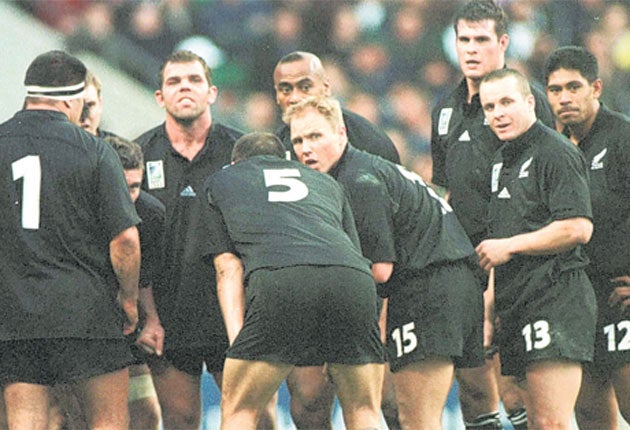
1999: One of the finest games of all time. The French produced a staggering performance to win a Twickenham semi-final 43-31. France were written off against the tournament's red-hot favourites and hardly helped their cause by falling 24-10 behind but Les Bleus, in an incredible turnaround, piled on 33 points as the All Blacks fell apart, even with Jonah Lomu in their ranks.
1995: One of the great conspiracy theories. Forty-eight hours before a final in South Africa against the Springboks, amid the fervour of Nelson Mandela's rise to the presidency, the entire All Black team suffered food poisoning after being served by a waitress called "Suzie". Whether the offending substance was chilli sauce, chicken burgers or prawns has never been discovered. On the field, a below-par New Zealand – who had hammered England in the semi-final – were beaten 15-12 in extra time by a late Joel Stransky drop goal.
1991: After winning the inaugural World Cup at home, the All Blacks travelled to Britain for the second one but were stunned in the semis at Lansdowne Road, as David Campese led the Wallabies to a 16-6 win. Little did Grant Fox and Co realise they would go the next 20 years without winning the global crown.
Join our commenting forum
Join thought-provoking conversations, follow other Independent readers and see their replies
Comments