Lancaster to call time on England's weak links
South Africa 36 England 27: Brave fightback does not distract coach from need for further surgery on squad
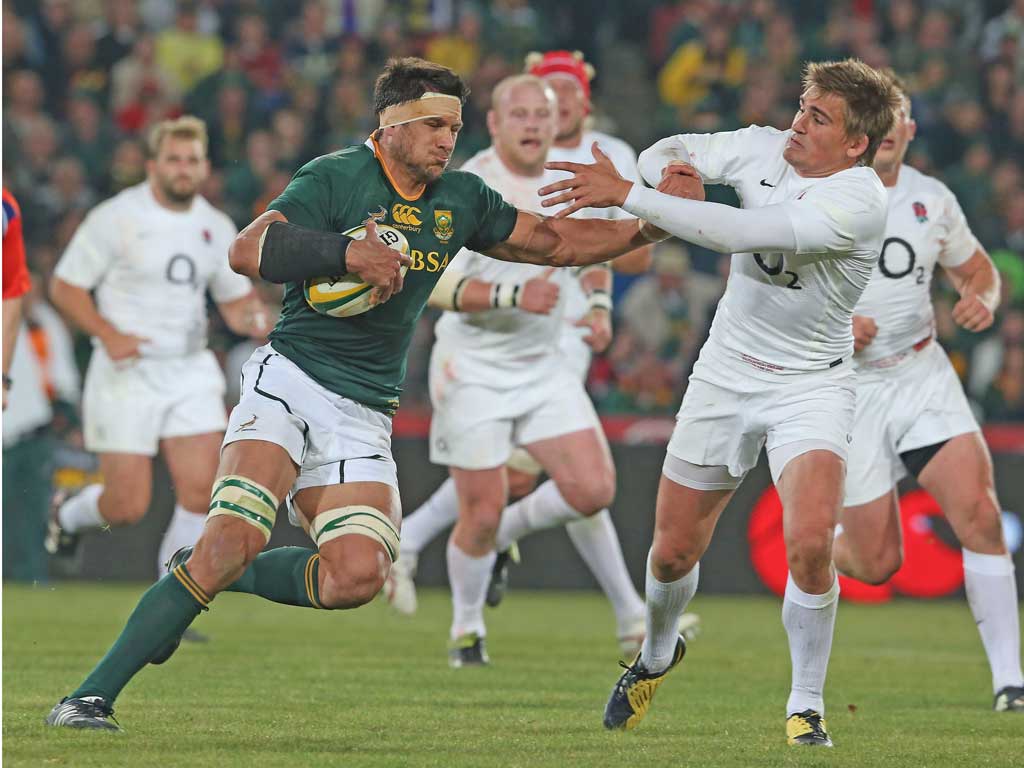
Just as there is a first time for everything – never before have England found themselves on an eight-match losing streak against the Springboks – there is also a last time, and it may well be that before the new season is very old, the international careers of some of those who participated in this bizarre and deeply discombobulating 36-27 defeat will have been consigned to the past tense. "When we reach the autumn Tests," said the England head coach Stuart Lancaster, quietly but with meaning, "we'll want to have a very clear idea of which players are capable of moving up to the next level." In other words, there are decisions to be made.
Those decisions will be delicate and sensitive, which is right up Lancaster's street. He is, as every last member of the current squad acknowledges, an excellent man-manager who communicates positively and has a happy knack of making people feel good about themselves. Yet when he reaches for the knife, he shows little mercy.
Mark Cueto, Mike Tindall, Nick Easter… all three returned from last year's World Cup tragi-comedy under the impression that they still had a red-rose future ahead of them, only to be disabused of the notion by the new coach. Danny Care, something of a protg, was told to go away and not come back until he had sorted his relationship with alcohol. Others – Phil Dowson, Tom Palmer, Charlie Hodgson, even Owen Farrell – have found themselves on the painful end of the coach's selectorial adjustments.
For the players who cracked and crumbled at this most forbidding of great Afrikaner rugby strongholds, things are looking just a little bleak. Some of those found most wanting during a grisly opening quarter in which the Boks swept along at more than a point a minute and won the game as a consequence will have opportunities to redeem themselves. The inexperienced No 8 Ben Morgan falls squarely into this category. Others, like the lock Mouritz Botha and the blind-side flanker Tom Johnson, could quickly find themselves marginalised.
Neither Botha nor Johnson could conceivably be accused of giving anything less than their all, but England had no answer to the early intensity generated by the likes of Eben Etzebeth, Willem Alberts, Marcell Coetzee and Pierre Spies in the Springbok pack. If two of the three tries registered by the hosts in the opening 18 minutes were questionable under law, it is impossible to think that perfectly legitimate scores would not have followed soon enough. The last time folk in this country saw one-way traffic moving at such a velocity, Formula One was in town. And that was in 1993.
Of course, it is to England's enormous credit that they responded to this suffering, these agonies of hell, by dragging themselves back into the contest, cutting an 18-point deficit after 46 minutes to one of the four-point variety early in the final quarter and establishing such momentum of their own that victory was possible, bordering on the probable.
With Ben Youngs and Toby Flood running hot at half-back, Chris Robshaw turning over ball on the floor almost at will and the intelligent Alex Corbisiero making a significant front-row impact off the bench – seldom has a replacement prop been so instrumental in changing the course of a game, in the loose as well as at the set-piece – there were moments late on when the fast-tiring Boks matched England's early ineptitude, error for panic-ridden error.
"If Ben Foden's chip had been just a foot higher," said Lancaster, referring to the full-back's marginally under-propelled attempt to kick over the head of an exposed Frans Steyn down the right touchline, "who knows what might have happened? We played some good stuff in the second half, no doubt about it. But you can't give the Springboks a start like that and hope to win.
"I'll have to ask the players how they were feeling at kick-off before reaching any firm conclusions about what happened, but I sensed a nervous tension in the warm-up and I think it was still there in the opening 20 minutes. It goes without saying that I'm proud of the way the team responded: they showed a lot of guts, a lot of character. And looking on the bright side, it's good that the overriding emotion in the dressing-room immediately after the game was one of frustration, rather than one of satisfaction that they'd fought back and gone so close.
"I'd have been disappointed if that had been the case, but these players don't work like that. If we were to review the game in the context of a brave fightback, it could be dangerous for us. But we won't. There'll be no hiding behind that when it comes to the feedback. The players won't expect it, and they won't want it."
All this made sense. Lancaster knows that even though his side won the second half by the useful margin of 17-11, the Boks missed important kicks at goal, were badly affected by injury after the interval and contributed to their own hassles by withdrawing the Du Plessis brothers from their scrum and sending on substitutes who turned out to be significantly inferior. The coach also accepts that even though his starting pack was pretty much as heavy as the Springbok unit in terms of pounds and ounces, they were a whole lot lighter when it came to weight of impact. He will be a much happier man when Courtney Lawes and Tom Wood are fit for selection.
In a perfect world, he would also have a pair of wings like JP Pietersen and Bryan Habana. If Habana was the stand-out back in Durban a week previously, this game belonged to his partner of long standing. But for Pietersen, the Boks might not have won the 2007 World Cup – a stunning cover tackle against Fiji at the quarter-final stage saved their bacon – and it was the same man who saw South Africa home on Saturday, carving up England in open field on 72 minutes before finishing with a flourish in the right corner.
"I was going to substitute him at half-time because he'd taken a huge knock," said Heyneke Meyer, the Springbok coach. "I'm glad I didn't." England can be forgiven for not subscribing to that opinion, but they will be making a mighty big mistake if they place too much importance on Pietersen's intervention, dramatic as it was. To beat the Boks on a regular basis – or even once in a while – they must concentrate on matching the intensity of the collective, not the brilliance of the individual.
Join our commenting forum
Join thought-provoking conversations, follow other Independent readers and see their replies
Comments