Ultimate adventure in rugby's heartland
South Africa has always been a harsh proving ground – and this year's Lions tourists know they must take on a Springboks side of world champions

Sign up to our free sport newsletter for all the latest news on everything from cycling to boxing
Sign up to our free sport email for all the latest news
When it started, a small matter of 118 years ago, the Lions were not known as the Lions and would not be so for more than a quarter of a century; the Springboks were new to the union game and next to hopeless; the first Test was played on a Thursday; and the entire three-match series, in which only 11 points were scored, was watched by a total of 12,000 spectators. Over the coming weeks, around 50,000 supporters will travel from the British Isles to South Africa, the reigning world champions, in search of a little red-shirted glory. The last great adventure in rugby is under way.
By common consent, it is also the ultimate adventure. New Zealand is a mighty challenge – there is not, and never has been, any such thing as a weak All Black team – but a rugby occasion in Wellington or Dunedin, however special, is an occasion in miniature compared with the epic grandeur of a Lions Test in Durban or Johannesburg. As for Australia, whose rise as a union power in the 1980s (combined with apartheid South Africa's growing isolation) caused the Lions tour cycle to be increased from eight years to 12, there really is no comparison. In the land of the Wallaby, union remains the fourth game in town. In South Africa, it is an expression of nationhood.
And it is largely in South Africa that the Lions have left their imprint on the sporting world, romanticised and mythologised themselves, secured a place at the very forefront of the rugby imagination. The victory over the All Blacks in 1971 will never lose its lustre – how could it, when such fabled individuals as Carwyn James, Barry John, Gareth Edwards, Gerald Davies and Mike Gibson discovered the best of themselves simultaneously? – but the trips to Springbok country in 1955, 1974 and 1997 had different, wholly distinctive brands of magic about them.
In '55, the Lions lost the series narrowly, but in the grand style; indeed, the first Test in Johannesburg, which they sneaked by a point, is classed among the greatest ever played. In '74, Willie John McBride's undefeated team humiliated the Boks so comprehensively, winning the try count 10-1, that the tour is still regarded as the high-water mark of northern hemisphere rugby. And '97? The Lions might easily have been humiliated themselves, but defended with such extraordinary passion that the rubber was won before the final match. "We're playing 15-man rugby, without the ball," remarked the coach, Ian McGeechan, at the time.
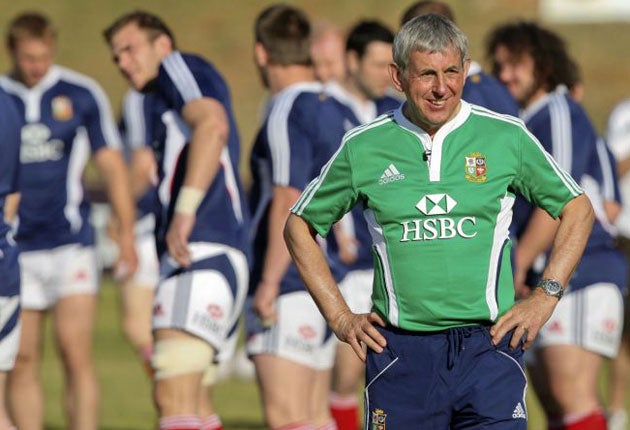
It has fallen to the 62-year-old Scot to run the show once again and the Lions are lucky to have him, for coaches as successful as Graham Henry and Sir Clive Woodward have discovered to their cost that it is no easy matter to create a team from scratch in the space of a few weeks. At least McGeechan has an instinctive understanding of the dynamics of a Lions tour, a proven ability to harness the forces of the four home countries and channel them in a single direction. In short, he has been there and done it. More than once.
Modern-day Lions tours are nowhere near as long as those of the amateur era, when time was of little consequence: the '55 Lions played 25 matches and McBride's vintage 22. As McGeechan, who played under McBride, recalled a few days ago: "We had two weeks together in South Africa before we played a single match, and it was two and a half months before the opening Test. It was a different age, a different world." These Lions have just six matches before the first Test in Durban and only 10 in all, yet they are expected to come together as an elite unit every bit as effectively as those illustrious predecessors blessed with a more sympathetic timescale. "It is," the coach confessed, "a mammoth task. The most formidable of my career, without doubt."
The challenges in South Africa come in all manner of shapes, but only one size: big. Each of the four home unions has a single Test venue: Twickenham in England, Murrayfield in Scotland, the Millennium Stadium in Wales and (when current redevelopment is complete) Lansdowne Road in Ireland. In South Africa, full Tests are played in seven cities, from Cape Town, Durban and Port Elizabeth on the coast to Johannesburg, Pretoria, Bloemfontein and Rustenburg on the high ground of the veld. The majority of the stadiums have capacities of 50,000-plus.
And then there are the Springboks themselves. Afrikaners from the farmlands of the Transvaal and the Free State have always been fierce, imposing and threatening on the rugby field, but now, in these happier and more enlightened times, there is a new breed of black player equally capable of doing union business the South African way, from the electrifying Bryan Habana on the wing to the explosive Tendai Mtawarira in the front row. In the bad old days, black interest in the "white man's sport" was heavily concentrated in the Eastern Cape. Now the Rainbow Nation is with us, there are no outsiders anywhere.
Except, of course, the Lions themselves. The odds about a Springbok triumph are short – they are, after all, the holders of the Webb Ellis Trophy – and even if the tourists survive the usual softening-up techniques employed by their provincial opponents and win the opening Test in Durban on 20 June, the extreme demands of beating the South Africans at altitude in the two remaining internationals could easily prove too much. Yes, they won here 12 years ago, but there were three extra fixtures then, and two of the Tests were played at sea level.
But whatever happens, it will be memorable. As the Springbok captain John Smit, as eloquent as he is tough, reminded his audience this week, it is as great a privilege, if not greater, for a South African to play against the Lions as it is for a British Isles player to be selected for the tour. The 12-year cycle ensures two things: that some of the finest players will never taste the Lions experience, and that those who do will live and breathe it to the last. Rarity is all too rare in sport these days. Over the next six weeks, we will be reminded how important it is.
Subscribe to Independent Premium to bookmark this article
Want to bookmark your favourite articles and stories to read or reference later? Start your Independent Premium subscription today.
Join our commenting forum
Join thought-provoking conversations, follow other Independent readers and see their replies