Brian Ashton: Tunnel vision the positive cure for white-line fever
Tackling The Issues

Sign up to our free sport newsletter for all the latest news on everything from cycling to boxing
Sign up to our free sport email for all the latest news
The most gratifying news to emerge from the rugby world this week was that Michael Lynagh, the great Wallaby outside-half and analyst of renown, had left hospital after suffering a very serious stroke. It will not, to use Michael's own words, be a short road to recovery, but I am certain that I echo a multitude of voices throughout the union-playing nations in wishing him a speedy and complete return to health.
There was less good news for England rugby with Wayne Smith, the respected New Zealander, deciding not to take up the offer of a senior position in Stuart Lancaster's coaching team. There was always a possibility of this happening: Wayne had many issues to weigh up in his own mind, largely relating to his family, and the reasons he gave for turning down the job were, to my mind, compelling.
What this episode has unquestionably done is open up an opportunity for Mike Catt to dip his toes in the waters of international rugby coaching. He's clearly not the first choice, but as Stuart pointed out in his usual honest fashion, he himself was not Twickenham's initial preferred candidate as full-time head coach when he was appointed on an interim basis before Christmas. Mike was an innovative player. If he has retained that mentality and can translate it into his coaching at this high level, the prospects for him and for England will be intriguing.
Up here in the northern hemisphere, the big news was that on 19 May at Twickenham, the Heineken Cup final will have a uniquely Irish flavour to it: Leinster, the reigning champions, against Ulster, who were the first team from the Emerald Isle to win the title, in 1999.
The fine South African player Ruan Pienaar was once again central to the victory chiselled out by the men from Belfast. He seems to me almost a reincarnation of Austin Healey in his positional versatility and capacity to make a major impact on important Heineken Cup contests. Equally at home performing both half-back roles (and, indeed, operating elsewhere), the Springbok, like the Englishman before him, is blessed with a sharp appreciation of the possibilities and opportunities offered by the game, together with the capacity to be both positive and decisive in making informed choices and acting upon them.
I found the Clermont Auvergne-Leinster match thoroughly engrossing. Regular readers of this column will not hesitate to point out that I called the result wrongly, but in my own defence I would point out it was only the flip of a coin that led me to predict a narrow victory for the Frenchmen. And as the game entered its final moments, another coin flip would have been as valid as anything else in anticipating who would come out on top.
In moments such as these you do not expect a side as awash with international quality and experience as Clermont to fall victim to an outbreak of white-line fever – that well-known rugby condition that has, in the past, swept through many lesser sides like an epidemic. At the precise juncture when a Ruan Pienaar or an Austin Healey would have been invaluable, either at scrum-half or at stand-off, Brock James and his colleagues lost all directional sense. The predatory All Black wing Sitiveni Sivivatu must have covered acres of ground inside the Leinster 22 in the last five minutes, switching from one side of Clermont's battering-ram forward assault to the other, seemingly always in space, always at pace, always (I presume) calling for the ball, and always being ignored. Even had Sivivatu been armed with a Ph D in medicine, I doubt he would have found a cure for the cursed WLF disease.
From Leinster's angle, the key was whether they could ride out the physical assault and impose their game of movement. From Clermont's, it centred on whether, having established physical authority, they could use it to implement a wider, more challenging plan of action.
Leinster indicated their intention from the outset, using the midfield tunnel-ball play as the staple of their attacking diet. This is an underused, albeit straightforward tactic that, when executed well, can hold midfield defenders, allow an immediate exploration of the wider channels and bring forwards into the game by getting them running off the shoulders of 10 and 12 from the preceding set piece. There is no huffing and puffing through the phases; instead, you string together three passes and you arrive. Mindset positive? Technique sound? Job done.
Another beauty of the plan is that by preventing defenders migrating across field a team can open up a 20-metre short side to which they can return. This is where the passing game of Leinster is so impressive: four or five players attacking at pace down a narrow channel is an intimidating prospect for defenders resetting from the previous ruck. Add to this Leinster's penchant for chipping the ball along the touchline and trapping the defending receiver in an area from where there is little chance of escape and you have a productive range of options.
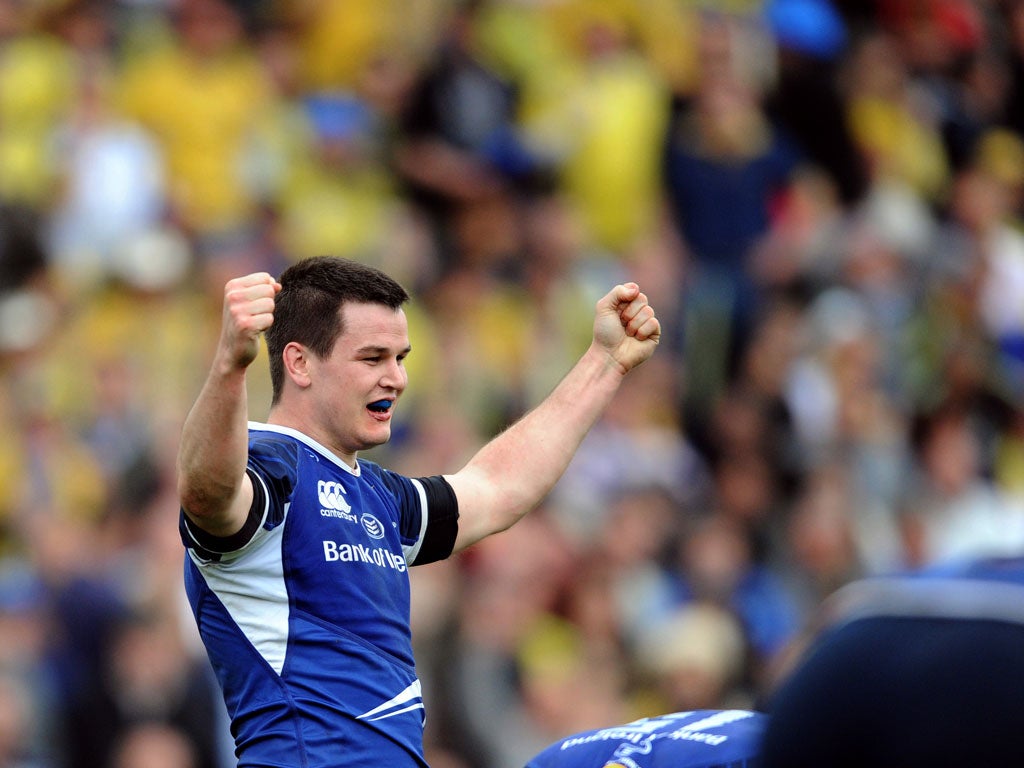
One of the defining differences last weekend was the performance of the two outside-halves, Jonathan Sexton of Leinster and the aforementioned James. Sexton had one of his Damascus-like visions at half-time, which led him to plot the game's only try, but his general game management was pretty good too: he showed a mature appreciation of options and had obviously been granted the freedom to release his team from deep positions when the circumstances were right. James, by contrast, struggled to maintain shape when his team fell behind and committed the cardinal sin, on three occasions, of showing indecision and allowing the Leinster back-rowers to turn him over in the tackle. Clermont's failure was not all his doing, but when it came to manipulating the match Sexton won hands down.
In this weekend's Premiership, all eyes will be on the Wasps-Newcastle "relegation" match. (I use the inverted commas because the craziness of the regulations covering promotion means both sides could yet stay up). It is to the Tynesiders' credit that they have fought back to give themselves a chance of staying in the top league: they have no choice now but to go out all guns blazing. Wasps find themselves in a living nightmare, and I cannot help thinking that in the days of Lawrence Dallaglio and company, there would have been an emphatic riposte. Those days having gone, this is not a match for the faint of heart.
Subscribe to Independent Premium to bookmark this article
Want to bookmark your favourite articles and stories to read or reference later? Start your Independent Premium subscription today.
Join our commenting forum
Join thought-provoking conversations, follow other Independent readers and see their replies