Ignacio Mieres is 'the Messi of rugby'
Argentina are blessed with two magicians at No 10. And one of them has ended up at Exeter, thrilling crowds with his bag of tricks
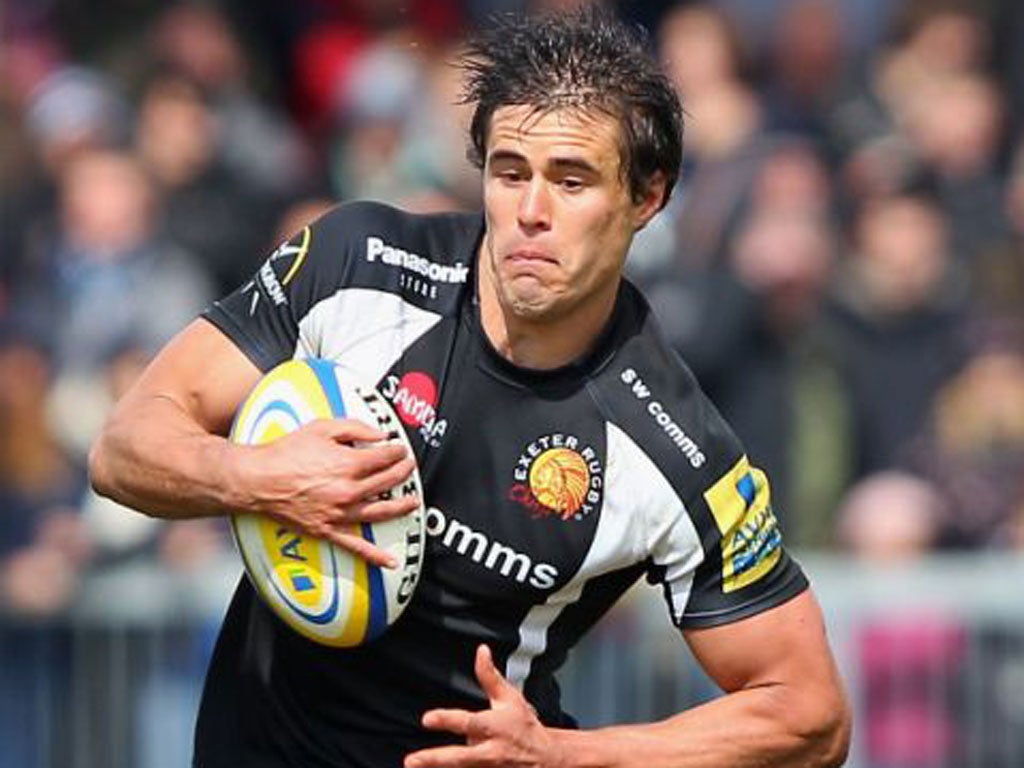
If Juan Martin Hernandez is the "Maradona of rugby", as he was famously christened ahead of the World Cup in 2007, it stands to reason that there must be a "Messi of the oval ball" perfecting his skills and refining his trickery in some far-flung corner of the union landscape. Ignacio Mieres rolls his eyes at the suggestion that he might be the man, and that Exeter might be the place. "Hernandez? He is a player of all the talents," he says of his Argentine compatriot. "I don't think people will ever talk about me in the way they talk of him. He has special gifts."
Yet whenever Mieres pulls a special trick or two of his own on behalf of the Devon club, with whom he has just started a third Premiership campaign, those watching are tempted to make certain comparisons.
Like Hernandez, he was born in Buenos Aires and mastered rugby's fundamentals at the Deportivo Francesa club. Like Hernandez, he is a goal-kicking stand-off of a high calibre, blessed with sufficient versatility to do a turn elsewhere in the back division. Like Hernandez, he is well over 6ft in height – unusually tall for a No 10. Like Hernandez, he has set his heart on representing the Pumas at the next World Cup, in England in three years' time.
His advantage? At 25, he is five years younger than the maestro and his game is developing almost by the week. His disadvantage? Apart from the fact that Hernandez is the man currently denying him the international shirt he craves? Well, there are a few. As yet, it is by no means obvious that Mieres – or, indeed, anyone else currently active in the sport, including Daniel Carter and Quade Cooper – could conceivably throw the spellbinding passes with which Hernandez illuminated that global tournament in France back in 2007. It may also be the case that even on a dry, windless day, he could not match his rival's astonishing party piece, a perfectly weighted, flat-ball banana kick to safety, delivered during Argentina's captivating contest with the All Blacks in storm-tossed Wellington a week ago.
"I didn't see the game," he says, "but I've seen that kick before and it's quite something." Can he see a way past Hernandez into the Puma line-up? "I want to play for my country. I've tasted international rugby now and I believe I'm in their thoughts. But Hernandez will play at Test level as long as he plays rugby. I'm convinced of this. Who knows what the coaches will decide to do? All I can say is that there are things in my game that must be improved, and that I am doing everything in my power to make those improvements. After that, we'll see."
Mieres is indeed in the thoughts of Santiago Phelan, the Argentine coach, and his inner circle. Back in June, he was selected for the home Test against Italy in San Juan and, a week later, against the French in Cordoba. The Pumas won both, yet Mieres, whose previous international experience had been of the low-key variety against Uruguay and Chile, already knew he would not be involved in the serious business of the year – the ground-breaking involvement in the newly expanded southern hemisphere Tri-Nations, which had to be renamed for obvious reasons and is now called The Rugby Championship.
"It was not an official policy – it was communicated by word of mouth," he says. "We were told that if we played in June, we would not be involved in the new tournament unless there were exceptional circumstances. Why? Because in Argentina, we need to minimise our problems with the clubs in Europe. If we play too much international rugby and are away too long, will those clubs still want us? Do they really want all of us coming back midway through a season after three months with the Pumas, tired and maybe injured? Of course not. And if we cannot play top-level rugby in Europe, where else is there? We have no professional structure in Argentina. Without our opportunities here, we would be unable to develop.
"The situation is difficult. Maybe it will get worse. I think it will reach the point when players from Argentina have to decide between international rugby and a club career here, and that will be tough for us. I understand both sides of the argument. When it is possible to see both sides, you have real issues when it is time to make a decision."
Right now, Mieres believes his decision to accept an offer from Exeter in 2010 was one of the soundest of his life. He first came to Europe three years previously at the behest of the former England stand-off Les Cusworth, who had long been heavily involved in Argentine rugby and thought it might be a good idea to pack him off to his old club, Leicester, for a spot of hothousing. As Marcelo Loffreda, who had guided the Pumas to a thoroughly deserved if barely credible podium finish at the 2007 World Cup, had just taken over at Welford Road, it made sense.
Unfortunately, Loffreda was drummed out of the Midlands in short order and, as Mieres had played next to no meaningful rugby, the chance of a move to the Parisian club Stade Français seemed an attractive option. "It was completely different," he recalls. "There was the Leicester way – very hard, very professional – and there was the Stade Français way, where the players were given much more freedom to do as they liked. Actually, I preferred the English philosophy: I was in Europe to learn, not drink coffee. And anyway, there were few possibilities for me at Stade Français. Only two foreign players could be in the first team, and I was third behind Rodrigo Roncero and Mark Gasnier."
At which point, the big-spending Catalans of Perpignan offered him a deal as a "medical joker" – the in-house phrase for injury replacement. And who might he be replacing? Why, none other than the stellar signing of the age: Carter, the All Black hero who had left New Zealand on a short-term sabbatical and had promptly done himself an orthopaedic mischief. "That was an interesting time," confesses Mieres. "You could hear people saying: 'Who is taking Carter's place? A 20-year-old kid with no experience? Ah'."
After a second spell at Stade Français and a brief sojourn back home in Buenos Aires, he moved to Exeter – a club whose intelligent moves in the marketplace have kept pace with the fast-developing quality of their rugby. "I did not know what to expect," Mieres admits. "I find it tough, being away from home, and when you're not playing in the first team, it's even tougher. For the first few months, I was playing for the seconds – a very good standard of rugby, but not what I wanted.
"But slowly, I began to understand what the coaches wanted of me, and when you understand that, you feel part of things. I know now how well this club is run and how quickly it is growing. People who look at Exeter from the outside may be surprised at how well the team has done in the Premiership – that we have qualified for the Heineken Cup after only two seasons in the top league – but when you see it from the inside and realise how everyone pulls together towards the same clear objective, it is no surprise. They take care of everything here, from the playing surface to the playing squad and all things in between."
During his teens, Mieres found himself being pulled in different directions. He was patently a rugby player of rich promise, but he was also an extremely useful goalkeeper with the potential to play professional football. "They wanted me to go to the academy at Chacarita [a long-established Buenos Aires club, situated in the Villa Maipu district], but I could not play both sports and give of my best. If I had played football seriously, I wouldn't have had the time to train for rugby. And rugby is my first love. My father was a rugby player, also with Deportivo Francesa. I am completely happy with the decision I made."
He will be happier still if, when he reaches the end of his current contract at Sandy Park at the end of the 2013-14 season, two things happen: he is given the chance to extend his Premiership career, and the Pumas pencil him in for the World Cup.
Hernandez will, the South Americans can only hope, still be in his Maradona phase. If Mieres adds just a twist of Messi to the mix, heaven help their opponents.
Join our commenting forum
Join thought-provoking conversations, follow other Independent readers and see their replies
Comments