James Lawton: Great honour goes to France, but the right team has won
The French played one half brilliantly against England and then did the same in the final
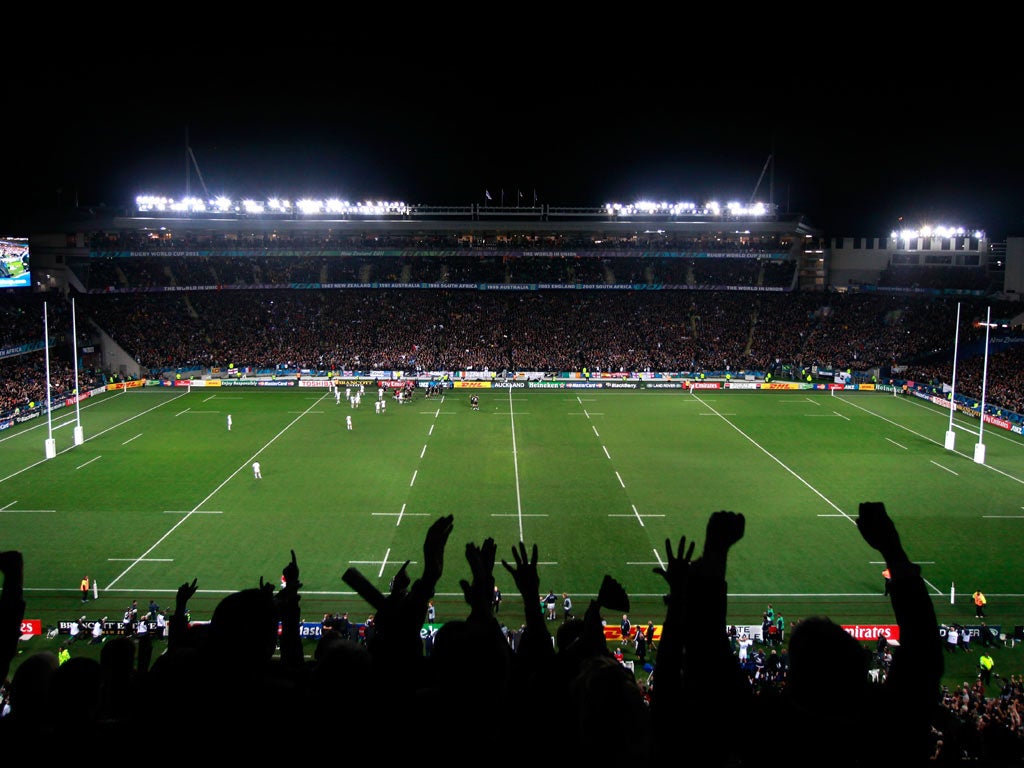
If the World Cup of rugby is about seizing one night, if it was available to a man like Thierry Dusautoir claiming it as a personal possession, it would this morning be draped in the Tricolore and heading for the Champs élysées.
But it isn't, not morally anyway, and so the trophy goes to New Zealand, the world's No 1 rugby nation, for only the second time in the 24-year-history of the World Cup.
You may say this is harsh on the French, variously the most sublimely brilliant and deeply schizophrenic entity in any front-line sport, and in a way it is. But as the All Black line held, quite desperately in the end, as fireworks began to erupt from the craggy shoreline of North Island to Stewart Island in the south, it was hard not to believe that a rough kind of justice had been imposed.
France stole most of the night gloriously and no one more thoroughly than their magnificent captain Dusautoir, who not only made so many tackles your body began to ache on his behalf, but also scored a try that landed on the New Zealand psyche with potentially fatal force.
However, when the battle was over it was possible to make an unequivocal statement of fact. It said that if the wrong team lost the match, the right one won the tournament.
New Zealand are worthy world champions because in the end they did everything, as opposed to the French who played one half of a quarter-final against England quite brilliantly and then did much the same against the All Blacks in the final.
If you put those halves together, it makes just one whole match performed at the level which everyone here suspected they were capable of all along, and this when they were being swamped by New Zealand in a group game, losing to Tonga in another and performing so feebly against 14-man Wales in the semi-final that even their own coach, Marc Lièvremont, admitted that a guardian angel had been on double-time guiding them into the last match.
By comparison, the All Blacks were required to beat off a whole series of major assaults on their confidence – quite apart from the growing national paranoia that one way or another they would be ambushed somewhere along the way to the final in Eden Park – and keep on winning.
They did it at differing levels of brilliance – the semi-final triumph over Australia serving as a master-class in superbly orchestrated power and determination – but there was one unbroken thread.
Unlike the French, the virtuosos of the last chapter, they never lost sight of the obligation to perform at their very limits. If their execution wavered at times critically in the final 8-7 victory, their will did not.
And then, when the race was over, they were entitled to remind themselves that from time to time they had been obliged to deal with problems that might have seriously distracted, if not destroyed, a less motivated group of players.
They lost their talisman, Daniel Carter, who also happens to be the most gifted player in the world. They saw his understudy, Colin Slade, battered out of the action at the quarter-final stage by a bunch of extremely uncompromising Argentines. Last night, as the French began to carve great chunks out the All Black self-belief, a third fly-half limped away, the precocious, resilient young Aaron Cruden.
There was also the aggravating fear that iconic captain, Richie McCaw, three times voted the world's best player, would break down with a foot injury that kept him out of serious training for most of the tournament.
Yet McCaw made it to the finish line, despite the awesome obstacle of a French back row in which Imanol Harinordoquy and Julien Bonnaire were overshadowed only by Dusautoir producing arguably the game of his already highly distinguished rugby life. In the last strides McCaw received significant help from Stephen Donald, fourth-choice fly-half who reported for emergency duty while admitting that a holiday devoted to fishing for whitebait had also involved a not inconsiderable amount of beer drinking.
Nor did Donald, along with team-mates Ali Williams and Sonny Bill Williams, impress himself as a man totally focussed on his mission when he put in a boorish press conference performance which drew widespread criticism.
Yet when the issue was most pressing, Donald emerged as still another All Black who knew how to attend to business when it mattered most.
His successful penalty kick steadied New Zealand nerves which had been worn down by the ineptitude of erstwhile hero Piri Weepu. The New Zealand scrum half had become so rattled he committed the cardinal sin of fly-kicking the ball into the arms of an advancing Frenchman, a breakdown which led to Dusautoir's try.
Weepu disappeared soon after – and along with him, a glance at the All Blacks coaches' box suggested, pretty much the last of his team's composure.
It wasn't so. If the French continued to play with freedom and conviction, with powerful centre Aurelien Rougerie and François Trinh-Duc, who replaced the battered fly-half Morgan Parra, looking especially liable to create a killing breakthrough, the All Blacks settled into their last option. They defended with absolute resolution.
This was a long journey from their their destruction of the Wallabies, when the running of Israel Dagg, Cory Jane, Ma'a Nonu and Conrad Smith came with breathtaking force. It was the acceptance that life is not how you would always like it to be. It was the resilience of those teams who understand that in winning and losing there are many degrees and that the unbreakable obligation is always to play to your limits.
It is a claim that France could not make for themselves at the end of a tournament which, yet again, had confirmed their status as the team for whom brilliance is often so much more accessible than anything as humdrum as mere consistency. But then what would rugby do without them? Where would it find the intrigue and all that uncharted country which they seem to find, it seems, almost by whim?
Yes, they were unquestionably the better, more imaginative side yesterday. And it would be even more astonishing if their form in the matter did not run back so far and so deeply They had, by some distance, the man of the match ... and no shortage of sympathisers when they implied that referee Craig Joubert had given their opponents almost all benefits of the doubt.
The controversial and complex Lièvremont, whose eccentric methods brought him so close to legend, on this occasion provoked only understanding when he declared, "It is tremendously sad and I am tremendously proud of my players."
An early sense that ultimately he might enjoy entirely different emotions came with the aplomb displayed by his players when facing the haka. They made an arrow-head formation, then advanced on the All Blacks, Dusautoir reporting: "At one point we were so close to the New Zealanders some of the guys wanted to kiss them. I told them to take it easy."
It was a rare moment of restraint from the man who led his team so close to a redemption that would have been remarkable even by their own standards. For that, great honour goes to the French. However, the World Cup stays in New Zealand. When you look back, you see there could be no more appropriate place.
Join our commenting forum
Join thought-provoking conversations, follow other Independent readers and see their replies
Comments