Regime change in Rugby Union
Rugby union is becoming more and more like football in its willingness to sack coaches. Chris Hewett examines a disturbing trend, while the Saracens coach offers a first-hand insight into the perils of having to deliver instant success
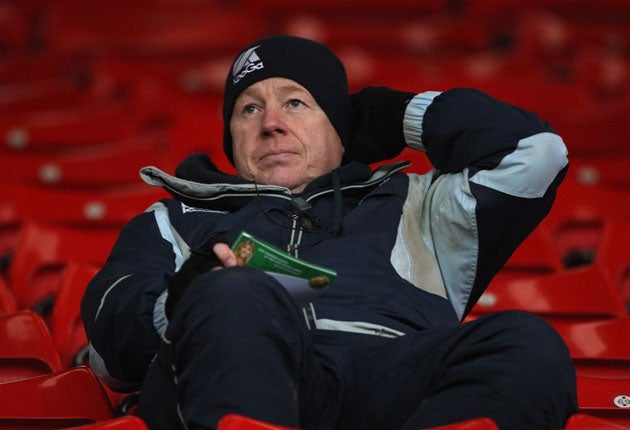
Richard Hill ended a long and frequently heroic coaching association with Bristol last week, and the manner of his leaving was not pleasant in the slightest. Eddie Jones will walk away from Saracens at the end of the season, exasperated and unfulfilled, while Philippe Saint-André is about to leave Sale, one of the best top-flight teams in England, for Toulon, one of the worst in France. There is no guarantee that when Wasps begin their 2009-10 campaign in September, they will do so under the stewardship of Ian McGeechan. The same uncertainty surrounds Dean Ryan's future at Gloucester.
In Formula One, they call it "musical chairs". In football, they call it normal. But big-time club rugby was never meant to be like football: everyone said so, from the owners and chairmen in their private lounges to the chief executives and Guinness Premiership administrators charged with growing a business from scratch in the face of considerable adversity. Football was "not the right model" at this early point in the union game's development as a professional sport, they insisted. "If we go down the football road, we'll find a brick wall at the end of it."
Yet in some important respects, Premiership rugby resembles Premier League football a little more each day, in the way a small boy mimics the ways of his grown-up brother. There are several good reasons why the more highfalutin rugger types criticise football for its excesses, but when they mock the national game for the way its managers are routinely sacked at the drop of a hat – and how they love to point the finger in that supercilious way of theirs – they are on very thin ice indeed. Far from refusing to venture down the football road, their sport is already halfway along it and travelling ever faster.
Since the start of the 2004-05 season, 39 individuals have performed the roles of director of rugby or head coach at Premiership level, and there have been some 25 changes of regime. Football, by comparison, has seen 57 managers operating in the Premier League, with 41 changes at the top. If these numbers seem too close for comfort, they get a whole lot closer. English football's showcase competition is a 20-club concern, and 29 teams have played in it over the last five years. As the 12-team Premiership is much smaller – only 13 clubs have participated over the same period – it is perfectly reasonable to argue that in terms of career expectancy, rugby is the less secure of the two sports.
Three clubs – Leicester, Northampton and Saracens – have had five "No 1s" in as many campaigns, which puts them on a par with Newcastle United and Portsmouth, the least stable of the nation's major football teams. (Extraordinarily, Saracens have gone through 10 directors of rugby in a little over a decade, which confirms them as the basket case of the English game). Only Saint-André, the former captain of France who joined Sale in 2004 after coaching spells on either side of the Channel, has travelled the full distance.
Had he stayed, he might one day have merited some sort of comparison with his closest footballing neighbour, Sir Alex Ferguson. But he isn't staying, so he won't.
"I have to say that the statistics are pretty startling," admitted Mark Evans, the chief executive of Harlequins. Evans knows what it is to coach at Premiership level, having done the job at both Saracens and Quins; indeed, he performed the role at the latter while carrying out his CEO duties and effectively sacked himself as coach to bring Dean Richards to the club in 2005. "Of course, some people have moved up into international rugby – Brian Ashton, Brian Smith – and others have left positions for reasons of their own. But the fallout is still remarkable for a league of this size.
"It is to a degree the consequence of having a 12-team competition with tiny margins between most of the clubs and the threat of relegation overshadowing everything. If you don't win, you're under pressure. The instability does not just affect the coaches, either. When I look around the CEOs' table at meetings, there aren't many who have been in place from the outset. I've been at Quins nine years now. Only Peter Wheeler at Leicester and Ken Nottage at Gloucester have done more time, so to speak, and Ken started out with Newcastle.
"Stability is a key element for any business, and we're certainly conscious of that at Quins. We have a model that we're trying to roll out and we don't take much notice of how other people see us or what they say about us. Our owner has been here for 12 years, John Kingston has been coaching here for eight, Dean is in his fourth season and we're very keen that he should stick with it. We're lucky to have supporters who understand the project, which is about growing the operation across the piece – the team, the stadium, the academy, the community work – while not losing money in the process. For anyone attempting this, continuity is absolutely essential. It is, however, true to say that continuity is not a priority at every Premiership club, and it's one of the reasons why professional club rugby has yet to produce a Sir Alex. Jack Rowell was probably the game's Sir Alex, and he was pre-professionalism."
Rowell joined Bath in 1977 and stayed until England came calling in 1994. During those 17 years, he pieced together the finest club side ever seen in these islands – perhaps even in the whole of Europe, although there are those in Toulouse who might argue the toss – yet was never in a position to devote anything other than his evening and weekend hours to the task, thanks to the demands of a high-powered business career. Is he comfortable with the current direction of the sport? Does he see the trend of hiring and firing being reversed?
"On the second point, I think it unlikely in the foreseeable future," he said this week. "Club rugby at ownership level is still evolving and until it settles down, this combustibility will continue. You have people involved who are entrepreneurial types; people who have invested, and lost, a lot of money; people who pride themselves on getting things right in business, and getting them right quickly. I find the behaviour patterns fascinating, because some of these very ambitious and successful men occasionally allow their hearts to rule their heads. That makes life very challenging for the coaches, as we've seen at places like Saracens.
"As to whether I'm comfortable with the direction rugby is heading – well, I was a coach, so I take the side of the coaches. But I've also spent a life in business and in that environment, it's a case of delivering attractive results today while planning to win again tomorrow. Rugby is a business now, and it's a growing business. I can quite see how the weight of pressure and the pace of change will increase as more and more importance is attached to success. Philosophically speaking, I don't see much difference between rugby and football. Alex Ferguson and Arsène Wenger have been in place a long time now, but why wouldn't they be in place? They're winning managers, and that's the long and short of it."
If anyone can be said to have brought a win-at-all-costs mentality to club rugby, it was Rowell. He does not deny it for a second. "We were ruthless in pursuit of success, and we had to be. In the late 1970s we were the poor relations of West Country rugby and to turn that around was a significant task. Of course, Bath was run by a committee then, not by an owner with a major investment to protect, but I wanted to feel pressure, to be made to feel accountable. It was the only way I felt I could make things work.
"Some of those on the committee were really very conservative and were not, I have to admit, too sure about my approach. One said to me: 'Your problem, Jack, is that you want to win every week. You keep throwing challenges at people.' I replied: 'If you don't want to win every week, I suggest you go and tell the players.'"
Even today, there are those lurking in the backwoods of the Rugby Football Union council who would instinctively sympathise with that committee man. But the governing body has not set much of an example in respect of investing in people for the long term – in stability and continuity and all the other virtues apparently common to all truly successful sporting organisations. Ask Ashton, or Andy Robinson, or any of the 2003 World Cup-winning back-room team stabbed in the front on Twickenham's "day of the long knives" a little over three years ago.
The notion that anyone might spend 17 years in a head coach's role in this day and age seems wholly ridiculous. By present standards, 17 months is a good effort. Towards the end of his three-year stint at the top end of the England operation, Rowell indicated that he would not be interested in doing the national job on a full-time basis. It might just have been the smartest decision he ever made.
Off with the head coach
*Saracens
Head coaches (5): Rod Kafer, Steve Diamond, Mike Ford, Alan Gaffney, Eddie Jones.
Director of rugby (1): Steve Diamond.
Rugby consultant (1): Eddie Jones.
Current league position: 7th.
Last four finishes: 8th, 4th, 10th, 5th.
*Northampton Saints
Head coaches (4): Alan Solomons, Paul Grayson, Peter Sloane, Jim Mallinder.
Joint coaches (2): Budge Pountney and Paul Grayson.
Current league position: 9th.
Last four finishes: promoted from First Division, 12th (relegated), 11th, 6th.
*Leicester Tigers
Head Coaches (6): Dean Richards, John Wells, Pat Howard, Marcelo Loffreda, Heyneke Meyer and Richard Cockerill (left).
Current league position: 5th
Last four finishes: 4th, 2nd, 2nd, 1st
Join our commenting forum
Join thought-provoking conversations, follow other Independent readers and see their replies
Comments