How tennis failed to act in vital betting test case
The ATP sat on a potentially crucial dossier on the only occasion match-fixing allegations were aired in court, writes Nick Harris
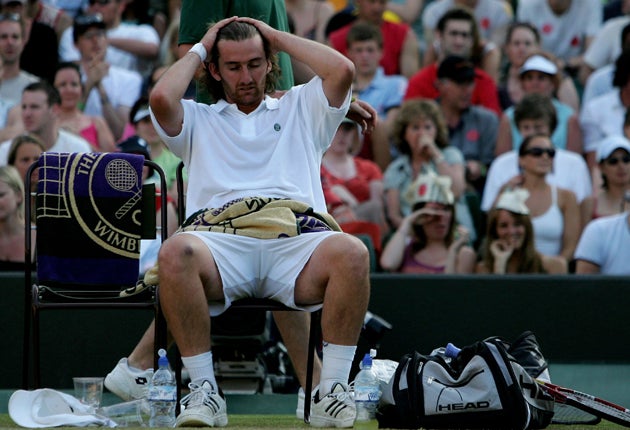
Only once in tennis history has an allegation of match-fixing been aired in a court. It is almost two years since the case was settled in favour of a gambler who profited by tens of thousands of dollars by betting on a player, who was his friend, to lose games.
The ATP, which governs the men's game, has yet to explain why it failed to present evidence to help the prosecution case despite being in possession of a dossier that might have influenced the verdict.
The case involved a professional gambler from Austria, Martin Fuhrer; a Georgian tennis player, Irakli Labadze, and an Austrian bookmaking firm, CashPoint, which accepted a bet by Fuhrer on Labadze to lose a match in St Poelten, Austria, in May 2004. Fuhrer stood to win more than $20,000 on the bet.
Unknown to most people then was the friendship between Fuhrer and Labadze. The pair socialised and dined at tournaments. Labadze also had a background, including an incident of "non-trying".
At an ATP event in Palermo, Italy in September 2003, Labadze, then ranked No 84 in the world, was drawn to play Tomas Tenconi, ranked No 225. An unusual amount, $362,741, was bet on Labadze to lose. That was six times the regular amount on a first-round match at that level. Even before the game started, bookmakers tipped off the ATP that the match was a suspected "fix". The umpire even warned both players at the start to try their best.
Labadze lost 0-6, 2-6. He was fined $7,500 by the ATP for lack of effort. What wasn't known at the time was that the gambler wagering the biggest single sum on Labadze to lose was Fuhrer.
Fuhrer was a professional gambler who knew a number of players, became a regular face on the tour in 2003 and 2004, and spent $2.5m on Betfair alone in those years betting on tennis.
On 18 May 2004 he bet on Labadze to lose by two sets to one against Austria's Julian Knowle in the last 32 at St Poelten, Austria. Labadze duly lost 2-1 but when Fuhrer went to collect his winnings, CashPoint refused to pay, saying a cashier had overheard Fuhrer telling a friend to back the 2-1 score line against Labadze.
Fuhrer took CashPoint to court, but CashPoint's defence rested on Fuhrer's bet being "an attempted betting fraud". CashPoint asked the ATP for assistance, and the request ended up in 2005 with Richard Ings, then the ATP's vice-president of rules and competition.
As chance would have it, the ATP was at the start of a cooperative information-sharing relationship with Betfair. Ings ran Fuhrer's name through Betfair's database and discovered that Fuhrer had made tens of thousands of dollars in profits by betting on Labadze to lose matches, among many other bets.
"We had little pieces of the puzzle," Ings told an investigation for ESPN's The Magazine last year. "We just didn't know what they meant." Ings emailed CashPoint's lawyers to tell them that Fuhrer had bet on Labadze five times to lose in 2003 alone, winning $45,000. Ings described how Fuhrer had taken "unusual positions placing bets at almost any odds on Labadze to lose."
Ings told CashPoint's lawyers that before the information could be used in court, his ATP superiors would need to give approval. Ings left the ATP shortly afterwards – he is now the head of Australia's anti-doping agency – but left a briefing note behind telling the ATP to keep an eye on what would be a landmark case.
"It is an important test case," Ings recalls writing. "The first time anyone has gone to court to challenge the relationship of a player and a gambler."
For reasons unknown, the dossier linking Fuhrer's history of bets on Labadze to lose matches never appeared before the court.
In the absence of ATP evidence, the judge in the CashPoint v Fuhrer case, eventually passing judgement on 24 September 2007, ruled in Fuhrer's favour. CashPoint had to pay Fuhrer $25,353 in winnings plus four per cent interest and $13,419 in court costs.
Labadze returned to the pro circuit in 2009 after a year's absence. Fuhrer lives in Vienna. Both have consistently denied any wrongdoing. The ATP yesterday said: "No comment".
42
Highest world ranking achieved by Irakli Labadze – he has now dropped to No 495.
Join our commenting forum
Join thought-provoking conversations, follow other Independent readers and see their replies
Comments