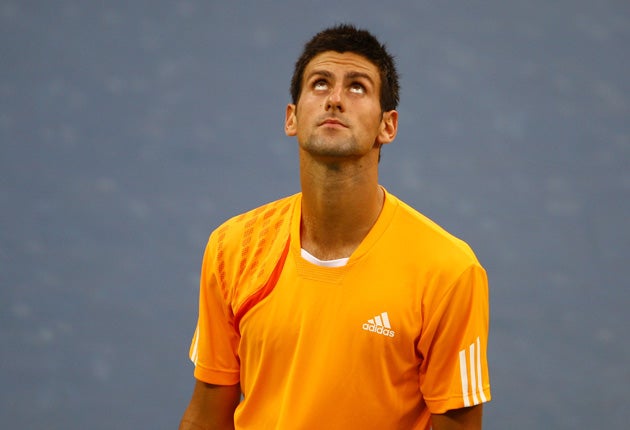
Novak Djokovic: The man who met his match with Murray
They were rivals as boys and have stayed neck and neck ever since but the Serb has got his nose back in front in the race to the top of the tennis summit. Paul Newman speaks to Novak Djokovic

Sign up to our free sport newsletter for all the latest news on everything from cycling to boxing
Sign up to our free sport email for all the latest news
Given that they were born just a week apart, perhaps it should be no surprise that Novak Djokovic and Andy Murray have matched each other rung for rung in their climb up the tennis ladder. Long-term rivals from their junior days, they earned their first senior ranking points within a fortnight of each other in 2003, broke into the world's top 100 within three months of one another in 2005 and reached the top 10 within one month of each other two years ago.
Djokovic, the younger of the 22-year-olds by just seven days, was the first to reach a Grand Slam final, at the US Open in 2007, with Murray following suit in the same tournament 12 months later. The Serb is one up in terms of success at the majors, having won last year's Australian Open, while the Scot has achieved the higher ranking, having briefly displaced Rafael Nadal as world No 2 this summer.
Nevertheless, when the world order was updated last week it was Djokovic's turn to look down once again on his contemporary. Five months ago, Murray took over the world No 3 position that Djokovic had held for nearly two years, but in the second half of this season the Serb has been recovering lost ground.
While Djokovic has been making hay in the Far East, winning the China Open in Beijing and reaching the semi-finals of the Shanghai Masters, Murray has had to let the grass grow under his feet, having not played a tournament since the US Open in early September because of an injury to his left wrist.
Like most players, Djokovic insists he does not pay too much attention to the rankings, although he is well-placed to appreciate their value. Being in the world's top four for the last 27 months has meant that he has not had to face Nadal or Roger Federer – or, latterly, Murray – before the semi-finals of any tournament in that period.
What did it mean to Djokovic to reclaim the No 3 ranking last week? "I was world No 3 for a long time and to get it back feels great, because I think I deserved it, playing well in the last two or three months," he said. "I'm aware that another reason why I'm there is that I was able to play two weeks in a row [in Beijing and Shanghai] when Andy wasn't, but that's tennis.
"I'm trying not to pay too much attention to the rankings, because calculations can distract you. I just want to continue playing tournament after tournament and building up a good shape and good form. I'm feeling good right now. Physically I'm feeling very fit and mentally I'm motivated to achieve good results."
The key to Djokovic's current physical and mental well-being has been the introduction of two new figures to his entourage. Back in April he hired Gebhard Phil-Gritsch, Thomas Muster's former trainer, as his new fitness coach, while Todd Martin, a former world No 4, joined his team before the US Open. Marian Vajda is still officially Djokovic's coach, but Martin, a 39-year-old American, is a growing influence.
In hiring Phil-Gritsch, who helped Muster become one of the fittest players in tennis, Djokovic has shown a determination to improve upon an area which had been a weakness in the past. He had developed a reputation for failing to last the distance, having retired four times during Grand Slam matches. In the quarter-finals of this year's Australian Open he quit in the fourth set against Andy Roddick because of heat exhaustion.
"I've been putting a lot of work into the physical stuff," Djokovic said. "It's hard when you switch fitness coaches. You don't want to make a big change because it might ruin your system, so he adapted to my body and got me into his routine. It's been working well. We've put a lot of work into the legs, into my movement, because this is where I have a good feeling about my game. My advantage is my running ability. I like to be dynamic and show a lot of energy on the court."
Martin's influence, as a thoughtful coach and a cool head, has probably been even more significant. Djokovic, a forceful and demonstrative character, may not be the easiest of men to coach. He has had a knack for rubbing up tennis people the wrong way, upsetting some with his mid-match retirements and calls to the trainer and others with his impressions of fellow players. When does self-confidence become arrogance?
For all his ability to entertain crowds – witness his hilarious jousting with John McEnroe at the US Open last month – Djokovic can also turn the public against him. Twelve months earlier he had incurred the New York crowd's wrath with ill-judged criticisms of Roddick.
So how has Martin helped? "He obviously brings his great knowledge and experience – and great calmness," Djokovic said. "He's a very positive person and that's what I like. Before the US Open we had lots of time on the tennis court. We put a lot of work into it. I'm a temperamental player. I show my emotions, even in practice.
"When I get frustrated I throw my racket. Then I look at Todd and I'm kind of scared about what his reaction might be, what he's going to say. But he always says: 'The shot you made before the mistake was good. So keep it going.' He always tries to find the positive in everything. I think that's a great thing about him. He's going to bring a lot of freshness to the team."
Djokovic has made his name as a baseliner, but Martin has been working on his slice and volleys in order to give him more options. "I think it's great that I've improved my slice a lot," Djokovic said. "I have more variety in my shots now. I've gained a lot of confidence there. I've always been a good defensive player and a good baseliner. Now I will try to make my life a little bit easier and improve on my volleys and try to give myself confidence and push myself more to get to the net.
"When you've been a baseliner all your life, to try to get into the routine of playing volleys more often is a process," he admitted. "It's all about work and practice. It's like everything in life. You have to work, work, work. Some day I hope it will work into my routine that I get into the net naturally, without forcing myself."
Nevertheless, Martin's other commitments in the United States limit his availability. The former US Open and Australian Open finalist did not travel to China with Djokovic and may not be at the O2 Arena during next month's Barclays ATP World Tour Finals, although they plan to work together in the Serb's next two tournaments, in Basel and at the Paris Masters, and in the build-up to London.
"He has a lot of obligations," Djokovic said. "He's still very active and he's a father of three kids. It's hard to find the right times, but we're doing well now. We try to make compromises over who is going to work with me where. Generally I think it will be Todd I'll work with when I go to the States and Marian when I'm in Europe."
Earlier in his career Djokovic had seemed to run out of steam at this stage of the year, but he won the Tennis Masters Cup in Shanghai last November and is in fine form in the run-up to this year's end-of-season finale, which has since been rebranded as the World Tour Finals.
That represents an impressive turn-around given his poor form at the start of the year, which he put down to a combination of unease with a new racket and self-inflicted pressure. "It started with the Australian Open and defending my title there. I expected too much of myself and it wasn't good, with the racket change and distractions off the court. It all reflected on the court."
Although he had a good season on clay, Djokovic fell in the third round in Paris and went on to lose in the quarter-finals at Wimbledon. His fortunes picked up with the switch to his favoured hard courts and he reached the final and semi-finals of the Cincinnati Masters and US Open respectively, losing to Federer, the eventual champion, on both occasions.
"Since Cincinnati I've been playing great tennis," he said. "Hard courts were always the surface that suited my game most and where I felt most comfortable. It's a good period. It's never too early or too late to find your form. It's a great time to find it now. I think I could have done a better job looking over the season overall. I could have done better in the Grand Slams but, except for a couple of ups and downs, I've had quite a consistent season."
As for losing his No 3 ranking earlier in the year, Djokovic gives credit to Murray for overhauling him. "I didn't think it was basically my fault, so much as Andy Murray's great season," he said. "He deserved to get there."
Playing by numbers
1: Grand Slam tournaments won by Novak Djokovic (2008 Australian Open)
2: Brothers (Marko, 18, and Djordje, 14, are both promising junior players)
3: Current (and highest) world ranking
4: Masters Series titles won (plus 2008 Tennis Masters Cup)
7: Matches against Andy Murray (won 4, lost 3)
13: Matches against Roger Federer (won 4, lost 9)
14: Singles titles won
19: Matches against Rafael Nadal (won 5, lost 14)
31: Months in world's top 10
84: Matches played in 2009 (more than any other player on the men's tour)
94: Tie-breaks won in career (lost 48)
251: Career singles victories (86 defeats)
13,901,121: Career earnings in dollars (about £8.5m)
Paul Newman
Subscribe to Independent Premium to bookmark this article
Want to bookmark your favourite articles and stories to read or reference later? Start your Independent Premium subscription today.
Join our commenting forum
Join thought-provoking conversations, follow other Independent readers and see their replies