Novak Djokovic: 'We can't expect just to shorten the season'
The Serb understands his fellow players' complaints about the packed calendar, but as a tournament organiser in his native Belgrade, he also knows it is not as simple as cutting back the number of events. The world No 4 talks to Paul Newman in Shanghai about the need for a third way...
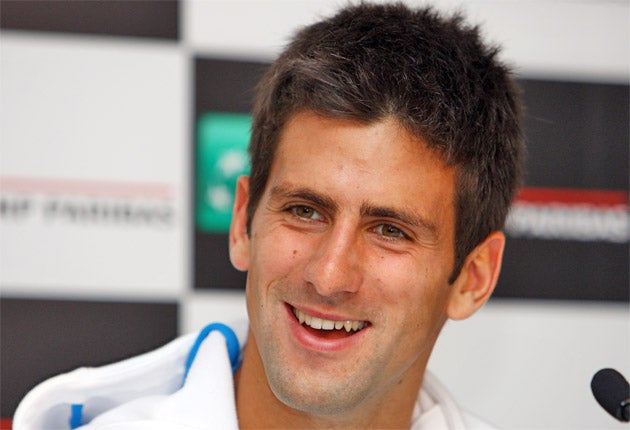
Novak Djokovic arrived for the interview with food rather than tennis at the top of his agenda. "I've just had an unbelievable lunch," the 22-year-old Serb said here at the Shanghai Masters yesterday. "The food here is just incredible. It was sushi, international cuisine, everything."
In a week when the game's leading players have been complaining about the demands of the tennis calendar and the impossibility of maintaining form and fitness through an 11-month season, it was informative to hear the views of someone who is ideally placed to see both the positives and the negatives in the running of tennis, whether he is referring to the chefs or the chiefs.
Djokovic views the arguments from both sides of the uneasy player-tournament divide within the Association of Tennis Professionals, which runs the men's game. He is not only the world No 4 and one of the representatives on the ATP Player Council (alongside Roger Federer and Rafael Nadal) but also responsible, along with members of his family, for the running of the Belgrade clay-court tournament, which was held for the first time earlier this year.
The Serb, who arrived here on Monday night fresh from his tournament victory in Beijing at the weekend, has already sought out Adam Helfant, the new executive chairman and president of the ATP, to register his seal of approval for the two tournaments here in China during the tour's Asia swing.
"It's always important for somebody who works in the ATP to know what the players feel like and how the players like or dislike the tournaments," Djokovic said. "Usually players go to them when they dislike something, but I needed to go and say how much I like the Beijing and Shanghai tournaments. All the small details are just right: the locker rooms, the showers, the balls, the space, the playing room, the quality of the food, everything is of a very high level. This should be an example to all of the other tournaments."
While Djokovic has sympathy with the likes of Andy Roddick, who 24 hours earlier had used the words "ridiculous" and "short-sighted" in discussing the tennis calendar, the Serb preferred to stress the positive response from Helfant to the players' concerns and to emphasise the new mood of co-operation he senses within the game. Djokovic has been at the forefront of discussions that will culminate in a summit meeting of the leading players at next month's ATP World Tour Finals in London.
"The top players will meet in London and then again at the Australian Open in January," Djokovic said. "We will work on doing something that is comfortable to both the players and the tournaments in the future. The tournaments still understand their job and their obligations better than we understand their job – and vice versa. But the players now are more united than ever.
"The current leadership of the ATP is willing to do a lot of things for the players. We have already talked about it at the US Open and we have to dedicate the whole half-a-day meeting to this, because it's a very sensitive task. It affects both players and tournaments. We can't expect just to shorten the season by a month or two, because that would hurt certain tournaments.
"We have to make a compromise. The ATP is an association of tournaments and players together. The bottom line is that you don't want to have injured players. The schedule, in my opinion, is too long, but we have to go step by step and try to solve it."
Djokovic said an improvement in communications between players, tournaments and administrators was a crucial first step in resolving the current differences. He believes a failure on that front in the past has led to some tournaments taking players for granted, with some of the Masters Series events especially at fault, although he exempts the current competition here from any such criticism.
"The tournaments are aware the best players in the world are going to have to come to their events," he said. "I don't say they don't want to improve, but they are not thinking in that direction. I don't think there has been enough communication between the players and the tournaments. In one sense it's just as much the players' fault. Players talk between each other and in the locker room about things that can be improved and then when the time comes to talk and really do something about it they stop."
He added: "I haven't been in tennis for that long, but what I can say is that we have a lot of young guys at the top who are willing to do a lot of good things for tennis in general."
Djokovic had the perfect chance to put theory into practice when his family bought the licence to stage a clay-court tournament in his home city of Belgrade earlier this year. In the space of six months the venue at the Milan Gale Muskatirovic club in the Serbian capital was completely rebuilt.
"The main goal and the priority was that every single person who came as a guest at our tournament would feel good," he said. "That's what we tried to do, starting from the restaurant and the availability of the courts through to the hotel and transport. I asked the players and everyone was happy. Now we have a year to prepare for the next tournament and we are still adding some things. We made more space at the centre court, a pool next to the courts, a bigger players' lounge. There are always things to improve."
While Djokovic's parents and uncle looked after most of the practical arrangements for the tournament, the 2008 Australian Open champion took a personal interest in ensuring that player facilities, such as the practice facilities and locker rooms, were up to scratch.
The Djokovics also wanted the tournament to show the Serbian nation in the best possible light. "After the finals we spread this big Serbian flag all over the whole court and we had the Serbian police academy and the Serbian army perform on the court with three planes flying over," said Djokovic, who won the singles title. "We made a whole show and wanted to leave a good impression on the people who were there and who were watching."
Djokovic begins his campaign in the Shanghai Masters here tonight against Italy's Fabio Fognini. The Serb's recent results – his run to the US Open semi-finals was his best Grand Slam performance of the year and was followed by victory in Beijing – mean that, whatever he does here, he will recapture the world No 3 ranking from Andy Murray next week. Murray did not play last week and is missing here while he continues to recover from an ankle injury.
"It certainly feels great to get the ranking back because I think I deserved it, playing well in the last two or three months, but I'm aware that it's also because Andy has missed the last two weeks in a row," Djokovic said. "I'm trying not to pay too much attention to the rankings because calculations can distract you.
"I just want to continue playing tournament after tournament and staying in good shape and good form. Physically I'm feeling very fit now and mentally I'm motivated to achieve good results."
Join our commenting forum
Join thought-provoking conversations, follow other Independent readers and see their replies
Comments