Law
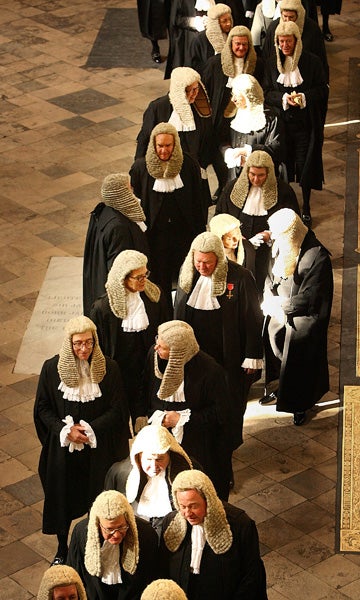
What courses? Law; Accountancy and legal studies; business law; commercial law; criminal law; criminology; European law; European business law; international law; land economy; law with different European languages; maritime law; human rights; politics.
What do you come out with? LLB (Bachelor of Laws), which leads you straight to Part 2 of the Bar or Law Society qualifying examinations. You can also do a BA or a BSc in law, but most do not entitle you to go on to the next level.
Find out more: The insider's guide to working in commercial law
Why do it? "Law is the attempt to subject human conduct to the governance of rules.This highlights what is simple and complex about legal study. We are obliged to simplify a complex reality by conceiving all human relationships - husband-wife, landlord-tenant, employer- employee, citizen-government etc. - as orders of rules. This requires analytical skills in rule-handling. But it must never be forgotten that we are dealing with human conduct. These analytical techniques can be effectively used only once we realize that 'the life of the law is not logic but experience'. Rules are simple, life is complex. Rules aspire to certainty, but life is uncertain. Rules provide stability, but life unsettles our expectations. The key to success? Only connect." - Professor Martin Loughlin, professor of public law and head of department, London School of Economics
What's it about? Learning how to make a proper legal argument whilst equipping yourself with a sound understanding of the foundations of legal knowledge and beyond. Creativity is important, and a degree in law calls for originality and inspiration as well as information and accuracy. Top universities such as LSE encourage students to reflect on the complexity of legal practice and of the variety of ways of understanding law's role in contemporary society. A law degree is renowned for being one of the hardest degrees. You’ll learn skills to help maximise your problem solving and arguing your way out of a tight spot. The laws governing our constitution, criminals, contracts, land, property and jurisprudence (theory of law) are covered in the first year. You then do a range of options, such as environmental, international, tax, family and immigration law. You will be assessed with a combination of exams and projects, plus one or two dissertations. You’ll need a good memory for cases, an analytical brain for seeing round dubious clauses, and the ability to speed-read dusty old documents.
Study options: The course will last three years. Four years if you combine it with a language, spend a year abroad, or study in Scotland. It is possible to do an intensive two-year LLB course. Some institutions also offer practical workshops: at Birmingham City University, for example, you will have the opportunity to work on 'real' cases with 'real' clients at the Legal Advice and Representation Unit, where students will be able to work in a local Citizens Advice Bureau. Cambridge instead focuses more on research, especially in criminology and international law. Together with other universities, such as Oxford, it also offers the possibility to spend one year abroad in France, Spain, the Netherlands or Germany.
What will I need to do it? An A-level in law is neither advantageous nor disadvantageous. Anything goes, although some of the flakier options will be sniffed at. History, politics, maths and english would be useful. Many courses does not have any specific A level requirements, although offers tend to range from A*AA to AAA. Nine universities including Oxford, Birmingham and Bristol, ask the applicants to take the National Admission Test for Law, while Cambridge has its own Law test.
What are my job prospects? Good, although not until you’ve completed the Legal Practice Course or Bar Vocational Course. Hence why the number of students that go straight into further study is so high. According to The Times’ Good University Guide 2012, graduate salaries average £18,911 – lower than one might expect, but trainee wages are notoriously tight, and it’s only later in your career when you start to earn big bucks. Whether you end up in the magic circle of major corporate firms like Freshfields, Clifford Chance Bruckhaus Deringer and Allen & Overy, depends on your having a degree from red brick universities or Oxbridge to a large extent. Plus, there is serious competition from non-law undergrads.
Where’s best to do it? LSE topped the Complete University Guide 2012, followed by Cambridge and Oxford in second and third position respectively and UCL in fourth. Students at Greenwich, Newcastle and Queen Mary are the most satisfied with their courses however.
Related courses: Politics; economics; business and management; sociology; philosophy.
Join our commenting forum
Join thought-provoking conversations, follow other Independent readers and see their replies
Comments
Bookmark popover
Removed from bookmarks