Cutting down on cases of mistaken identity
Yvonne Cook examines the methods being used to improve the accuracy of eyewitness evidence
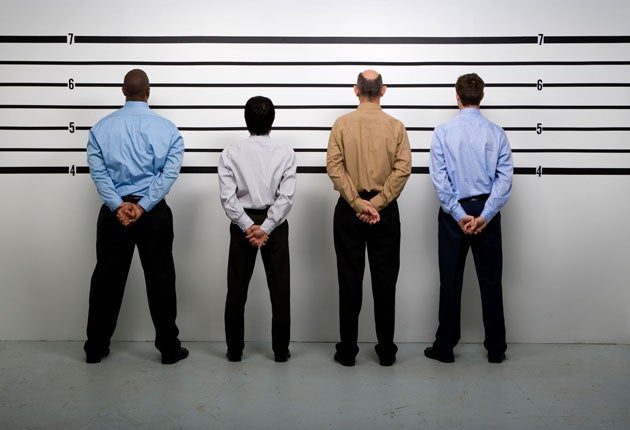
The phrase “I saw it with my own eyes” can sound convincing in a court of law.
But eyewitness identification has been responsible for serious miscarriages of justice. The US Innocence Project, which is dedicated to using DNA evidence to overturn wrongful convictions, estimates that mistaken eyewitness identification plays a role in more than 75 per cent of its cases.
Professor Graham Pike, a member of the Forensic Psychology Research Group based at the Open University, is one of a number of psychologists who have been working with police to reduce the number of misidentifications. He says the key to understanding why eyewitnesses can be so unreliable lies in the psychology of human memory.
“Memory is not like a video of an event which can be replayed endlessly and is always perfect. Human memories alter over time, and are very suggestible,” he says. “In a classic experiment carried out by the psychologist Elizabeth Loftus, witnesses were asked to recall details of a road accident they had seen on film. She found that when the witnesses were asked ‘how fast were the cars going when they smashed into each other?’ they remembered the cars as travelling faster than when they were asked ‘how fast were the cars going when they hit each other?’ Simply changing one word in the question influenced the way people remembered the event.”
In the UK, research such as this has transformed the way witness evidence is collected. The police are now aware that asking a witness “What colour hat was the man wearing?” is likely to cause the witness to remember the man as wearing a hat, even if he wasn’t. Avoiding such leading questions is standard practice in police interviews today.
Under the Police and Criminal Evidence act, eyewitnesses taking part in an identification parade are routinely told that the person being sought for the crime may or may not be present in the parade line-up. Research has shown that this tactic reduces the number of misidentifications. By contrast, asking witnesses “who do you think it is?” suggests that the guilty person must be present in the line-up, and increases the subconscious pressure to pick someone, even if the guilty person is not there.
Psychologists have also demonstrated that people’s memories are less reliable when they are under stress. One direct result of this is the rise of the video identity parade. The Forensic Psychology Research Group worked with West Yorkshire Police in the 1990s to pioneer VIPER, which is now used by more than 30 police forces. Instead of a viewing a line-up of people, the witness or victim is invited to pick the perpetrator from a series of video clips of faces. “This is much less stressful for the witness than coming face to face with the offender at a live identity parade,” says Professor Pike. VIPER also builds on research which showed that presenting the faces of suspects one by one reduces misidentification.
If witnesses are presented with a number of faces all at once, they will be more inclined to pick out “the best match”, and they will tend to do so even if it is not the perpetrator.
The work of the Forensic Psychology Research Group was the inspiration for the BBC2 series Eyewitness, funded by the OU, in which crimes were staged in front of participants and then investigated by the Greater Manchester Police. The group also helped to develop E-FIT, a computer-based PhotoFit system whose results will be familiar to viewers of Crimewatch. EFIT enables witnesses to reconstruct an image of the suspect’s face on a computer; it has largely superseded the old hand-drawn “artist’s impression”.
“Eyewitnesses not only have to try to picture the face of the perpetrator in their mind, they have to translate this visual image into a verbal description," says Professor Pike. “Both of these actions are very hard to do, which is why systems such as PhotoFIT and E-FIT were developed. These enable a witness to construct a picture of the perpetrator’s face visually, by searching through albums of individual features and then putting these together to form a whole face.”
There is a snag, though. “The problem is that we do not recognise faces feature by feature, and do not store faces in our memories as collections of nose and eyes and so on. Instead we remember the whole face, and therefore find it difficult to picture individual features in our mind and to construct faces one feature at a time.”
E-FIT was developed to take advantage of this psychological insight, by using a whole face as the starting point, with witnesses changing the features one by one to match the details they can remember.
“The introduction of video identity parades and the professionalisation of the police interview have significantly reduced the number of misidentifications, and psychologists are continuing to refine and develop these areas,” says Professor Pike. But the nature of human memory has not changed, and jurors at British trials are warned about the fallibility of eyewitness evidence. Eyewitnesses will continue to ply a key role in criminal trials, though, if for no other reason than we have nothing better, says Professor Pike.
“Although we have some fantastic forensic techniques such as DNA analysis, they still have their limitations. For some crimes, they can be good at proving that someone was at the crime scene, but less good in determining exactly what they did there. Often the only direct evidence of what happened comes from an eyewitness. In the future, technology may replace eyewitnesses, but we are not there yet.”
How forensic evidence is constructed and used in court is the theme of a conference being held at the Open University on 7 and 8 July. The conference will also explore public understanding of forensic science, particularly how well jurors can distinguish between forensic science fact and fiction. Details at www.open.ac.uk/icccr/events.shtml
The Open University has developed a widget called PhotoFitMe, based on E-FIT, which lets you put together a virtual face from individual features. You can try it out here.
Join our commenting forum
Join thought-provoking conversations, follow other Independent readers and see their replies
Comments
Bookmark popover
Removed from bookmarks