This shocking honeymoon murder should not stop us travelling to Antigua
The shooting of the Mullanys has highlighted the increasing problem of violent crime in the Caribbean. But the way to make the region safe is to keep visiting, says Travel Editor Kate Simon
The shocking murder of Catherine Mullany in Antigua last Sunday has reignited debate about the security of tourists visiting the Caribbean. And although the government of the two-island state of Antigua and Barbuda has been quick to point out that this is its first murder of a tourist in 10 years, violent crime is on the increase on the island and across the region.
The killing of a tourist is guaranteed to grab the headlines, but the problem of violent crime is one that islanders have had to endure for some time. Murder statistics for the Caribbean are undeniably disturbing – it is one of the most dangerous places on earth.
According to a 2007 study by the World Bank and the United Nations Office on Drugs and Crime, the region has a murder rate of 30 per 100,000 inhabitants, more than four times the figure for North America and 15 times the average for Western and Central Europe.
Jamaica has long been dogged with a poor reputation for security, suffering the ignominy of being dubbed "murder capital of the world" in the past. And although the most recent recorded homicide rate has shown a 15 per cent drop, it still stands at a staggering 49 per 100,000 inhabitants, one of the worst in the world.
Trinidad and Tobago has seen its murder rate quadruple over the past decade, with violent crime figures for other places, including the Dominican Republic, St Lucia and Antigua, following an upward trend.
Such a gloomy picture is less inviting than the idyllic tropical paradise painted by the island's marketeers. But the reality is that the victims are usually locals and returning family caught in the crossfire of poverty and drug trafficking; the Caribbean has the misfortune of sitting between the source of cocaine, South America, and the main illegal drug markets – the US and Europe. The spiralling violence is curtailing daily life for islanders across the region – but in truth, it very rarely impinges on the experience of tourists, hence the Caribbean remains one of our favourite holiday destinations.
Gordon Campbell Gray, whose luxury hotel portfolio includes Antigua's five-star Carlisle Bay, just along the coast from Cocos Hotel where the Mullanys were attacked, confirms that the visitor's experience is generally very positive. "I've been going to the island for years and I haven't felt safer anywhere," he says. "We've always had 24-hour patrols, but more to make sure our guests weren't pestered."
He confirms that security arrangements at Carlisle Bay are under review following the murder, but maintains that guests should feel safe. No one has cancelled their booking so far, he says. But other tour operators and hotels have reported cancellations, and the murder is likely to have negative repercussions for the island's tourism industry.
Some 33,000 British holidaymakers visit Antigua each year, and tourism provides most of the foreign-exchange earnings, employment and revenue, amounting to 50 per cent of gross domestic product (GDP) for the twin-island state. Around 75 per cent of the workforce is employed in hotels and restaurants.
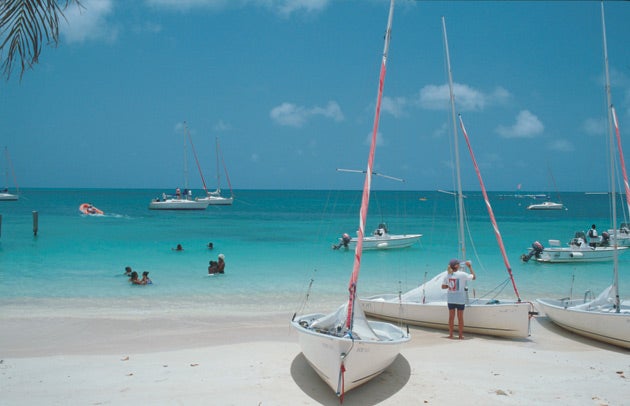
It's no surprise that Catherine and her husband, Benjamin, chose Antigua for their honeymoon. The island has all the essentials for such a celebration: temperatures commonly in the eighties cooled by the trade winds, low humidity, an average of just 10 rainy days a year, 365 beaches – one for every day of the year, as the island's cliché goes – and high-quality tourist accommodation.
As well as its fly-and-flop assets, there are also a few interesting sights to see, including the ruins of Betty's Hope, Antigua's first sugar plantation, built in the 1650s, and Nelson's Dockyard, the only remaining example of a Georgian fort.
The traditional Shirley Heights Sunday-night jump-up has become such a draw for visitors keen to mingle with the islanders that it has turned into a tourist trap. Long gone are the days when visitors imprisoned themselves in their resorts, fearful of meeting the locals.
Plus, Antigua is one of the easier Caribbean islands to reach from the UK. The VC Bird International Airport hosts British Airways five times a week and Virgin Atlantic three times a week, all-year-round. Both carriers continue on to other former British colonies, including Grenada, St Lucia and Tobago, making multi-centre trips possible, and the inter-island airline, Liat, enables exploration further afield.
Compared to Barbados's "platinum coast", where hotels and resorts appear to squeeze use out of every inch of space along its eastern shoreline, Antigua is relatively undeveloped. But the landscape has been changing. Catherine Mullany's murder comes just as the island has been enjoying a surge of investment in its tourist infrastructure, and increased popularity with holidaymakers.
Carol Hay, director of tourism for Antigua and Barbuda, explains: "There has been major growth in tourism on the island, with an increase in boutique-type properties, offering a more upmarket experience."
She confirms that, in the past year, three luxury hotels have opened: The Verandah Resort and Spa, a 200-room complex on the east coast; Hermitage Bay, offering 25 cottage-style suites on the west coast; and the 114-room Hodges Bay Club, on the north shore. Sandals has had a revamp and Blue Waters is adding rooms. Improvements have also been made to the shops in the capital, St John's, including a large undercover crafts market.
Tourism has been crucial to the prosperity of Antiguans and is key to stopping further incursions by the drug lords. The offer of more than £60,000 as a reward for finding Catherine's killers – made by the Antigua Hotels and Tourist Association and a private businessman – underlines the level of concern locally about her murder.
Meanwhile, Antigua's authorities say they are committed to reversing the increase in violent crime and earlier this year they engaged Gary Nelson, a former Canadian Mountie, as police chief, to shake up anti-crime operations.
Much of the Caribbean's tourist industry is winding down for the low season – this is the time when hurricanes are most likely to hit the region – and it won't pick up again until October. But the murder of Catherine Mullany is likely to dwell on the minds of holidaymakers when choosing a destination for some sunshine this winter.
It will be a tough task for Antiguans to persuade these tourists to visit their island. But as Carol Hay says: "Even at this tragic time, it is important that we maintain a sense of perspective." The fact is, the best way to help the Caribbean become safer for locals and tourists is to continue to travel to this beautiful part of the world.
How to get there
Kate Simon travelled to Antigua with British Airways Prestige Collection (0844 493 0752; ba.com/holidays), which offers seven nights at Carlisle Bay in Antigua from £2,059 per person, based on two sharing, departing October, including return flights with British Airways from Gatwick, private transfers and B&B. UK connecting flights are available from £86 per person from most regional airports.
Further information
Antigua and Barbuda Tourist Office (020-7258 0070; antigua-barbuda.com).
Join our commenting forum
Join thought-provoking conversations, follow other Independent readers and see their replies
Comments
Bookmark popover
Removed from bookmarks