Best for weather-watching: India
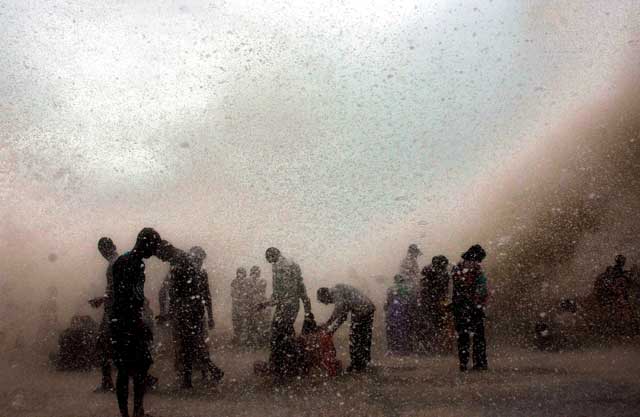
It's the winds that bring it. They come in from the east, a cool rush that lifts the dust of a long dry summer and a lock of hair from your head. You lift your head, too, and the air darkens; a shift in pressure that strokes its way down your back. You didn't realise how taut the air was until now. A rumble, a crack, the splashdown of a heavy droplet as big as a fingertip and then it's on you. Words drown in the roar of water streaming through gutters and rushing through streets. At night, flashes of lightening turn mouldering skies an electric, quasar purple. This is a weather event.
The southwest monsoon sweeps in to India from the Arabian Sea, driven by the temperature difference between a land hot from the summer and the colder ocean. It splits into two over the Indian peninsula, one arm curling in over the southwest coast towards the Western Ghats; the other flowing up towards the Bay of Bengal to marry with tropical cyclones and depressions before hurling rain on to northeast India.
About 80 per cent of India's yearly rainfall is delivered by the southwest monsoon in just three or four months: it is the country's lifeblood, and a rich tapestry of culture exists around it, even as modern India moves away from its agrarian roots. If the rains are late, desperation sets in: women in Uttar Pradesh even yoke themselves to ploughs in the middle of the night, replacing the oxen with their own naked bodies in an attempt to embarrass the Rain God into delivering water from the skies.
Some communities believe the rain that falls during the monsoon has magical qualities. Keralan fishermen attest that fish swim at the water's surface with their mouths open to catch it, and traditional lore advises that farmers drink a handful each day – as one day there will be a rain of nectar. Rivers flow, flowers bloom, food is tastier. There is a saying that even a human finger, if it were planted at this time, would sprout.
Such rampant fertility has not been lost on artists. Sanskrit poetry on the monsoon is sensual and erotic, replete with symbolic imagery of opening flowers and clouds emptying themselves over women's breasts. Because the heavy rains restricted travel and warfare, men would hurry home for three months devoted to family and festivity, and the monsoon was therefore also associated with domestic bliss and sexual satisfaction. In Tamil Nadu, women celebrate the rising of the sacred river Kaveri as the swelling of the river goddess's pregnant belly, floating lit lamps made from jaggery and rice flour downstream: delicacies for the expecting deity.
That's not to say the monsoon is uniformly welcomed. Every year the onslaught of water brings havoc, claiming lives and destroying homes. For city dwellers, in particular, the monsoon is often a pain, disrupting their urbanite calendar. Concrete also creates problems, giving rise to run-off reminiscent of small rivers. When the plumbing system can't handle it, the drains regurgitate water like underground volcanoes. People are swept away and buses slide down roads on the cascade of water, pulling under anything in their path. Contact with dirty flood water causes rashes to flower on young skin and incidences of cholera and malaria increase where there are pools of standing water. Hundreds die every year.
But it is this dichotomy – the ability to murder and to create – that gives the monsoon its significance. It's an inherently feminine duality, a contradiction understood by Hindu mythology: stories of the goddess Kali describe her licking up the blood of her enemies on the battlefield. Like the sudden shift from parched to drenched, the duality is also passionate, precarious and unmistakably Indian. It speaks of a country where existence is less cosseted and everyone swings just a little closer to the mortality line.
Climate capers
# During storm-watching season (March to November) see ferocious Pacific waves as they pound the cliffs, bringing driftwood and trees into land, or set off in search of bears at the Black Rock Resort, Vancouver. Bridge & Wickers (bridgeand wickers.co.uk) offers three nights from £189.
# Explore the Arctic's Northwest Passage. Watch and wait as the summer sun creates a pathway through the polar ice. Tailor Made Travel (0800 988 5887; tailor-made-travel.com) offers a 12-day trip through part of the Passage, from Resolute to Cambridge Bay, from £3,460, flights not included.
# There's nowhere like Iceland for barometric magic – and with lava fields as backdrops, active volcanoes and scant population, this island offers serious natural drama, especially on its western reaches. Try the striking, black-clad Hotel Budir (hotelbudir.is). Rooms from £88.
# Expect a peak in the Northern Lights above Tromso, in Norway's Arctic Circle this coming winter. After the recent trough in the solar activity that causes the Aurora Borealis, the heavens are expected to be working their celestial light magic once again. See scantours. co.uk; trips from £660.
# In April, Thailand celebrates with the Songkran festival – which involves a lot of water. In Chang Mai, expect buckets to be chucked over unsuspecting tourists, drive-by shootings with water pistols and even monks joining in the fun. For tailor-made tours see audleytravel.com.
Join our commenting forum
Join thought-provoking conversations, follow other Independent readers and see their replies
Comments