A prize-winner's tale about the giants of Malta
Marie Kreft, who won our travel-writing competition in 2010, follows a history trail
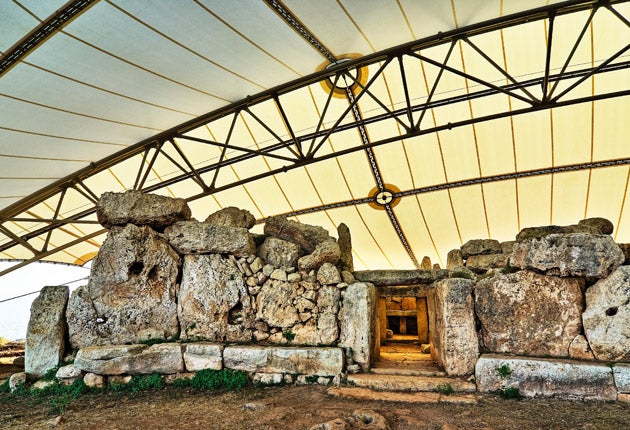
I'd always thought of Malta as a package-holiday destination; its history and beauty squashed between high-rise hotels.
But as I find myself on a quiet patch of the island's west coast, walking down a gentle slope to the remains of some of the oldest religious sites on earth, I start to change my mind.
Hagar Qim and Mnajdra are megalithic temple complexes, hewn from sand-coloured limestone and set near an expanse of Mediterranean blue. Evidence of similarly mysterious sites is scattered across Malta and its little-sister island Gozo, some just unassuming clusters of stones. The earliest temples were built in 3,600BC, predating the Egyptian pyramids by nearly a thousand years.
Since their unearthing in 1839 and 1840, Hagar Qim and Mnajdra have suffered damage from the elements. Restoration work has had varied results. The temples' vulnerable position by the ocean means that they are the first sites to be given protective canopies by the EU and Maltese government: cream awnings stretched taut over steel arches. But in the shade of this modern covering, the stones still resemble altars, benches and annexes, whispering secrets from a time long gone.
This is a Unesco World Heritage site but in late October, when I visit, it almost echoes with a lack of visitors. "Do you think Malta is making enough of the temples with tourists?" I ask Darrell Azzopardi, my guide, as we study one of Hagar Qim's largest megaliths. It is more than six metres (20ft) long and thought to weigh 20 tons: I can understand why Gozo's best-preserved temple site was named Ggantija, meaning "gigantic" or "of the giants".
"We can never make enough of the temples because we always need more visitors," Darrell says. "But it's not enough to promote Malta for the temples only. We have to integrate this prehistory with the rest of the history here."
And what a history. Malta's position at the heart of the Mediterranean meant it was occupied by the Phoenicians, Greeks, Romans, French and British. It has seen wars and sieges, invasion and bombings, and rule by the Knights of St John. But today I'm intrigued by what came before; the puzzle of the people who designed and constructed these temples without written language or sophisticated tools.
I admire the pitted decoration on what is believed to be the altar stone of Mnajdra's East Temple. Some astronomers think the marks represent a tally of days between the appearances of certain stars. I'm fascinated by the idea that, during equinoxes, the sun rises in perfect alignment with the main axis of the South Temple. During summer and winter solstices it aligns with the door jambs, so only a slither of light enters.
The canopies above us caused controversy when they were introduced in 2009 in a conservation and development project costing ¤4.7m (£4.1m), which included building a visitors' centre. They are only an interim measure to protect the limestone until a less intrusive method can be found, yet people still complain about the canopies' visual impact, and, of course, their expense. "I think the site would look better left as it was," says Darrell. "But this measure was needed. In a hundred years' time the temples would have crumbled."
I don't mind the canopies. For me, their sail-like curves sit well beside the calmly rolling ocean, and they let in light. The corbelled wall structure hints that the temples may once have had roofs – made from a perishable material such as grass or wood – and so the artificial cover creates atmosphere in the temple rooms, which aids my imagination.
As we wander back to the visitors' centre, officially opened last September by Malta's prime minister Lawrence Gonzi, Darrell talks about Heritage Malta's plans to create a nature walk at this site. It's an ideal spot: wild rosemary and Mediterranean thyme are known to spring up from the soft scrubland, alongside dandelions and delightfully named spurge, fleabane and sea squill. This is a home for weasels and wall lizards, while two birds, Sardinian warblers and Zitting Cisticolas, visit to breed. In February and March when cape sorrel is flowering, the ground turns yellow.
Best of all, on this western coastal edge, there are no high-rise hotels to cast shadows over the island's prehistoric giants. Glancing back at the canopied temples, I'm pleased to have changed my mind about Malta.
Compact Facts
How to get there
Marie Kreft was a guest of Visit Malta (visitmalta.com). She travelled with EasyJet (easyjet.com), which offers return fares from £39.99, and stayed at The Palace (thepalace malta.com), at Sliema on Malta, where doubles cost from €135 (£118) per night, and the Kempinski Hotel San Lawrenz (kempinski.com/en/gozo) on Gozo, which offers rooms from €115 (£100) per night.
Further information
Darrell Azzopardi can be contacted direct at dazman@onvol.net. Heritage Malta (heritagemalta.org).
Now write your winning travel feature...
Win a trip to Turkey and a writing commission
Can you write a winning travel article? We're inviting all writers, published and unpublished, to enter the Independent on Sunday/Bradt travel-writing competition to win an exciting holiday and a commission for this newspaper's travel pages.
This year's prize is a trip for two to eastern Turkey, plus the winning entry will be published in The IoS Travel section. The winner will also earn a commission from this paper to write a piece about the prize holiday. And there is an extra category for unpublished writers, with a prize of a place on a travel-writing weekend course overseas.
To offer this opportunity, we have again teamed up with Bradt Travel Guides (bradtguides.com), publisher of pioneering guides to offbeat destinations and guides with unique perspectives on more popular spots.
How to enter
Write a piece on this year's theme – "Up the Creek" – basing your story on a personal experience. The theme can be interpreted as a metaphor or taken literally. Your article should be between 600 and 800 words. Submit your entry on line at bradtguides.com/travelwriting, or post it to Bradt Travel Guides (Travel-Writing Competition), 23 High Street, Chalfont St Peter, Bucks SL9 9QE, UK. The closing date is noon on Friday 20 May 2011. For full rules, go to independent.co.uk/travel.
The competition judges will be Hilary Bradt, Donald Greig and Adrian Phillips of Bradt Travel Guides, Jonathan Lorie of Travellers' Tales and Kate Simon, Travel Editor of The IoS. The winner will be selected from a shortlist of about six articles by travel writer, broadcaster and columnist Matthew Parris and announced at an event held at Stanfords in London, the UK's leading travel bookshop.
The prizes
The holiday for two to eastern Turkey has been donated by Turkish specialist operator Anatolian Sky Holidays in conjunction with the Turkish Culture and Tourism Office.
You'll win two places on a small group tour departing on dates in September 2011 or May 2012. There are two possible seven-night itineraries: the south-eastern Anatolian tour takes in the stone heads of Mount Nemrut, the mosaics of Zeugma and the lake of sacred carp at Sanliurfa; the north-eastern tour starts at Lake Van and includes visits to the palace of Ishak Pasha and the ancient city of Ani before reaching the Black Sea coast. Transport is in an air-conditioned minibus with a professional English-speaking guide, and entrance to historic sites is included. Accommodation will be in three- or four-star standard hotels on a half-board basis and lunch is provided. Flights from the UK will be on scheduled services with Turkish Airlines.
The prize in the unpublished writers' category is a place on a travel writing weekend overseas with top travel writing training agency Travellers' Tales (travellerstales.org).
Could you write a travel book?
Bradt is launching a new series of travel literature (the first titles will be published in spring 2012), and welcomes synopses from writers, new or published. To find out more go to bradtguides.com
For full competition rules please follow the related link above.
Join our commenting forum
Join thought-provoking conversations, follow other Independent readers and see their replies
Comments
Bookmark popover
Removed from bookmarks