Guernica: A brush with history
The bombing of Guernica 75 years ago inspired one of Picasso's best-known works. Now, visitors to this iconic part of Spain's Basque Country will discover a town devoted to peace
It's a Sunday evening when I arrive in Guernica. In the pedestrianised main street, lined with bars and restaurants, locals drown the end of the weekend in a glass of rioja or the Basque white wine txakoli. Plenty are eating their way through the pintxos (like tapas) heaped on the counters. Rolls filled with bacalao (salted cod) and dried red peppers are a local speciality, but there are also tortillas stuffed with potatoes, herbs and cheese, as well as cured ham and anchovies.
Just half an hour's drive east from the cosmopolitan razzmatazz of Bilbao, this is the Basque Country's spiritual heartland. Guernica, spelled Gernika in its native Basque, is a modest market town – it has a population of 16,000 – and everyone seems to know each other.
Locally, Guernica is known for its Assembly House, with its glorious stained-glass windows and oil paintings, and the oak tree under which the laws for the region of Vizcaya were made from ancient times. To the Basques, Guernica represents freedom and democracy. To the rest of the world, it's known for an act more violent by far.
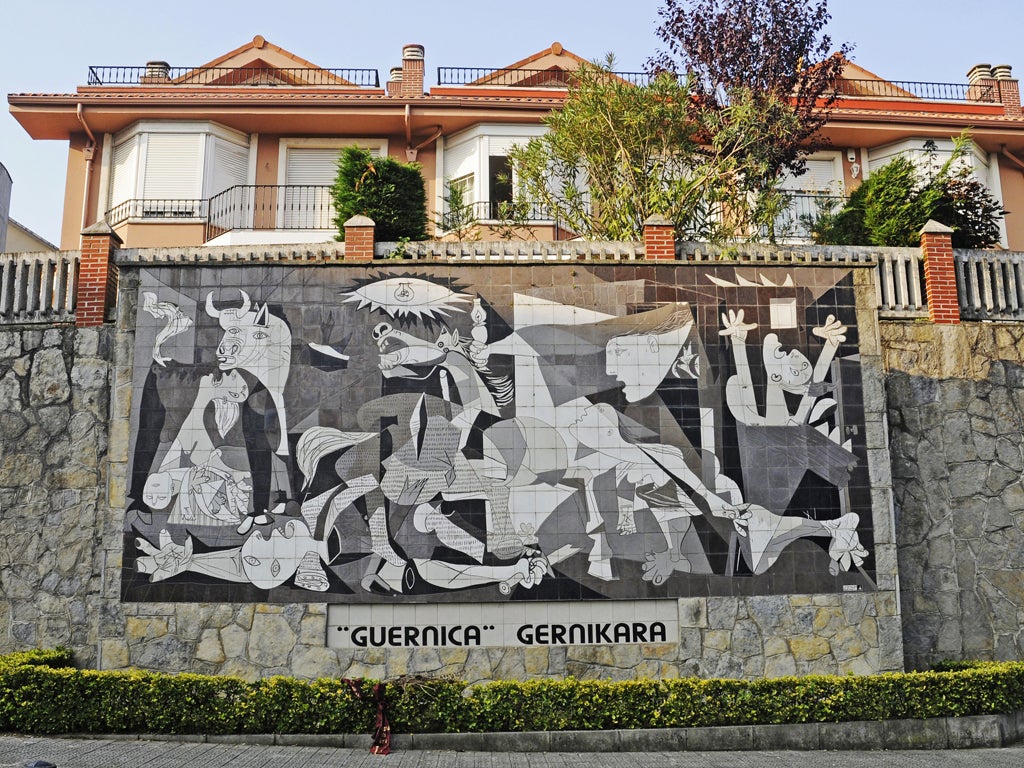
Seventy-five years ago tomorrow, on 26 April 1937, the German Luftwaffe bombed Guernica. Called in by Franco's Nationalist forces, the warplanes killed 1,600 people, according to the Basque authorities, and wiped out 70 per cent of the town's buildings. The story was reported by The Times journalist George Steer; it was picked up by the French newspaper L'Humanité and read by Pablo Picasso, who lived in Paris and immediately started work on the vast monochrome painting that would immortalise the name Guernica.
"When I was first shown the painting, I said, 'That is Guernica?'" Luis Iriondo laughs. Iriondo was born in Guernica and still lives there today. He was only 14 when the bombs fell; he's now nearly 90 but beyond a few brown liver spots around his temples, his face doesn't betray his age.
His memories are sharp. "There was a bull and a horse in the picture, and they're not animals we have much round here. If there'd been a cow and a donkey, well, OK." Later, though, he noticed similarities. "A friend said to me, 'You know what happened to Fernando's mother? She came out with the body of his little brother, clutched in her arms.' It's odd that in the picture there's a woman like that."
It was a Monday – market day – and the town's population was swelled by those from nearby villages who'd come to sell, buy and catch up on gossip. By afternoon, when the church bells began to peal as a warning that aircraft had been sighted, the stallholders had packed up and Iriondo was returning after lunch to the branch of the Bilbao-Vizcaya bank where he worked as an office boy. (The school had closed because the teachers had gone away to fight in the civil war, and after he and his friends found three pistols to play with – "fortunately we couldn't find bullets for two of them" – his mother had decided he needed employment.)
He didn't want to go to the shelter. There had been air-raid warnings before and the shelter was boring. A colleague insisted, however, that they go together. "I never saw that man again in my life," he tells me as he recalls the events of that day.
Today, a traveller passing through Spain's Basque Country lands who is unaware of Guernica's tragic back-story would be unlikely to notice anything unusual: inland from the rugged Atlantic coast, the landscape is softer here, the hills draped in green. But plenty of people who have seen Picasso's picture in the Reina Sofia Museum in Madrid make a pilgrimage to the town that it depicts.
So how does Iriondo feel about the fact that, across the world, the name of his town is associated with an atrocity of war? "Here in Guernica," he says, "the painting is seen as a picture for peace."
Guernica's current mayor, Jose Maria Gorroño, insists that the town, as well as the painting, has been successful in promoting reconciliation. "I don't believe that people think of Guernica as being linked to violence. It's quite the opposite. What the town of Guernica has done is transform violence into a culture of peace."
The efforts made by the town to promote peace and reconciliation are evident to the visitor 75 years on. After talking to Iriondo, I visit the Guernica Peace Museum, which focuses on different interpretations of the term "peace"; on the bombardment of 1937; and on peace in the world in the 21st century. It offers educational workshops and hosts conferences and seminars on the theme, and each year nominates global winners for the Guernica Awards for Peace and Reconciliation.
The town is twinned with Pforzheim in Germany, which suffered a devastating air raid from the RAF in 1945; adults and schoolchildren are involved in annual exchange programmes.
Up above the town, in green parkland, I stroll past a sculpture by Henry Moore (Large Figure in a Shelter) and one by the Basque sculptor Eduardo Chillida (Our Father's House), installed to represent Guernica's status as a city of peace.
"And it was no coincidence that the Guernica Agreement, which was signed two years ago, has that name," Mayor Gorroño says. It was through the Guernica Agreement that Eta announced a permanent ceasefire: though signed in Bilbao, its name confirms that Guernica holds an important place in the heart of the Basques not only for its ancient rites, but for its recent work, too.
Luis Iriondo was one of the lucky ones that day in 1937. When the bombs stopped falling, he emerged from the shelter to find Guernica ablaze. He ran to the nearby hamlet of Lumo, where he was given a bed in a stable with some animals. "In the middle of the night, I woke up. I heard someone shouting my name. It was my mother, standing in the square, calling for me. Somebody had told her they'd seen me running in that direction."
It's Monday now – market day, still – and the sky is clear, just as it was that Monday 75 years ago. The shelter where Iriondo took refuge has since been refitted as the ladies' loo in an old people's day centre. I leave it, and walk across to the market, just as it's closing up.
Green-painted trestle-tables are loaded with the beans for which this part of the Basque Country is famous, plus leeks, gargantuan squashes, home-made chorizo and artisanal cheese. Young men, mothers with pushchairs, and elderly couples wander away with their shopping bags, chattering in a mixture of Spanish and Basque.
The town was rebuilt long ago, and has flourished: it's grown to more than three times the size it was in 1937. But the people of Guernica still commemorate that day 75 years ago. "Lo importante es no olvidar," Mayor Gorroño says. "The important thing is not to forget."
Travel Essentials
Getting there
The nearest airport to Guernica is Bilbao, which is served from Heathrow by Vueling (0906 754 7541; vueling.com) and from Stansted by easyJet (0843 104 5000; easyJet.com).
Seeing there
Gernika Hotel (00 34 94 625 03 50; hotel-gernika.com). Doubles start at €70, room only.
Boliña Hotel (00 34 94 625 03 00; hotelbolina.es). Doubles start at €40, including breakfast.
More information
Spanish Tourist Office: 020 7486 8077; spain.info
Join our commenting forum
Join thought-provoking conversations, follow other Independent readers and see their replies
Comments