Secret garden: Explore Valencia's Sierra de Irta
Stretched out between two Spanish resort towns lies a rocky, undeveloped landscape. Mick Webb explores the area with no map and just a wild boar for company
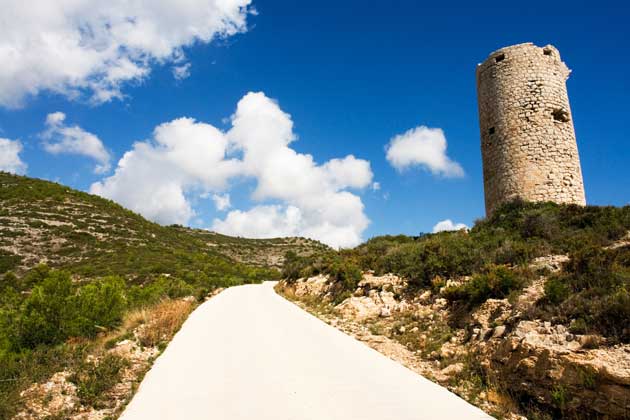
Amazing as it may seem, there is a stretch of land halfway down the east coast of Spain, just two hours' drive from Barcelona, which is unspoilt, undeveloped and largely unvisited.
Set between the extremely busy holiday town of Peñíscola and the less thronged resort of Alcossebre, it's a rectangular and mountainous outcrop of rock, about 20km long and 10km wide, called the Sierra de Irta, one of the protected spaces maintained by the region of Valencia.
Irta was a mystery to me – as it is to many other visitors – when I arrived last year in Alcossebre for a family holiday. But there it was, on the very doorstep of our rented apartment, just demanding to be explored. And the only way of doing that was on foot.
So, every morning I dragged myself out of bed (helped in no small way by the unfailingly blue skies), packed a small rucksack with a compass, camera, pen, paper and binoculars (I would have included a map if I'd been able to find one) and set out into the sierra feeling like a version of that great explorer of Spanish landscapes, Laurie Lee.
The first expedition was not entirely successful: I left the apartment block on a well-marked track, heading in the direction of a forbidding cliff which marked the edge of the Sierra de Irta. But after 20 minutes or so the path ended abruptly at the municipal water cistern, and any further progress was impeded by serried ranks of gorse bushes.
Undeterred, I tried another direction, down the hill this time and into the barranco, or gorge, which was thickly wooded with pines. Beyond it a path seemed to climb towards the the top of the cliff via a gentler ridge. A short way into the trees I caught the pungent scent of an animal and heard a loud crashing very close at hand, but failed to spot the cause of it. A dog appeared, excited by the activity, followed by its owner, an oldish chap, very bronzed, in shorts and a golf cap.
"Buenos dias, hay un animal grande..." I started to explain before he interrupted me in blunt, northern English tones: "That was wild boar, you know. You ought to be careful down here; the females can be very dangerous."
He turned out to be a local expatriate who lived all year round in Alcossebre. As his dog-walking activities had acquainted him not just with the local fauna but also the local footpaths he was able to suggest a more sensible route up to the sierra, which I decided to leave for another day, as by 10.30am the sun was high and already extremely hot.
The next day I added a stick, a cap, powerful sunblock and a water bottle to my bag of essential supplies, along with a penknife – not that I intended to take on a wild boar, but it made me feel braver.
The new path did indeed connect with the ridge and then led away from the main resort of Alcossebre to the suburb of El Pinar, where those with money had built rather grand and often eccentric villas up above the madding crowds and a bit closer to the cooling breezes. There was also a restaurant (El Pinar, Urbanizació*Pinar; 00 34 96 441 2266) with wonderful sea views. Indeed, we later returned here and tried some interesting dishes, among which was wild boar, which I felt had my name on it.
Just as Alcossebre is not a very substantial town, more of a holiday annex of Alcalà de Xibert (10km inland), the main focus of most holidaymakers'attention is not the mountains but the impressive beaches that stretch for 6km or so southwards from the rugged shoreline of Irta towards the flat lands around Torreblanca. The town beach of El Carregador was where we usually enjoyed a morning swim before retreating to our shaded terrace to sit out the scorching midday period.
Pleasingly – for me anyway – there was precious little in the way of expensive or dangerous fun to be had on Alcossebre's beaches: no banana boats, no jet skis, nor even any windsurfing, although all these distractions can be found an hour's drive away at Peñíscola or Oropesa.
As a substitute, our teenage boys resorted to attempts to drown one another in the quicksand created by the unusual freshwater springs at the Platja de Les Fonts. These also produce a layer of chilly, soft water which floats on top of the generally very warm sea.
The scope of my morning sorties had been curtailed by lack of a decent map, and neither the newsagents nor the tourist office could come up with anything of a scale that would suit a walker. But the issue was resolved unexpectedly during an evening paseo along the promenade: a large information panel showed in detail a number of paths through the Sierra de Irta. I copied them down as best I could and resumed my morning expeditions.
The key to the heart of the mountains was a path that led up a steep, rocky spur to a tiny church whose silhouette could just be made out from sea level. This was la Ermita de San Benet, and the local council had provided wooden balustrades and ropes to help even the unfittest of believers reach the 17th-century chapel. Wonderful views stretch down the coast, and on a clear day onwards to the islands of Columbrete, an offshore nature reserve.
From here a waymarked path leads along the central backbone of the Serra towards its highest point, the 672m Torre de Campanilles. The views are spectacular and the countryside is classically mediterranean: pine woods and scrub with juniper bushes, dwarf palm trees and a carpet of herbs.
An hour into the walk is the Torre Ebri, a circular watchtower, whose twin, the Torre Badum can be found by the sea closer to Peñíscola. From Campanilles a long scramble takes you down the Barranco de la Parra gulley and then to the sea, from where it's a relatively easy walk back along the coast to Alcossebre past some tiny, rocky coves that are ideal for snorkelling.
There are other walks on the Peñíscola side of the Sierra de Irta, in particular a circular walk (called the PR-V 194), described in a leaflet from the local tourist office. It's also possible to walk the whole length of the sierra, from Alcossebre to Peñíscola or vice versa, either along the coast or following the mountain ridge. These day-long treks are better undertaken outside the hot summer months.
My own favourite walks were actually closer to home, enlivened by the exotic birdlife. One morning I saw the brilliant yellow flash of a pair of golden orioles (left). On another occasion I saw a number of black wheatears. An occasional hoopoe swooped by, while a flock of around 20 bee-eaters had nested in the sandy banks of a dried-up river bed; their aerobatics, stunning colours and liquid musical notes provided a regular spectacle of natural son et lumière.
Best of all, on the last day was the sight of a large, pale bird of prey flying across the barranco – a young, short-toed eagle – holding its favourite meal, a long snake, in its talons.
Alcossebre tourist office (alcossebre.org); Peñíscola tourist office (peniscola.org)
Join our commenting forum
Join thought-provoking conversations, follow other Independent readers and see their replies
Comments
Bookmark popover
Removed from bookmarks