The Independent's journalism is supported by our readers. When you purchase through links on our site, we may earn commission.
Turku: a beacon in the Baltic
The Finnish city of Turku is expecting more than two million visitors during its time as European Capital of Culture for 2011. And now's the perfect time to visit this enlightened wonderland, says Jo Caird
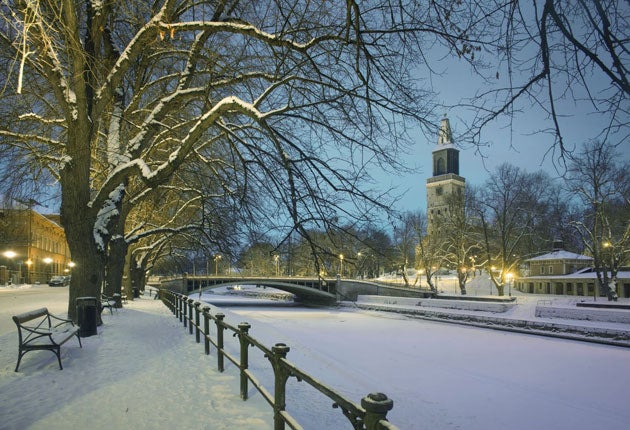
Turku's 13th-century cathedral is an impressive sight, standing dark and tall against the gleam of the surrounding snow-covered ground. In its shadow, shining like a beacon in the gathering gloom of the winter afternoon, is a small, paper-walled shed, its door open to welcome passers-by in from the cold.
Stepping inside this "Cot of Darkness" offers not just shelter from the bitter chill, but also a glimpse into the psyche of this port city. This artist-designed structure, along with the other "cots" dotted around the place, is part of "876 Shades of Darkness", a project celebrating Finland's long, bleak winters. It treats them as a positive resource: a time for quiet contemplation and a period in which to appreciate the power of light. Rather than bemoaning their country's seasonal shortcomings, the people of Turku view their situation with optimism and humour. It's an attitude that shines through a lot of other aspects of life here.
For centuries under Swedish rule, Turku was Finland's most important city – a centre for culture, trade and political power. Then, in the 1800s, following a power grab by Russia and the transfer of government to Helsinki, Turku's star faded. Its decline was exacerbated by a fire in 1827 that destroyed much of the city.
Turku's time in the artistic sun will begin when it becomes – along with Tallinn, across the Baltic in Estonia – European Capital of Culture for 2011. The cultural programme for the coming year is impressive. Thousands of visual arts, theatre, dance and musical events will take place under the umbrella of 150 large projects, beginning with an opening burst of events from 14-16 January. The city is expecting two million visitors during 2011.
Much of the cityscape is dominated by low-level 1970s monstrosities. But there are pockets of picturesque 19th-century architecture that provide a backdrop for some lovely city strolls. The areas around the cathedral and across the River Aura towards the Central Library are a case in point, home to both imposing terraces and the beautifully conserved, painted clapboard houses that were built for city workers after the great fire in 1827.
Leaving my cot, I set off on foot, following the course of the Aura in search of the Rittig Palace, a grand building from the 1920s that overlooks the river. It houses Aboa Vetus & Ars Nova (Old Turku & New Art), a modern art gallery with an archaeological museum underneath it. It was established when the building's foundations were excavated and the contractors discovered a warren of medieval streets. The two museums complement each other, encapsulating Turku's pride in its heritage and the city's ambition as a centre for creativity.
Heading north towards the train station, I found the building at the heart of Turku's creative ambitions. A converted 19th-century railway yard and workshop, Logomo is home to a 1,200-seat theatre and five enormous exhibition spaces, as well as a 3,500-seat
auditorium that will open towards the end of the 2011. They were still putting the finishing touches to the building when I visited, but I was awed by the extraordinary scale of the place. Think of several Tate Moderns laid next to each other and you'll get a rough idea.
The complex will host shows, concerts and exhibitions during the course of Turku 2011, including "Fire! Fire!", a year-long, interactive exhibit about the conflagration that destroyed 19th-century Turku, and The Dancing Tower, a performance featuring the Turku AB Dance Company (Aurinkobaletti). I saw the ensemble perform the witty and irreverent Catwalk and have great expectations for the new piece, which sees the dancers perform 10 metres up, atop a specially designed iron tower.
Turku is not just a good bet for urban culture opportunities: the archipelago that bears the city's name and stretches 100km into the Baltic Sea is made up of over 20,000 islands. Some of these are accessible by public transport all year round. I visited Utö, the furthermost inhabited island in the archipelago. This summer, it will host events as part of the Contemporary Arts Archipelago project.
An idyllic holiday island in summer, this tiny rock in the sea (population: 40) remains extraordinary in winter. Battered by 45km/h sleet-bearing wind, I toured its ruggedly beautiful shores. My guide was Hanna Kovanen, who also runs the bed and breakfast and keeps a small shop. Shouting to be heard over the weather, Hanna told me about the island's history. Inhabited since the 17th century, it has been at various points a customs station and naval base; its most important role, however, has been as home to the pilot-boat captains who have led countless ships safely through the treacherous, rock-filled waters that surround it. Hanna's father is a retired pilot.
In the shelter of Utö's modest chapel, Hanna pointed out the memorial to 10 American sailors who drowned when their ship, the SS Park Victory, was wrecked off the island on Christmas Eve 1947. The whole island came together to rescue the survivors from the freezing waves and shelter them in their homes. Her account occupied my thoughts long after the spectacular boat journey back to the mainland. As our craft navigated the narrow channel through the icy archipelago, hundreds of tiny, snow-covered islands rushed by, some so close together that it felt like a judicious jump would carry you from one to its neighbour.
Before leaving Turku I stopped into the Cot of Darkness one last time and was reminded of something Hanna had said during my tour of Utö. Speaking of the islanders' openness and willingness to receive new people and ideas, she'd explained: "We are not a very dark place in Finland. We are enlightened." Standing within the light-filled walls of that piece of living urban art, an example of the treats to come as part of the European Capital of Culture project next year, I saw what she meant.
Travel essentials
Getting there
Turku is served via Helsinki from Heathrow or Manchester by Finnair (0870 241 4411; finnair.com) and BA (0844 493 0787; ba.com). Alternatively you can fly via Copenhagen or Stockholm from Heathrow with SAS (0871 226 7760; flysas.com); or via Riga from Gatwick with Air Baltic (00 371 6700 6006; airbaltic.com).
Getting around
From June to August, the M/S Aspö goes direct from Turku to Utö twice a week. From September to May, take a bus from Turku to Nauvo, then the M/S Eivor to Utö.
Staying there
Sokos Hotel Seurahuone, Turku (00 358 2 337 301; sokoshotels.fi). Doubles start at €75 including breakfast.
Utö Havshotel (00 358 2 240 5330; utohotel.fi). Doubles start at €160, including breakfast, sauna and swim.
More information
Turku Tourist Board: 00 358 2 262 7444; turku.fi
Information on Turku 2011 events: 00 358 2 262 2022; turku2011.fi
Utö information: uto.fi
Join our commenting forum
Join thought-provoking conversations, follow other Independent readers and see their replies
Comments
Bookmark popover
Removed from bookmarks