The Independent's journalism is supported by our readers. When you purchase through links on our site, we may earn commission.
Venice: Italy's winter wonderland
How do you get the best out of Venice? Visit La Serenissima during the low season, and you'll enjoy the city's faded elegance while avoiding the crowds that descend in summer
We say
For most of the year, Venice is gorgeous, but maddening: the finest squares, flanked by churches and palaces, are choked with people; while the tawdry side-industries that thrive on mass tourism diminish the appeal of the city and make a mockery of its nickname, La Serenissima.
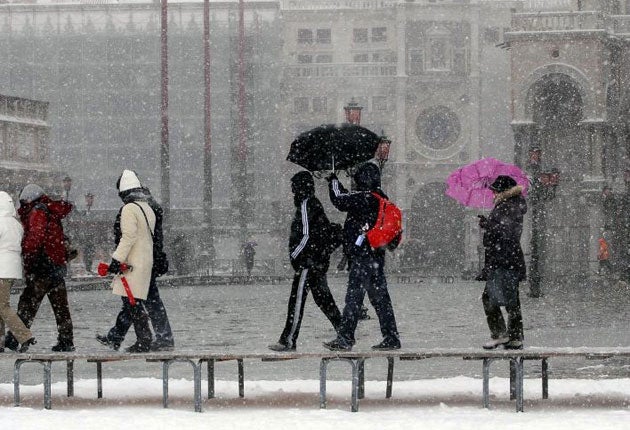
In winter, though, the crowds melt away as the December mists confer the canals with an exquisite extra dimension. While Christmas and New Year are popular (especially with Italian visitors), travelling before midwinter's day and between early January and the St Valentine's Day weekend is richly rewarding. If you have been to Venice previously only in summer, you get a chance to see the beauty of the naked city. Without the waterborne congestion caused by gondolas, you are better able to appreciate the fascinating ways in which the city copes with its unusual geography: everything from the post to funeral processions moves by water. And after the sun sets (before 5pm at this time of year), you will also meet its people, and discover a conviviality in the cafés and restaurants that gets submerged when the tourists take over.
More practically, air fares are at their lowest in early December (with bargains to be found after new year, too), and hotels are offering special deals.
They say
"Some November and December days are so clear that the Dolomites seem to start on the edge of the mainland, but others bring torrential rain or fog so dense you can't see across the Canal Grande. However, the desertion of the streets in winter is magical, and the sight of the Piazza San Marco under flood water is unforgettable. The acqua alta, as Venice's seasonal flooding is called, is an increasingly common occurrence between October and March." – The Rough Guide to Venice & the Veneto by Jonathan Buckley.
Get me there
By air, the best deals are from Gatwick, where easyJet (0905 821 0905; easyjet.com) competes with British Airways (0844 493 0787; ba.com); easyJet is selling seats as cheap as £52 return, while BA's minimum is £98. BA also flies from Heathrow.
The most pleasant way to get from the airport to the city is by water. While a water taxi will set you back about €100 (£85), Alilaguna ( alilaguna.it) operates a regular service from the airport to the Piazza San Marco (St Mark's Square), taking just over an hour and costing €12.50 (£10.60) one-way.
From Marco Polo airport, the cheap way into town is on the blue Atvo bus, which departs from outside the terminal every 20 minutes or so; buy your €3 (£2.50) ticket from the machine before you board. It takes you across the long, low Ponte della Liberta to the Piazzale Roma near the north-western edge of the city.
This is also the arrival point for buses from Treviso, 20 miles north, the Venice airport served by Ryanair (0871 246 0000; ryanair.com) . The Atvo "Eurobus" service takes an hour; €5 (£4.20). The most convenient tourist office (00 39 41 529 8711; turismovenezia.it) is in this square; 9am-3.30pm daily.
Venice is planted in the middle of a lagoon. The two odd interlocking jigsaw pieces that make up the centre are separated by the Grand Canal. Each piece in turn is diced by dozens of smaller canals to make a total of more than 100 islands, which slot together to form a mosaic of canals and cobbled streets.
Check me in
For a break on a reasonable budget there are some excellent hotels in less commercialised parts of town – notably either side of the Giudecca Canal in the south-west. A vast renovated flour mill on Giudecca Island has become the Hilton Molino Stucky (00 39 41 272 3311; molinostuckyhilton.com); advance-purchase doubles cost €199 (£168), including breakfast. A complimentary water shuttle connects the hotel to St Mark's Square. If you are visiting later in winter – from 25 February onwards – the Pensione Seguso at Zattere 779 (00 39 041 528 6858; pensionesegusovenice.com) will reopen after renovations. It has an excellent location, right next to a waterbus stop (served by the Rosso boat from the airport) and a few minutes' walk from the Accademia gallery. Doubles start at €100 (£85), including breakfast.
Send me sightseeing
St Mark's Square, the Campanile and the Doge's Palace comprise a stunning tableau, but the uniqueness of Venice lies in the play of light and reflections on canalside palaces and scruffy backstreets. So get lost between Santiago Calatrava's bold new glass-and-steel bridge and the city's signature ponte – the marbled, colonnaded Rialto. Cross from Santa Lucia station and bear left, brushing south of the Papadopoli gardens. Then tackle a succession of bridges interspersed with campi and churches. With luck you will bump into the church of Santa Maria Gloriosa dei Frari, a 14th-century Gothic masterpiece that contains a huge Titian Assumption of the Virgin, arguably the greatest work of art in the city.
The greatest collection of art is to be found in the Accademia – best seen at opening time, 8.15am. While everyone else is rounding off their breakfast, you have precious minutes to savour glory upon glory. The highlight is room 10, where Veronese's Feast in the House of Levi (a Last Supper with theatrical, life-sized figures) fills an entire wall.
Complete the circuit by taking vaporetto (waterbus) 1 the length of the Grand Canal, the delicious inverted S-shaped artery that swishes through the city and brims with Venetian life.
I'm hungry
Keep it simple. Some of the best pizzas in Venice are prepared at Pizza al Volo on Campo Santa Margherita. For dinner, book ahead for a restaurant at one end or the other of the Ponte del Megio: the Trattoria al Ponte (00 39 41 719 777), where fish fresh from the nearby market is the strong suit, and the cosy Osteria La Zucca (00 39 41 524 1570; lazucca.it) – where vegetarians fare as well as carnivores.
One step beyond?
Staying in Venice, rather than merely visiting for a few hours, enables you to savour the city at either end of the day, and to explore the fascinating hinterland in between. Outlying islands are strewn around the lagoon like debris, and three can be easily combined using the LN waterbus. San Michele is the location for the city's principal cemetery. The elaborate, melancholy architecture is best appreciated early in the morning. To warm up, continue to Murano – where winter is the time to visit the glass-blowing workshops. And to invigorate your eyes on a grey winter's day, make the next stop Burano, where the quiet streets are enlivened by a rainbow of boldly painted houses.
The vision of Venice looming out of the mist as you return across the lagoon by waterbus LN is a magical revelation – but on clear days, your attention may be deflected by the sight of flights landing and taking off at Marco Polo airport.
What Google will tell you
"Travel Cards are the most economical solution for people who want to get around Venice and its surroundings on Actv's land and water services. They allow unlimited travel and can be used on all the services – both waterborne (except those of routes Alilaguna, Clodia and Fusina) and on land – that provide urban services within the municipality (comune) of Venice (land services on the Lido and in Mestre). Validity can be 12, 24, 36, 48 or 72 hours from stamping, depending on the chosen tariff solution. Included in the price is the transport of one luggage item of up to 150 centimetres as the sum of its three dimensions." – from www.actv.it, the city's public transport system (Azienda del Consorzio Trasporti Veneziano); Travel Card prices from €16 (£13.50) to €50 (£42).
What Google won't tell you... until now
In winter, you are unlikely to fall foul of the local law forbidding "walking around the city bare-chested or inadequately dressed", but you might transgress the rule that bans "sitting in public areas to consume food and drink".
Join our commenting forum
Join thought-provoking conversations, follow other Independent readers and see their replies
Comments
Bookmark popover
Removed from bookmarks