Airline crashes make 2009 a deadly year in the skies
Decades of improvement in aviation safety could be at an end after rise in fatalities
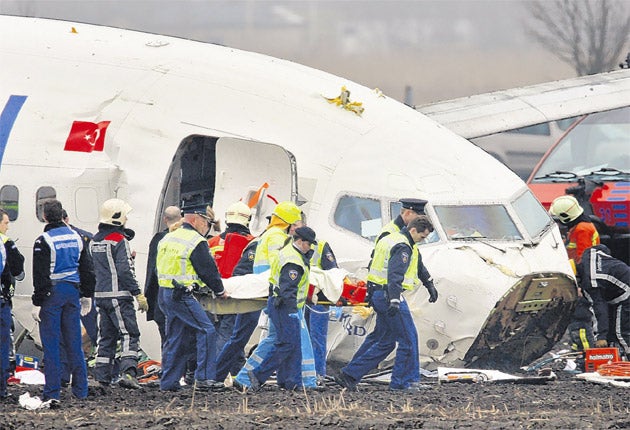
Ever since the Wright brothers hovered precariously in the air for their first 12-second flight in 1903, mankind's quest to take to the skies safely has seen the risks of aviation gradually diminish. But after a century of technological improvements, new figures suggest that aviation safety may be in decline for the first time in its history.
The number of people killed in plane crashes in the first six months of this year was the highest since 2002, confirming an emerging trend that the safety of passenger aircraft is no longer improving. Two serious crashes in the first half of 2009 have seen the number of fatalities this year jump to 499, according statistics complied by Flight International. There were only 175 deaths in the first six months of last year. This year's figure was also well above the average for the decade of 344 deaths. It means that unless there is a dramatic fall in fatalities from now until the end of 2010, the 2000s will become the first decade since the Second World War in which there was no increase in aviation safety. In reality, that would amount to the first plateau in improving the safety of air travel since its inception, though statistics from before the War are difficult to compile. Provisional statistics compiled by the International Civil Aviation Organisation are also said to confirm the trend.
This year's statistics have been boosted by one incredibly unusual incident. The crash of an Air France jet last month was the first fatal incident involving a major flag-carrying airline and a Western-built plane since November 2001. All 228 people on board were killed when the Airbus A330 crashed into the Atlantic, during a flight from Rio de Janeiro to Paris. No cause has yet been identified. The other major contributor to the figure was the crash of a Yemenia Yemen Airlines plane, which ditched into the Indian Ocean at the end of last month, killing 154 passengers. There was only a single survivor.
Flight International said a failure to improve pilot training was behind the plateau in air safety. "When the investigators have completed their analyses of the accidents so far this year, they will find in all cases – with the possible exception of the [New York] Hudson River ditching [of an Airbus A320 in January 2009] – opportunities to prevent them were missed," it said. Its warning comes a year after the Flight Safety Foundation warned that airlines would need to go beyond the minimum training standards demanded by the world's regulators to improve the safety of air travel.
Carolyn Evans, the British Airline Pilots Association's head of flight safety, said pilots had long held concerns that training had focused too much on "automated processes" rather than preparing them with the basic flying skills of old. "Basic flying skills are just as important as ever but their demonstration can be easily overlooked," she said. "Initial pilot training is moving away from a hands on stick and rudder approach to an alternative training syllabus where the pilot trains almost totally in a passenger transport jet aircraft simulator.
"We have concerns as to whether this syllabus arms the newly trained pilot with the same basic skill level as previous generation pilots. The discouragement of manual flying during normal operations further erodes hands-on flying skills which need to be maintained in the same manner as any other, by frequent repetition."
Other experts believe the growth of small airlines from poorer countries is to blame. "As a result of liberalisation worldwide, we have a lot of new start-up airlines coming into the market," said Rigas Doganis, an aviation industry expert. "A lot of the accidents involve young airlines, particularly accidents where pilot error or human error is a significant factor, whether in the cockpit or in maintenance. It is an inevitable result of liberalisation and the growth of airlines without the history in maintenance and training. Over the 2000s, the accidents have come from newer airlines from Third World countries. It is very rarely the case that only one factor is the cause. It is usually many, and one of those factors may be human error due to inadequate training. But we cannot blame human error for all accidents."
Join our commenting forum
Join thought-provoking conversations, follow other Independent readers and see their replies
Comments