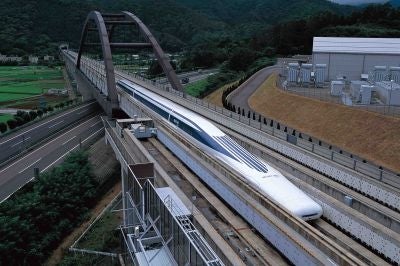
Japan is poised to give the go-ahead for a mass transportation system that could revolutionize the way in which we travel.
The government is to approve a plan by Central Japan Railway Co. to construct a line for a magnetically levitated train between its two largest cities, Tokyo and Osaka, suggests a recently released report. Japan will be the first nation to build a major, high-speed maglev route and hopes to be able to export the technology once it has been perfected.
Japan is famously the developer of the bullet train system, which can trace its genesis as far back as 1964 but is still regarded as one of the best high-speed mass transit systems in the world, but wants to get in ahead of the competition for the next generation of trains.
The maglev is designed to have a top speed of 500 kph and will travel the 438 km between the nation's business hubs in a mere 67 minutes, an impressive 51 minutes faster than the most advanced bullet trains of today. And by starting from central Tokyo and depositing passengers in the heart of Osaka, the developers say it will be more convenient than flying between the two cities because of the time needed to get to the airports at each end of the journey.
A panel under Japan's Ministry of Land, Infrastructure, Transport and Tourism is examining the route proposed for the new line by JR Tokai. The plan is for a track that runs through the mountain chain known as the Southern Alps to the northwest of Mount Fuji.
The railway company has been asked to come up with a firm proposal on the exact route and the location of stations before construction starts in 2014. The first maglev could be operational as soon as 2027, linking Tokyo with the city of Nagoya, which is roughly halfway between Tokyo and Osaka. The full service would be launched in 2045.
The new lines will cost Y8.44 trillion (€70.4 billion).
Research on the new technology has been under way for several decades and JR has a test track in Yamanashi Prefecture, west of Tokyo, where a test train reached a speed of 581 kph in 2003. If the vehicle that goes into service is capable of those speeds, it will be the fastest passenger train in the world.
The vehicle has no wheels - doing away with friction and, hence, providing a smoother and quieter ride at a faster speed - and is propelled along a track through electromagnetic pull.
At present, a maglev train operates in Shanghai and another version was studied in 1994 to link Berlin and Hamburg, although that plan was scrapped because of the high construction costs and a lack of demand on the route.
JR Tokai points out that bullet train technology will be 60 years old by 2025 - although it is constantly being enhanced and improved upon - while maglev technology is less polluting than flights that presently link the cities.
JR
Join our commenting forum
Join thought-provoking conversations, follow other Independent readers and see their replies
Comments