Sherylle Calder: 'When in South Africa we were isolated'
Imagine the fantasy of being the most successful sports person in the world.
Because you have been so good and because there were no national boundaries in this fantasy world where only talent counted, you represented the Crème de la crème of world sport: The Springbok rugby team and England's rugby side, in both cases with whom you won World Cups. Then there was the South African hockey and Davis Cup tennis teams, the Australian cricket team, the New Zealand All Blacks rugby team, England's 2012 elite athletes' programme, the national cricket teams of emerging nations like Kenya, Canada and Holland and the Prada Yachting team.
An Australian AFL side asked to see you, likewise Tottenham Hotspur Football Club in England, the French 1st division club AS Monaco and one of the England county cricket sides.
But this is no fantasy; one person has achieved all these things. She is arguably the most successful person involved in sport anywhere in the world.
Introducing Dr. Sherylle Calder...
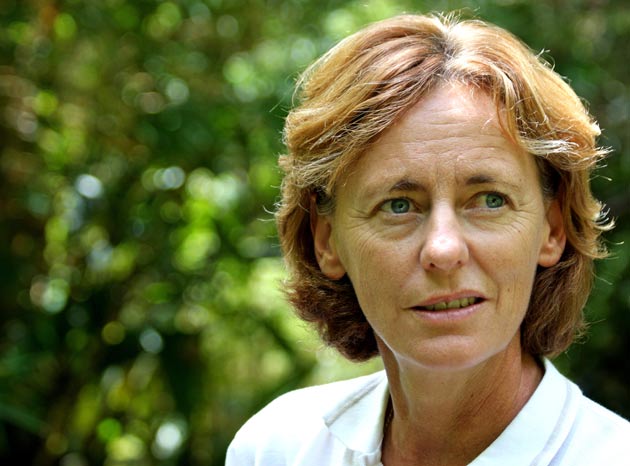
She comes to meet me, this slim, fit, almost waif-like figure, with a shy smile and a courteous greeting. Has she kept me waiting too long, did I find the place OK….All classic signs of the reserved, undemonstrative Sherylle Calder, the woman of whom South Africa should be inordinately proud. She is one of the country's greatest success stories.
Her unique talent, the skill that has taken her so seamlessly to the top of so many sports around the world is based on the field of hand/eye co-ordination. Of course, she played sport with great distinction, winning 50 field caps for South Africa and 18 indoor caps at hockey in the years from 1982-1996. But since retirement from the active side of sport, Calder has created a component part of sports worldwide which is regarded as of intrinsic importance by sports administrators in most fields.
Put simply, that skill revolves around one core issue: a judgement of where the ball is, plus judgement of line, length and angle. These skills can, quite literally, make the difference between success and failure in a World Cup or major Test match.
Lest anyone has the belief that Springboks such as Bryan Habana or Jean de Villiers got lucky by intercepting a host of passes in recent seasons, think again. The revealing one-on-one, warm up sessions that Calder held with both players (and others) prior to games, was to sharpen the anticipatory senses, ready to use those skills at every opportunity. And being part of the England 2003 and South Africa 2007 Rugby World Cup winning squads helped Calder immensely. "People like to see if you have been successful with a new science. When you have been twice, they see real merit in it."
Bryan Habana's phenomenal reaction times played a crucial part in the Springboks' 2007 Rugby World Cup win. He was so good and so fast in throwing a rugby ball at an elastic net in a frame that returned the ball at a variety of angles. Each time, Habana had to catch it and throw it back against the net. On one particular day, Habana threw, caught and threw the ball again 118 times in a single minute. The next closest to him was 88. "Most players had a reaction speed of about .56 of a second. After all that training on it, Bryan was down to .18" explains Calder.
"I still maintain to this day that the interception Bryan made in the semi-final against Argentina won South Africa the World Cup. It was 20-all when that intercept came and it killed the Argentine players' spirit. But we had trained so hard for that, it wasn't anything to do with luck. It proved to me that this aspect does impact on the performance of a team in subtle ways."
Nor was that the extent of Calder's influence on Jake White's Springboks. Percy Montgomery's career long difficulties under the high ball were largely eliminated, likewise the improvement in the same way of JP Pietersen.
Everyone, says Calder, has strengths and weaknesses. "Some might have the ability to see something well and very quickly. But the ability to see the ball early is one of the most important skills a sportsman or woman can have. It's not a question of whether or not you were born with it. It is about acquiring and developing those skills."
Calder has been able to demonstrate the merits of this element of sporting preparation to an extraordinary variety of sports. Take yachting. As the wind changes, split second decisions are required. Keeping your balance, being visually aware of changing conditions whilst engaged with another task, is essential.
It is like the rugby player. If he can 'sense' where the ball is being delivered, he can keep his main gaze upon the defence in front of him. That avoids the need to watch the pass coming to him, make sure he catches it and then look up to see where the defenders are. If he is aware of when and at what angle the ball will arrive, he gains perhaps a precious second or two. That could be vital, for 85-90% of the decisions made in sport are based on what the person sees, nothing else.
But where did it all start for Calder?
"When in South Africa we were isolated because of apartheid, I always wanted to measure myself against others in the world. So I went off on my own to Europe and some clubs where I played hockey."
She spent time in Holland, Germany and England just playing club hockey. One day, she played alongside a girl whose father watched all their games and was a member of the Olympic qualifying committee. He told Calder she was the only international hockey player he had ever seen who did not run on the field. Did she have eyes in the back of her head, he asked her, amazed at her ability to 'sense' opponents and the imminent arrival of the ball ?
"After that, I realised maybe there was something there" she says. "I looked at the things I did and began to work out how to put them into a training programme. That is where it all started. I had to prove it worked and it did.
"Of course, any sporting team can survive without these skills but if you want to win World Cups and be better than you are, then you need to get into this aspect. For if you lack visual skills you haven't fulfilled your potential. It is a choice the Union or player needs to make."
Today, Calder can work for so many differing sports clubs and organisations because she has set up a highly developed programme 'Eye Think'. Individuals, after some initial teaching, can work on the skills themselves and there is huge interest in the programme. For the fact is, as she says with a warm, golden smile upon her softly contoured face, you can improve someone's life if you improve their visual skills.
"For example, you can enhance the ability of kids anywhere in the world to read and comprehend. That is how you learn and improve. So the programme does not just reach the elite and in fact, I have now launched a schools programme called 'Eyeball'."
Reaching as many young people as possible is important to Calder because she fears a significant decline in their visual skills due to the influence of technology such as Play Stations, Computer games and TV. "Not just because of that but by the nature of not being kids anymore" she says. "They don't do simple things like climb trees anymore, for which eye/hand co-ordination is also important. Even childhood games like 'hide and seek' improve your peripherals because you have to be good to see people move. Those skills in children have deteriorated with the march of technology."
She prefers working with individuals but recognised that the only way to reach out to more people was to create an on-line programme that enabled kids to see and explore on the internet.
Yet her travel schedule is enough to daunt even the burliest of Springbok rugby forwards or the strongest of world yachtsmen. From her home just outside Cape Town, she travels the world, flying across oceans and time zones. No matter, not even the inevitable fatigue from long haul flights diminishes the petite Calder's passion for the job.
Now attached to the South African Sports Science Institute at Cape Town, she smiles and says "I just love what I do. Whether I am in Perth, Cape Town, London or wherever, it doesn't matter to me. I will travel happily to do it. You have to offer a quality service; that is the bottom line. But now my programme has been designed and worked out in such a way that it can be run without me and be monitored without me being there. However, my being there adds the edge as I work on specifics of the individual, as in the case of Habana and Pietersen."
Sadly, those who run South African Rugby apparently saw insufficient reason to extend Calder's contract with the Springboks. She concedes her disappointment and admits she would have stayed, had they asked. "The fact that nobody said a word to me disappointed me most. But that was some time ago and I have moved on."
Happily for Calder, others have stepped into the breach to use her skills. Their gain has undoubtedly been South African rugby's loss.
Join our commenting forum
Join thought-provoking conversations, follow other Independent readers and see their replies
Comments
Bookmark popover
Removed from bookmarks