
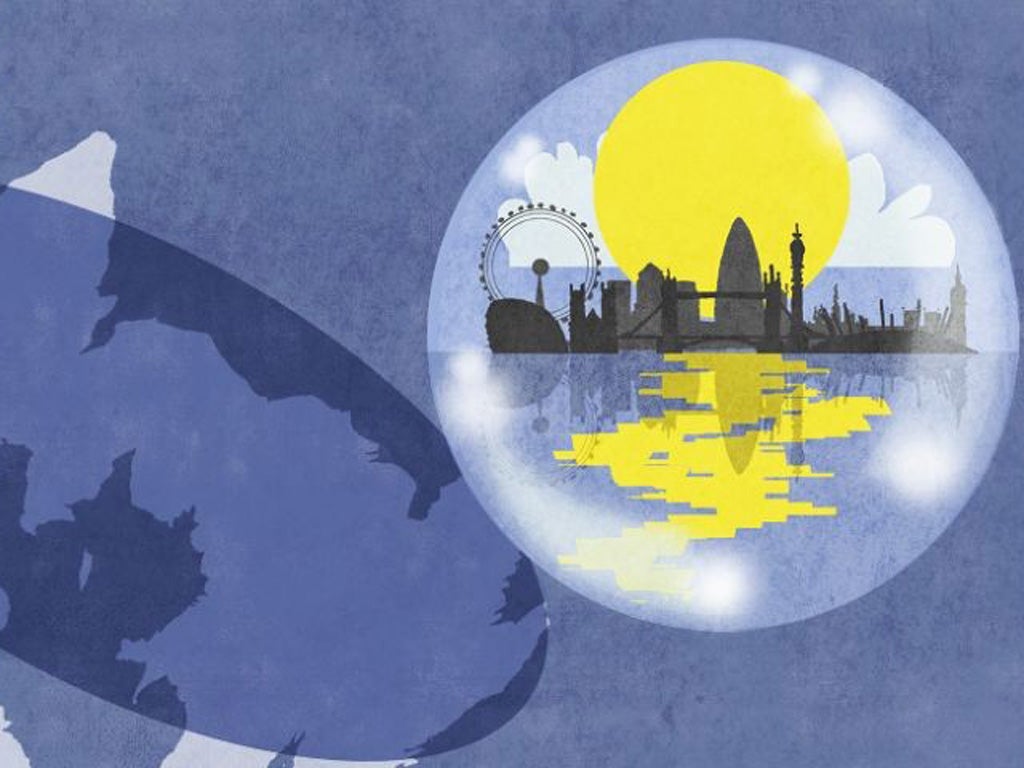
In conversation with John Gray a couple of months ago, the subject of Britain's future came up, and the philosopher opined that: "London will become a sort of Singapore, I think, a wealthy island of urbanity surrounded by impoverished satrapies." I found myself without any hesitation acceding to this dystopian vision, and with every successive week the Coalition's policies – acting as a turbocharger on the impact of international capital flows – only seem to be bringing this intensely divisive state of affairs closer.
The news this week that Newham council believes the Government's cap on housing benefit will result in the exodus of tens of thousands of the poor to urban centres as far north as Walsall is only – in my view – the continuation by other, more vicious means of the sort of "class cleansing" introduced by the New Labour regime's Pathfinder Scheme. Then the idea was that the brave new provincial cities would be made over in London's image: cloned retail and artists' quartiers paid for by an ever-bulging property asset bubble, while the less desirable would be rehoused using the profits. But, since 2007, this bubble has plangently popped – everywhere, that is, but in the capital itself.
Such noises that Cameron et al make about the regions now are hedged round on the one hand by constitutional worries, and on the other subjected to the Orwellian sing-song chant: "Public sector bad! Private sector good!" Obviously, given that the provinces – especially the North – are to a greater extent dependent on public sector funding means, ipso facto, that they are first in line for the chop – or would be, if they hadn't already been at the head of the queue since the late 1970s. True, you can find pockets of deprivation in London and the Southeast with intergenerational unemployment stretching back to the Thatcherite Götterdämmerung unleashed on manufacturing industry – but they are nothing like the entire districts of terminal desuetude you find in the Midlands, the North, and even such bosky cabinet ministerial holidaying spots as Cornwall.
Of course, the suspicion that London is sucking the lifeblood out of the rest of the country is nothing new – you can find medieval authorities aghast at the Great Wen's metastasising – but, in recent years, there has come a sinister new alignment of forces: the inertial dirigisme of central government has become allied to the dark star of the City of London, so that the political class find their institutional prejudices insistently reinforced by what they deem "economic realities". Naturally, they act to head off this riving apart of the country, and the creation of new mayoralties is part of this. However, as ever in politics: if you want to know where power really lies, follow the revenue. The tax base of the new city governance is no bigger than the piffling amount that has traditionally been allocated to local government – leaving all these municipal popinjays firmly under the control of Westminster.
That the London Assembly and mayoral elections receive such a fanfaronade of media attention is only, surely, a function of the capital's own irresistibly high profile, for no matter how much Boris blusters (and Ken wheedles), I've got news for you: you're nothing but a jumped-up transport commissioner with delusions of being an airport planner. Naturally, the next London mayor – whoever he may be – will continue as a cheerleader for the Stratford Festival of Running and Jumping – how could it be otherwise? The mayoralty is all about PR – and the Olympics is nothing but a PR exercise to sell the city.
Moreover, London remains as Janus-faced today as it was at the height of the Empire, when it served as the entrepôt and transhipment point for a vast proportion of the world's trade. One big smiling face looks to the rest of the world, saying: send us your rich and your upright, so that they may invest their reserve currency in our astronomically expensive property – and while you're at it, send us your poor and your huddled masses as well, so that they can clean the toilet bowls of the wealthy on below-minimum wage. The other grimacing face is turned on this less salubrious spectacle: a hinterland full of euphemistic "jobseekers", filling out their losing tickets in the National Lottery.
London's own ebb and flow of gentrification is nothing new: the house I live in, in Stockwell, south London, was completed in 1868 as an upper-middle-class dwelling complete with generous servants' accommodation, but within 35 years it was tenanted by three lower-middle-class families. What's new about the current reordering of the metropolis's vital organs is that the beating heart of Cockneydom is finally being excised altogether: London is undergoing a Manhattanisation, as property prices continue to rise and rise, and the centre of town becomes unaffordable except for the rich and their domestics. The Olympic project, with its frankly pathetic input into the local economy of the East End – including a paltry allocation of affordable housing – will probably prove the locus for the greatest piece of class cleansing yet seen, as the purlieu of the Park becomes another investment opportunity in postmodernist clothing.
If, as I did the week before last, you walk from London into the heart of England, you encounter a society in many ways just as divided as that of the metropolis. I walked all the way to the Prime Minister's constituency town of Witney, and found there plenty of loafing oafs. Witney's carpet-making industry has long since gone, and unlike the echt Cotswolds where the Notting Hill set like to play political charades in a carefully staged arcadia of gastropubs and manorial theme parks, there's no sign of the recession ending – what with charity shops aplenty along the high street.
But London cares nothing for this, having long since gone back into growth – any more than it does for the Northern laagers where the whey-faced burghers are now deprived of local industry and so deprived of local legatees and donors for their charitable sector. So much for the Big Society – the political class always bleat on about their constituencies, as if tooling up the motorway to spend a couple of days in some well-appointed gaff dining the Lord Lieutenant somehow made them the proverbial salts of the earth, but the truth is that the vast amount of their time is spent in Westminster, drinking skinny lattes as their hearts pitter-patter in response to the latest Beltway gossip.
In the past, London was undoubtedly the locus of England – and even of Britain as a whole – but there remained profound strengths in the regions; now a moat is being dug around the M25 and the bridges that cross it are being strategically mined.
Will Self is Professor of Contemporary Thought at Brunel University. His latest novel, 'Umbrella', is published by Bloomsbury in August
Join our commenting forum
Join thought-provoking conversations, follow other Independent readers and see their replies
Comments